
Manufacturing software pricing is unusually hard to pin down: ask what a system costs and you get a straight answer only about half the time. We checked 34 products across ERP, MES, CRM, and quality management, and only 14 of them show a starting price on their own website without a sales call. The rest route you to a quote. That is the first thing every plant owner runs into, and it is why a question that sounds simple, “what does this cost,” turns into three weeks of demos before a number appears.
This guide answers the cost question in two halves. First, the framework: the seven things every quote actually contains, so you can price the whole system instead of the headline subscription. Second, the numbers we could verify, category by category, with a plain tally of who publishes and who hides the price. Where a vendor would not show a figure, we say so rather than guess.
Direct answer — How much does manufacturing software cost?
Published entry prices run from about $14 per user per month for a manufacturing CRM to $49 to $110 per user per month for cloud ERP, with bundled mid-market suites starting near $2,185 per month (as of June 2026). Software Advice puts the typical manufacturing range at $100 to $300 per user per month. But the sticker is the smallest part of the bill. Implementation, modules, integration, training, and support often cost as much as the license or more, and MES plus most enterprise tiers stay quote-only.
Key Takeaways
- The sticker price is the smallest line. A manufacturing software quote also carries implementation, per-seat growth, modules, integration, training, and ongoing support, and those often outweigh the license in year one.
- Only 14 of 34 products we checked (about 41%) publish a starting price without a sales call, as of June 2026. Transparency falls hard by category: CRM 7 of 9, ERP 5 of 10, QMS 1 of 6, MES 1 of 9.
- Published entry pricing: manufacturing CRM from about $14 per user per month, cloud ERP from $49 to $110 per user per month, bundled ERP from under $2,185 per month. Software Advice pegs the typical range at $100 to $300 per user per month.
- MES is the most gated category. Tulip is the one mainstream system that publishes a number; Siemens, Rockwell Plex, AVEVA, and the rest price by quote.
- Even a published price can hide quote-only add-ons. Salesforce lists $275 per user, but its manufacturing CPQ and dealer portals are separately priced and quote-only.
Methodology
How we counted manufacturing-software pricing transparency
- Scope
- 34 manufacturing-software products across four categories, ERP/MRP (10), MES (9), CRM (9), and QMS (6), each checked for one thing: whether it shows a starting price on its own website without contacting sales. The ERP and CRM sets carry over from our published ERP and manufacturing-CRM guides; the MES and QMS sets were checked fresh for this article. MasterControl, which spans quality and manufacturing execution, is counted once, under MES.
- Sources reviewed
- Each vendor’s own pricing and product pages, read directly. Where a vendor showed no figure to a US buyer, localized its page with no price, or routed to a quote, we recorded it as quote-only rather than estimating. Third-party review-site “starting at” figures were not counted as vendor-published. Industry cost ranges come from Software Advice and Panorama Consulting, cited inline.
- Date range
- All pricing and publish-or-quote status was verified against official vendor pages in June 2026. Software pricing moves and much of it is quote-only, so every figure here is dated as of June 2026.
- Tools used
- A single binary test applied to every vendor: does a starting price appear on the vendor’s own site without a sales call, yes or no. A free tier counts only if it is usable for the manufacturing job; a region-locked page that shows no figure counts as no. No weighting and no scoring. This is a transparency tally, not a quality ranking.
- Limitations
- This counts pricing transparency, not value or total cost. A published starting price still excludes implementation, modules, integration, and support. Vendor pages change, regional pricing varies, and a page gated on our check date may publish later. One MES page (Rockwell Plex) refused our automated request and is recorded quote-only on the basis of no public figure found anywhere. The candidate lists are buyer shortlists, not the entire market.
- Editorial independence
- No vendor paid for placement, ranking, or coverage, and none reviewed this article before publication. Our full editorial policy explains how we keep this independent.
- Conflicts of interest
- Factory Investigator’s sister service business builds manufacturer websites and sets up analytics and CRM tracking; it does not sell ERP, MES, or QMS software, and none of the vendors counted here were clients at the time of writing.
Why manufacturing software pricing is so hard to pin down
Search “manufacturing software pricing” and the entire first page is ERP, most of it routed through a sales rep. The reason is structural, not accidental. A manufacturing system is configured to your plant, your modules, your user count, and your integrations, so vendors argue there is no single price to publish. That argument is real for a 12-plant enterprise rollout. It is mostly a sales tactic for a 30-person shop buying a standard cloud package.
The practical effect is that a buyer cannot compare two systems on cost until both have run a discovery call, and by then the evaluation has momentum. The more gated a category is, the more this favors the vendor. Our tally below shows the gating is not uniform: cheap horizontal CRMs publish freely, ERP is split down the middle, and shop-floor systems like MES go almost completely dark. Quoting and estimating tools sit on the dark end too, as our roundup of quoting software for manufacturing found: only a couple of vendors publish a number and the rest route every buyer through a demo.
One disambiguation before the numbers. “Manufacturing software pricing” pulls in two different searches. This guide answers what the software costs to buy. It is not about software that prices your products, which is production costing or price-optimization tooling, a separate category. If you came here to set your own part prices, this is the wrong page.
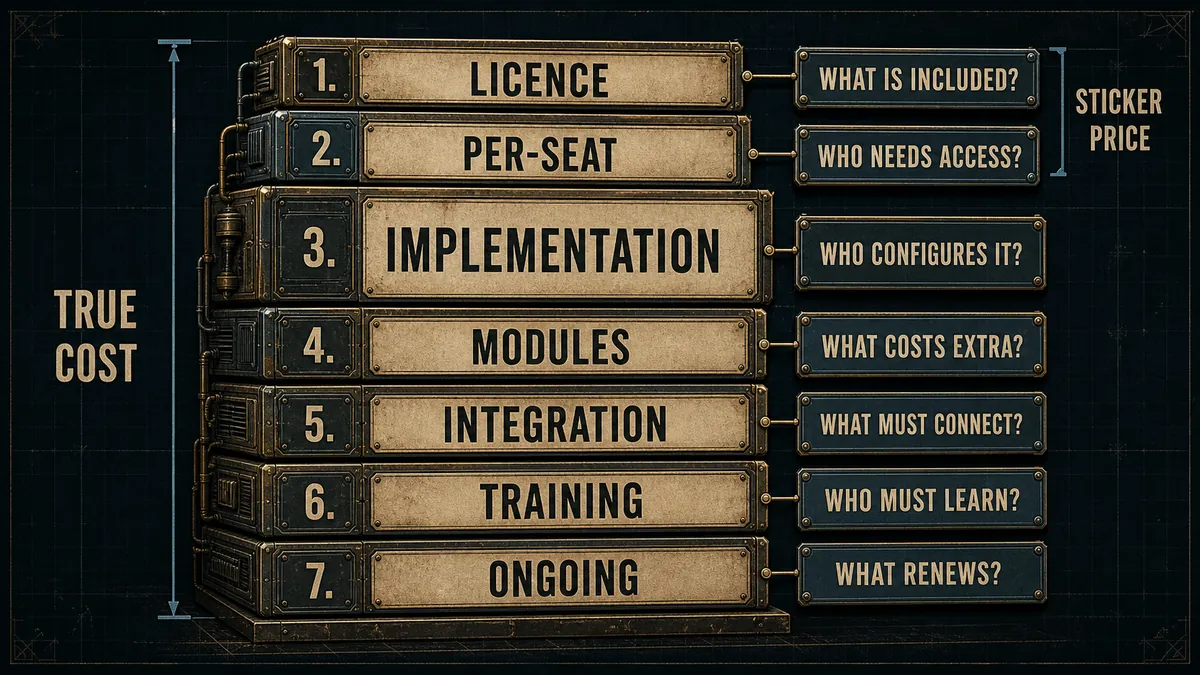
The True Cost Stack: the seven things every quote actually contains
The True Cost Stack is the set of seven line items that sit inside any manufacturing software purchase, whether or not the vendor breaks them out. The published subscription is one line. The other six are where the real money lives, and they are the lines a quote-only vendor is least eager to itemize before you have committed. Paying for modules and precision your floor will never use is extra-processing in software form, one of the eight lean wastes, so the stack starts by making every line visible. Deere’s fair-and-reasonable repair software terms are a reminder that access pricing still needs hardware, training, updates, support and model coverage spelled out.
Read it as a checklist. For every system you shortlist, get a number, or an honest “included,” against all seven before you compare. A low subscription with a heavy implementation fee can cost more over three years than a higher subscription that deploys in weeks. The same upfront-versus-lifetime gap runs through the choice between preventive and predictive maintenance, where the program that is cheapest to stand up is rarely the cheapest to live with. The same upfront-versus-lifetime gap runs through the choice between preventive and predictive maintenance, where the program that is cheapest to stand up is rarely the cheapest to live with.
| Cost component | What it is | How it’s priced | Share of first-year cost | The question to ask the vendor |
|---|---|---|---|---|
| License / subscription | The core right to run the software | Flat monthly or annual, or a named-user tier | Often the smallest line once year one is counted | Is this the platform fee or per-user, and what does the entry tier exclude? |
| Per-seat | Cost that scales with every user you add | Per user, per month | Grows with headcount and can overtake the base fee | Which roles need a full seat, and is there a cheaper read-only or shop-floor seat? |
| Implementation | Setup, configuration, data migration, and go-live | One-time project fee or partner day-rate | Frequently the largest first-year line | Is it fixed-fee or time-and-materials, and who owns the data migration? |
| Modules / add-ons | Capability beyond the base: MES, QMS, CPQ, traceability | Per-module subscription or one-time fee | Varies; the feature you assumed was included often is not | Which modules are in the quoted price, and which are extra? |
| Integration | Connecting to your other tools: ERP, accounting, shop floor | Connector fees, API tiers, or custom development | Easy to underestimate; rises with each connected system | Are the connectors I need standard, paid add-ons, or custom builds? |
| Training | Getting your team productive on the system | Per-session, per-seat, or bundled into implementation | Small line, large effect on whether the system gets used | Is training included, and is it role-based or one generic session? |
| Ongoing / hidden | Support tiers, upgrades, renewal uplift, usage overage, storage | Annual support percentage, renewal increase, overage fees | Compounds every year after year one | What is the annual support fee, the renewal uplift cap, and any usage overage? |
How to read your own quote against the stack
Lay the vendor’s quote next to the seven rows and mark each one: a real number, “included,” or blank. Blanks are not free, they are unpriced. A quote that lists only a per-user subscription has six empty rows, and every one of them will arrive as a separate invoice or a change order later. The goal of the stack is to move those surprises forward, into the negotiation, where you can still do something about them. The same rule applies past software: a marketing retainer quoted as one vague monthly number hides the scope you did not pin down, which is why our guide to what a fair manufacturing marketing agency engagement actually costs starts from the outcome you are buying, not the headline fee. The same rule applies past software: a marketing retainer quoted as one vague monthly number hides the scope you did not pin down, which is why our guide to what a fair manufacturing marketing agency engagement actually costs starts from the outcome you are buying, not the headline fee.
PRO TIP
Ask every quote-only vendor to itemize software, implementation, and annual support separately, in writing, before the demo ends. Vendors that resist breaking out implementation are usually the ones where it is largest.
What’s published vs quote-only across ERP, MES, CRM, and QMS
Here is the transparency picture in one view. The table maps each category to what a buyer can usually see up front, what stays behind a quote, and which stack lines bite hardest in that category. The pattern is consistent: the closer a system sits to the shop floor, the less it publishes. The configurators that build those quotes follow the same rule: nearly every CPQ priced for manufacturers is quote-based too, with Salesforce Revenue Cloud the one mainstream exception.
| Category | What it does | What’s usually published | What’s almost always quote-only | Cost-stack lines to ask about |
|---|---|---|---|---|
| ERP / MRP | Runs production, inventory, BOMs, and finance on one system | Entry cloud-MRP per-user prices (5 of 10 vendors) | Mid-market and enterprise tiers: NetSuite, Epicor, SAP Business One, JobBOSS² | Implementation, modules, data migration |
| MES | Controls and records the shop floor in real time | Almost nothing; Tulip is the main exception | Nearly the whole field: Siemens, Rockwell Plex, AVEVA, 42Q, iBASEt | Per-interface or per-site licensing, integration, implementation |
| CRM | Manages quotes, distributors, and repeat orders | Most per-seat starting prices (7 of 9 vendors) | ERP-bundled CRMs (Infor, Epicor) and CPQ or dealer-portal add-ons | Per-seat creep, manufacturing-cloud premium, add-ons |
| QMS | Manages documents, CAPA, audits, and compliance | Rare; Intellect publishes annual tiers | Validated and regulated tiers: MasterControl, ETQ, AssurX, Qualio | Validation, implementation, per-seat, modules |
Put numbers to it and the split is stark. Across the 34 products we checked in June 2026, only 14 show a starting price without a sales call. Cheap, horizontal categories publish; production-critical, regulated categories do not. Production scheduling splits the same way: SMB schedulers publish real numbers while most mid-market and enterprise APS stays quote-only, a pattern we mapped in the production scheduling software comparison. Automation hardware sits at the opposite end of that transparency scale: a deployed cobot system runs a fairly predictable $40,000 to $150,000, most of it in tooling and integration rather than the arm, which makes it easier to budget than quote-only software.
| Category | Vendors checked | Publish a starting price | Quote-only | Publish rate |
|---|---|---|---|---|
| CRM | 9 | 7 | 2 | 78% |
| ERP / MRP | 10 | 5 | 5 | 50% |
| QMS | 6 | 1 | 5 | 17% |
| MES | 9 | 1 | 8 | 11% |
| All categories | 34 | 14 | 20 | 41% |
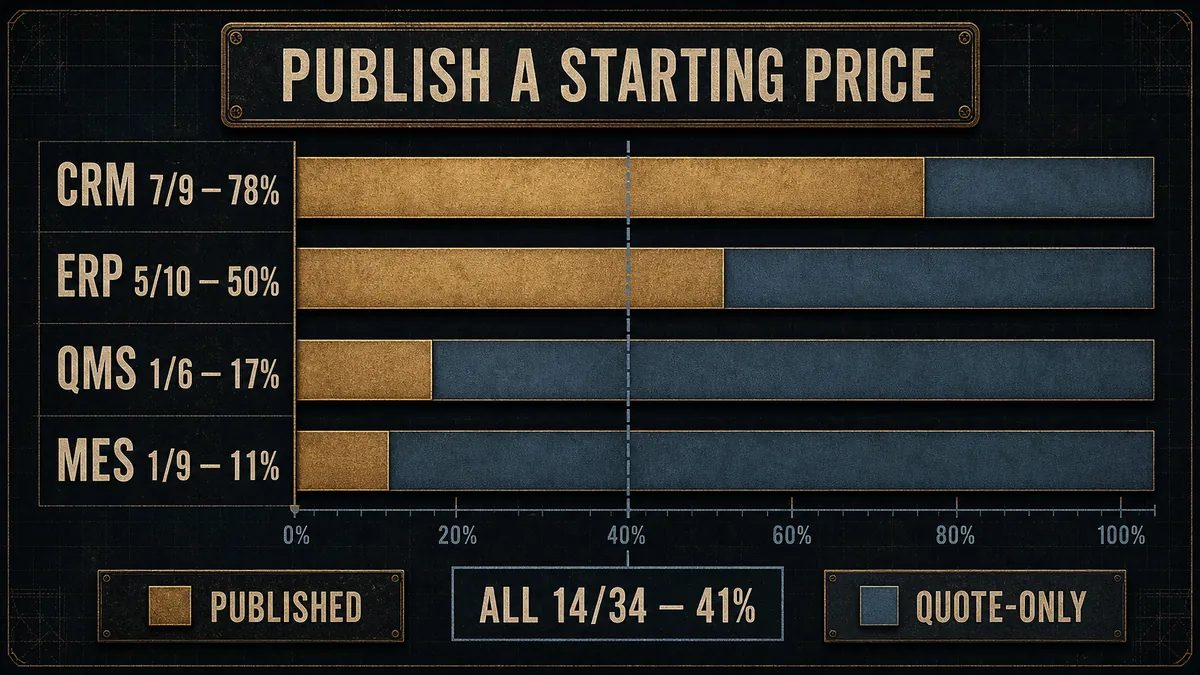
The price a vendor will not publish is not a missing number. It is a number they would rather you learn after the demo, not before it.
How much does manufacturing ERP cost?
Manufacturing ERP is the split category: half the systems publish, half route to a quote. On the published side, entry cloud MRP starts at $49 per user per month with MRPeasy, Katana runs a free starter tier and a Core plan from $299 per month, and Fishbowl lists $229 per month for two users. Stepping up, Microsoft Dynamics 365 Business Central lists $110 per user per month for the Premium tier that manufacturing requires, and Acumatica’s bundled APEX package starts under $2,185 per month flat (all as of June 2026). Those same entry-level tools are where most small manufacturers’ stock ends up, which makes where that inventory should actually live, in a standalone app, an MRP module, or a warehouse system, a decision worth settling before the price comparison.
On the quote-only side, the enterprise names go quiet. Oracle NetSuite, Epicor Kinetic, SAP Business One, and ECI JobBOSS² all keep pricing behind a sales conversation, which usually signals five- and six-figure annual commitments once users and modules are added. Odoo sits in an odd middle: it runs a free single-app plan and per-user paid tiers, but its pricing page localizes by region and showed no usable US figure for a manufacturing setup at our check, so we count it with the non-publishers. Part of why those enterprise names stay quiet is that they bundle several layers into one price, so before judging whether a quote is fair it helps to map how ERP, MES, and the other software layers divide the work you are actually paying for.
For the wider market, Software Advice reports that most manufacturers budget about $100 to $300 per user per month, with an average near $241 per user per month (as of June 2026). That band sits well above the cheap cloud-MRP entry points, because it folds in the heavier ERP and the add-on modules most shops end up buying. Increasingly, one of those add-on lines is AI itself: predictive-maintenance, forecasting, and vision features now ship as paid modules, so the value case for the plant-floor AI use cases worth paying for belongs in the same budget math. Increasingly, one of those add-on lines is AI itself: predictive-maintenance, forecasting, and vision features now ship as paid modules, so the value case for the plant-floor AI use cases worth paying for belongs in the same budget math.
How much does MES cost?
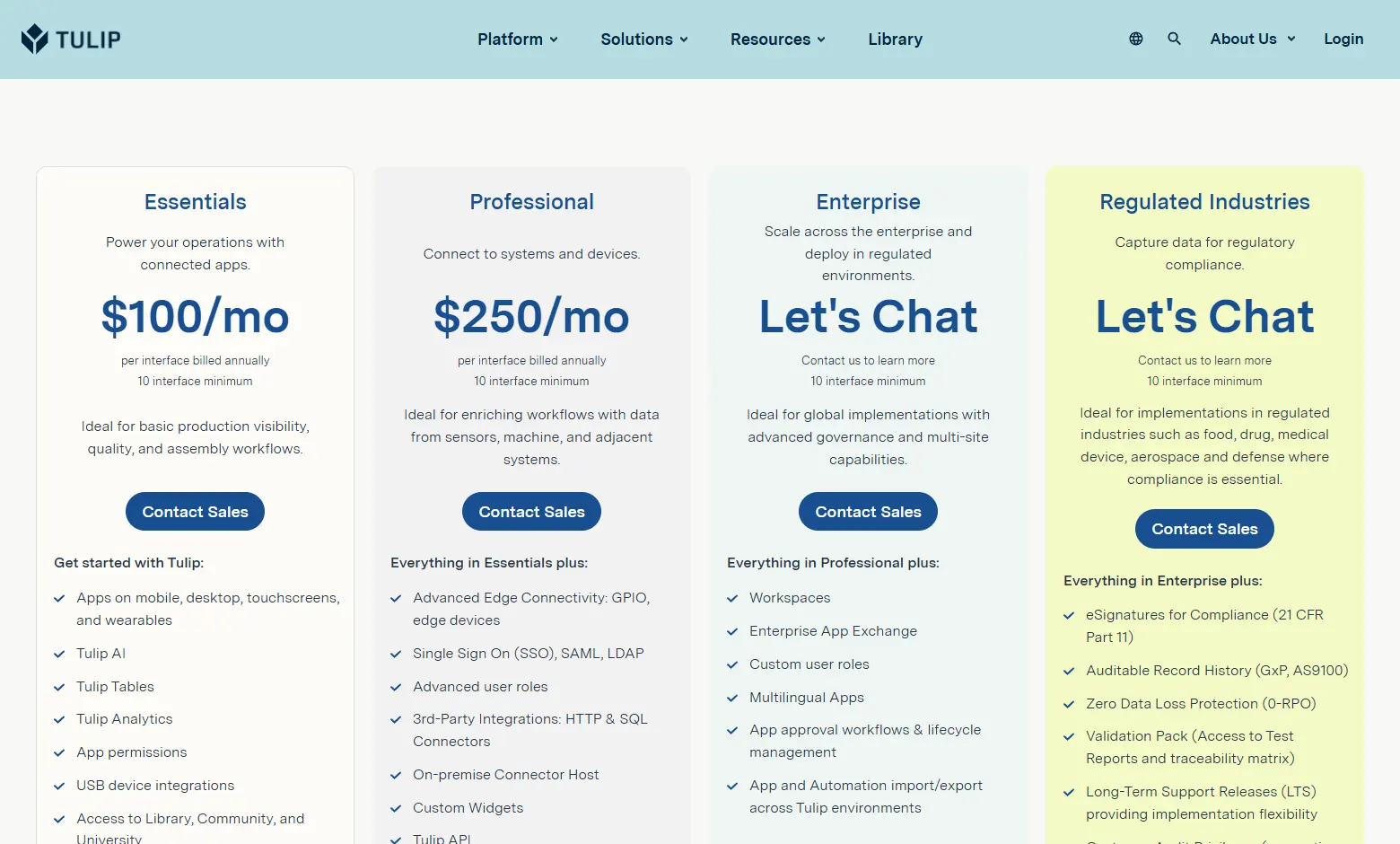
Manufacturing execution systems are the hardest pricing to find anywhere in the stack. Of the nine MES platforms we checked, exactly one publishes a usable number. Tulip lists $100 per interface per month for Essentials and $250 for Professional, billed annually with a 10-interface minimum, so entry lands around $12,000 a year (as of June 2026). Note the unit: Tulip prices per active interface, the devices running its apps, not per user, which is a different mental model from ERP seats. What that spend ultimately buys is a production number you can act on, and the one most buyers want first is OEE, so it helps to understand how OEE is calculated before you weigh an MES quote against the downtime it is meant to remove.
Everyone else routes to a quote. Siemens Opcenter, Rockwell Plex MES, AVEVA, Critical Manufacturing, 42Q, iBASEt, and Epicor’s Advanced MES publish no figure on their own sites. You will find “starting at” numbers for some of them on review aggregators, but those are third-party estimates, not vendor prices, so we did not count them. For enterprise MES, implementation and integration routinely run into six figures and dwarf the license, because the system has to wire into PLCs, ERP, and quality on the plant floor. The June 2026 ResilientEdge launch is another reminder to quote MES architecture as a program, not a per-seat app. The PLC end of that wiring is its own line item, and it is worth knowing what the PLC programming itself costs before the integration quote lands. The PLC end of that wiring is its own line item, and it is worth knowing what the PLC programming itself costs before the integration quote lands.
IMPORTANT
When an MES vendor will not publish a price, the integration line is usually the reason, not the license. Get the connection work to your ERP, PLCs, and quality system scoped and quoted as its own deliverable before you sign, or it becomes an open-ended bill. That connection work is the real cost of the connectivity layer behind Industry 4.0, where wiring sensors, PLCs, and existing software together almost always runs pricier than the licenses sitting on top. The same scoping rule applies to Schneider and HPE’s automation-modernization service: separate software, infrastructure, control migration, cybersecurity, validation, and support before comparing it to a capital upgrade.
How much does manufacturing CRM cost?
CRM is the most transparent category, and the cheapest to enter. Seven of the nine systems we checked publish a per-seat price: Zoho from $14 per user per month, Pipedrive from $14 per seat, HubSpot free to start and $7 per seat after, Microsoft Dynamics 365 Sales from $65 per user, SugarCRM from $59 per user with a 15-seat minimum, and Salesforce Manufacturing Cloud at $275 per user for Enterprise. Prospect CRM, the stock-aware option for distributors, starts at £177 per month for four users (all as of June 2026). Only Infor and Epicor, the ERP-embedded CRMs, are quote-only.
The trap in CRM is not the sticker, it is per-seat creep and the add-ons a published price excludes. Salesforce lists $275 per user, but the parts a manufacturer most needs, CPQ for configured quotes and dealer portals for the channel, are separately priced and quote-only. A clean per-seat number can still hide half the real bill, which is exactly why the stack matters more than the headline.
How much does QMS software cost for manufacturing?
Quality management software, the QMS software manufacturers use to run documents, CAPA, audits, and compliance, is the second-most-gated category after MES. Of the six quality management software platforms for manufacturing that we checked, only Intellect publishes figures: tiers from $19,000 a year for Pro, with five users included, rising to $29,000 and $39,000 a year for Premier and Enterprise (as of June 2026). Everyone else, ETQ Reliance, MasterControl, Greenlight Guru, Qualio, and AssurX, routes to a quote. Which of them you should even be requesting a quote from depends on the compliance standard you must hold, and our segment-by-segment QMS buyer guide maps each platform to ISO 9001, ISO 13485, IATF 16949, and AS9100. One line often left off that quote is the day-to-day monitoring itself: the control charts a plant runs on the line are a lighter and usually cheaper category than a full document-and-audit QMS.
Why validated QMS costs more than its license suggests
In regulated manufacturing, medical devices, aerospace, pharma, the QMS often has to be validated, meaning documented proof that the system performs as intended under your processes. Validation is a project in its own right, separate from the license and the implementation, and it is the line that makes a “cheap” published seat misleading. A regulated QMS with a modest subscription can still carry a validation and implementation bill several times the annual software cost, which is part of why most QMS vendors price the whole engagement by quote rather than publishing a seat.
The hidden costs nobody quotes: implementation, integration, and per-seat creep
Three lines in the stack do the most damage to a budget, and all three are routinely underestimated because the published price never mentions them. The ISM capacity-growth signal for 2026 makes those hidden lines more urgent, because software spend has to remove a real plant constraint when hiring growth is limited. Maintenance software carries the same trap in a different shape: the asset register and preventive-maintenance schedules behind choosing a CMMS for your plant are a setup project the per-user price never lists. The ISM capacity-growth signal for 2026 makes those hidden lines more urgent, because software spend has to remove a real plant constraint when hiring growth is limited.
Implementation is usually the largest first-year line. Panorama Consulting notes that software vendors typically estimate implementation at a 1:1 ratio to the software license, and that this estimate is “woefully low for most companies”. In plain terms, plan for implementation to cost at least as much as the first year of software, and often more, with the bulk going to configuration, data migration, and training rather than to the software itself. Sensor-based tools skew this even harder: with predictive maintenance software, the hardware and installation routinely outweigh the subscription in year one. Sensor-based tools skew this even harder: with predictive maintenance software, the hardware and installation routinely outweigh the subscription in year one.
Integration is the line that compounds with every system you connect. An ERP that has to sync to a CRM, a shop-floor MES, and an accounting package may need three connectors, and “standard” connectors have a habit of becoming “custom” once your data is involved. Per-seat creep is the quiet one: a $65 per-user CRM is cheap at five seats and a real budget line at fifty, and the seat count only goes up. The same integration risk shows up outside software: the 2026 WSI warehouse network survey found most manufacturers are redesigning warehouse footprints built through organic growth rather than deliberate architecture. Any software-defined automation claim should be tested against the same cost logic: what integration work disappears, and what simply moves into a different quote line? The same discipline applies to new PCB capacity, where qualification, audit, redesign, and lead-time risk can change the real cost of a sourcing decision. A Mastercam 2027 rollout belongs in that same budget frame if post validation, template cleanup, and programmer training are part of the upgrade. The same integration risk shows up outside software: the 2026 WSI warehouse network survey found most manufacturers are redesigning warehouse footprints built through organic growth rather than deliberate architecture.
First-year cost = (Subscription × 12) + Implementation + Data migration + Integration + Training + Year-1 supportRun that formula before you compare two systems, not after. The cheapest subscription frequently loses once the other six lines are filled in, and the only way to fill them in is to make every vendor, published or quote-only, put a number against each one. A warehouse autonomy quote deserves the same treatment: include mapping, training, support, safety review, integration, battery workflow, and downtime response before calling the payback clean. Maintenance tools follow the same rule: a free PM app and a full CMMS look far apart on the sticker but close the gap once setup and training land, which is why what a preventive maintenance program actually costs to stand up rarely matches the per-seat price. A warehouse autonomy quote deserves the same treatment: include mapping, training, support, safety review, integration, battery workflow, and downtime response before calling the payback clean.
What to ask before you sign: turning the stack into questions
The stack becomes useful when it becomes a list of questions you put to every vendor, in writing, before the contract. Walk this list and you convert a vague monthly price into a real total cost of ownership. A humanoid robotics pilot needs the same discipline: uptime, interventions, safety stops, support, integration, and cost per useful hour belong in the budget before the demo becomes a purchase. The Agility Robotics SPAC belongs in that cost conversation because scale funding does not remove integration, maintenance, safety, and useful-hour economics.
- License: Is the quoted price the platform fee or per-user, and what does the entry tier deliberately exclude?
- Per-seat: Which roles need a full seat, and is there a cheaper read-only or shop-floor licence for operators?
- Implementation: Is it fixed-fee or time-and-materials, what is the estimate in writing, and who owns data migration?
- Modules: Which modules are in this quote, and what do CPQ, MES, traceability, or quality cost as add-ons?
- Integration: Are the connectors to my ERP, accounting, and shop floor standard, paid, or custom builds?
- Training: Is training included, role-based, and enough to get the floor productive, or a single generic session?
- Ongoing: What is the annual support fee, the renewal uplift cap, and any usage or storage overage?
Knowing the true cost is only half the decision. The other half is whether the system earns it back, and that is a measurement problem: tracking quotes, conversion, and the orders the software is supposed to help you win. If you would rather not build that measurement in-house, our manufacturer analytics and CRM tracking service scopes the stack and the reporting around it.
Frequently Asked Questions
Published prices start around $49 per user per month for cloud MRP like MRPeasy and run to $110 per user per month for Dynamics 365 Business Central Premium, while Acumatica’s bundled APEX package starts under $2,185 per month (as of June 2026). Mid-market systems such as NetSuite, Epicor, and SAP are quote-only, often five to six figures a year once implementation is included.
Vendors argue that pricing depends on your modules, user count, and integrations, which is true for large rollouts and a sales tactic for standard ones. In our June 2026 check, only 14 of 34 products published a starting price. The more production-critical the category, the more it hides: MES and QMS publish least, cheap horizontal CRMs publish most.
Almost every MES is quote-only. Tulip is the exception, listing $100 per interface per month for Essentials and $250 for Professional, billed annually with a 10-interface minimum, so roughly $12,000 a year at entry (as of June 2026). Siemens, Rockwell Plex, AVEVA, and the rest price by quote, and integration to your ERP and shop floor often costs more than the license.
Most quality management software for manufacturing is quote-only. Intellect is the exception we found publishing figures, from $26,000 a year for its Core tier (as of June 2026). MasterControl, ETQ, Greenlight Guru, and Qualio route to a quote. In regulated industries, budget validation and implementation on top of the license, often several times the software cost.
The subscription is one of seven cost lines. The others are per-seat growth, implementation, modules and add-ons, integration, training, and ongoing support. Implementation is often the largest first-year line; Panorama Consulting notes vendors usually estimate it at a 1:1 ratio to the license and that this is typically too low. Price all seven before you compare systems.
The fastest way to avoid overpaying is to walk into every demo with the seven-line stack already filled in as questions, so a vague monthly price turns into a real total before you sign. If you want a clear read on where your current site and sales process are leaking the quotes this software is meant to win, request a free manufacturer website investigation and we will show you what to fix first.
