
Most “CPQ software for manufacturing” is generic sales CPQ with the word manufacturing bolted onto the landing page. It can build a quote; it cannot build your product. For a make-to-order shop that gap is the whole job, because the quote has to reflect what the line can actually produce, at a price that still holds once engineering sees the order.
If you searched for quoting software for manufacturing rather than CPQ, you are in the same place. For configurable and engineered products the engine is a CPQ; for custom machined or fabricated parts it is a job-shop quoting tool that prices straight from the CAD model. Both turn an RFQ into a quote you can stand behind, and this guide covers both.
We profiled ten platforms, scored the nine true configuration CPQs on a four-axis manufacturing-fit rubric, and assessed the job-shop quoting tools on the speed-from-RFQ criteria that tier is actually bought for. Every price was checked against the vendor’s own page in June 2026; where a vendor hides pricing, we say quote-based rather than guess. Find the segment that matches what you build, then read the three or four tools that fit it.
Direct answer — What is CPQ software for manufacturing?
CPQ software for manufacturing configures a product to a customer’s requirements, prices it against real engineering and cost rules, and generates an accurate, manufacturable quote. Unlike a generic sales CPQ, a manufacturing CPQ also builds the bill of materials and routing and often drives CAD drawings, so the quote ties to something the shop can actually make. Use a configurator CPQ for engineered or configurable products and a job-shop quoting tool for custom parts. Most vendors are quote-based as of June 2026; Salesforce Revenue Cloud is the rare one that publishes per-user pricing.
Key Takeaways
- A manufacturing CPQ is defined by engineering output, not sales features: rules-based configuration, a generated BOM and routing, and CAD or drawing automation. A sales CPQ that cannot produce those is a quoting form, not a manufacturing tool.
- Match the tool to what you build. Engineered and configurable products fit a configurator CPQ (Tacton, Epicor CPQ, DriveWorks, Configure One, Infor); custom machined or fabricated parts fit a job-shop quoting tool (Paperless Parts, MIE Trak Pro, JobBOSS²).
- The suite CPQs (Salesforce Revenue Cloud, Oracle, SAP, Conga) configure and price well but carry little native manufacturing engineering. They fit shops standardizing on that system of record, not shops that need a BOM out of the quote.
- Pricing is almost entirely gated. As of June 2026, Salesforce Revenue Cloud is the one platform here that publishes a per-user rate; treat every other figure as a sales conversation, and budget implementation, CAD and ERP connectors, and rule-building on top.
- The market is consolidating fast. Salesforce CPQ is end-of-sale, and Conga absorbed PROS Smart CPQ in February 2026, so check a vendor’s current status, not last year’s roundup, before you shortlist.
Methodology
How this comparison was scored
- Scope
- 10 CPQ and quoting platforms marketed to manufacturers. Nine configuration CPQs were scored on a four-axis manufacturing-fit rubric; Paperless Parts and the job-shop ERPs (MIE Trak Pro, JobBOSS²) were assessed on the estimating-speed criteria that tier is bought for, not on the configurator rubric. Inclusion required a real product configurator or manufacturing quoting tool with enough public detail to assess.
- Sources reviewed
- Each vendor’s own product and pricing pages; G2, Capterra, and Gartner Peer Insights review aggregates; the 2026 Gartner Magic Quadrant for CPQ recognition; and primary news on the acquisitions and end-of-sale events that reshaped the field (Conga–PROS, Salesforce CPQ).
- Date range
- Pricing, product status, and ratings were verified against official and primary sources in June 2026. Product names and pricing move quickly in this category; check the vendor page before you buy.
- Tools used
- A four-axis manufacturing-CPQ-fit rubric scoring configuration depth, engineering output (BOM and routing plus CAD generation), ERP/CRM integration and quote-to-order, and guided selling and quote speed, each 0 to 5, with an overall fit held at or below the average where a tool delivers its value only inside one vendor’s ERP or CRM. Job-shop quoting tools were assessed separately on speed from RFQ to an accurate, manufacturable quote.
- Limitations
- This is a documentary comparison, not a hands-on deployment. No system was implemented or tested first-hand. CPQ pricing is heavily gated, so most figures here are quote-based and vary by configuration, seat count, and negotiation. Some vendors have thin public-review samples, so analyst recognition is weighed where star counts are unreliable. Scores reflect a moment in time.
- Editorial independence
- No vendor named here paid for placement, ranking, or coverage, and no rankings were shared with any vendor before publication. Our editorial policy explains how we keep scored guides independent.
- Conflicts of interest
- Factory Investigator sells manufacturer website and SEO services, not CPQ software. None of the platforms reviewed were Factory Investigator clients at the time of writing.
What is CPQ software for manufacturing?
CPQ software for manufacturing is a system that configures a product to a customer’s requirements, prices it against real cost and engineering rules, and generates a quote tied to a buildable specification. The strongest manufacturing CPQs also produce the bill of materials, the routing, and CAD output, so sales never promises something production cannot make.
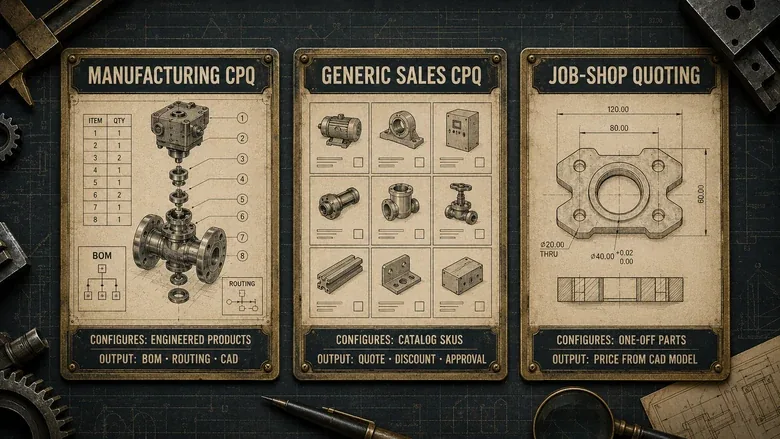
CPQ stands for configure, price, quote. In manufacturing it splits into three flavors that the generic roundups tend to blur together, and the difference decides which tools belong on your shortlist. A configurator handles engineered and configurable products; a sales CPQ handles standard catalog deals; a job-shop quoting tool prices a one-off part from its geometry. The capability page that earns the enquiry is upstream of all three, because a buyer who can qualify your shop without a phone call is the buyer who submits the RFQ your CPQ then turns into a quote.
| Type | What it is | What it configures | Best for |
|---|---|---|---|
| Manufacturing CPQ (configurator) | Rules-based product configuration, pricing, and a buildable quote | Engineered and configurable products | ETO and CTO makers: machinery, industrial equipment |
| Generic sales CPQ | Quoting and pricing for catalog, bundle, and subscription deals | Predefined SKUs and options | Sales teams selling standard products |
| Job-shop quoting / estimating | Cost and quote generated from a CAD model or spec | Custom one-off parts | Machine shops, fabricators, contract manufacturers |
Manufacturing CPQ vs a sales CPQ, CRM, and ERP
The line between a manufacturing CPQ and a sales CPQ is engineering output. A sales CPQ assembles options from a catalog and applies pricing rules. A manufacturing CPQ runs constraint logic so only valid combinations can be quoted, then drops out a bill of materials, a routing, and often a CAD drawing. If you need a BOM out of the quote, a generic deal-desk CPQ will not get you there.
A CPQ is also not a CRM. The CRM owns the relationship and the pipeline: who the account is, where the deal sits, what was promised. The CPQ owns the configured quote itself. They meet at the handoff, which is why the RFQ-and-quote axis decides so much in our manufacturing CRM scoring; the CPQ is the engine that fires after the CRM logs the opportunity, and several CRMs simply embed or integrate one.
It is not an ERP either. The ERP owns the order once it is accepted, plus production, inventory, and finance, so the CPQ feeds the configured order down into it. Many manufacturing ERPs ship their own CPQ module for exactly this reason, which is part of why an ERP shortlist and a CPQ shortlist overlap on names like Epicor and Infor. Decide whether the configurator should live inside your ERP or beside it before you compare products.
Use which, and when
- Use a configurator CPQ when most enquiries are for engineered or configurable products and the quote needs a valid BOM, routing, or drawing.
- Use a job-shop quoting tool when you make custom parts to a customer’s print and need a fast, accurate estimate from the CAD model.
- Use your CRM’s or ERP’s built-in CPQ when you are already standardized on that system and your configuration rules are moderate.
- Avoid a generic sales CPQ when production needs a manufacturable output, not just a priced line item, because retrofitting engineering rules onto it later is the expensive path.
Match CPQ to what you configure
Your product, not the vendor’s brochure, is the best predictor of fit. An engineer-to-order machine builder needs deep configuration and CAD automation; a shop standardized on Salesforce wants a CPQ that rides that stack; a job shop quoting custom brackets needs speed from a CAD file. Match the tool to how you actually sell and most of the feature debate answers itself. This is also where lead flow and the quote engine connect, since the channels behind your manufacturing lead generation only pay off if the RFQs they produce turn into quotes quickly, and if those requests stall on the way in, the RFQ intake and conversion path is the first thing to fix.
| Segment | What the tool must do well | Tools that tend to fit |
|---|---|---|
| Engineer-to-order and configure-to-order (machinery, industrial equipment) | Deep rules-based configuration, BOM and routing, CAD and drawing generation | Tacton, Epicor CPQ, DriveWorks, Configure One, Infor CPQ |
| Suite and system-of-record (you live in one CRM or ERP) | Configuration and pricing that rides your existing stack and quote-to-cash | Salesforce Revenue Cloud, Oracle CPQ, SAP CPQ, Conga CPQ |
| Job shop and custom parts (machined, fabricated) | Fast, accurate quote and estimate straight from a CAD model | Paperless Parts, MIE Trak Pro, JobBOSS² |
The best manufacturing CPQ at a glance
The table below is the shortlist in one view: ten platforms, the segment each belongs to, the manufacturer it fits best, the starting price as verified in June 2026, and the rating. Vendor names link to the official product page; “quote-based” means the vendor publishes no number and routes you to sales.
| Platform | Segment | Best-fit manufacturer | Starting price (as of June 2026) | Rating |
|---|---|---|---|---|
| Tacton | ETO configurator | Complex industrial machinery and equipment | Quote-based | Gartner MQ Leader · G2 4.3 |
| Epicor CPQ (KBMax) | ETO configurator | ETO needing sales-to-shop-floor | Quote-based | G2 4.5 (98) |
| DriveWorks Pro | ETO configurator | SOLIDWORKS-based engineering shops | Quote-based | G2 4.5 (52) |
| Configure One Cloud | ETO configurator | Configurable products on Salesforce or NetSuite | Quote-based (trackers list ~$150/user/mo) | G2 4.5 (122) |
| Infor CPQ | ETO configurator | Infor Kinetic ERP shops | Quote-based | Gartner MQ Leader |
| Salesforce Revenue Cloud | Suite CPQ | Shops standardized on Salesforce | From $150/user/mo (Growth); $200 Advanced, plus a Sales Cloud license | Capterra 4.2 |
| Oracle CPQ | Suite CPQ | Oracle-ecosystem mid-market and enterprise | Quote-based | Gartner MQ Leader · Peer Insights 4.2 |
| SAP CPQ | Suite CPQ | SAP S/4HANA manufacturers | Quote-based | Analyst-recognized |
| Conga CPQ | Suite CPQ | Sales-led complex quoting across a large catalog | Quote-based | Gartner MQ · Capterra 4.2 |
| Paperless Parts | Job-shop quoting | Custom-parts job shops and contract manufacturers | Quote-based | Capterra 4.9 (25) |
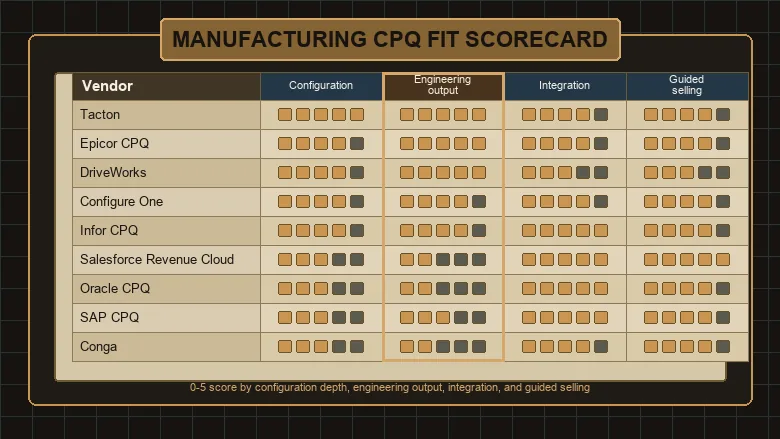
Only one platform here publishes a real per-user price. That split is the first honest signal about who sells to manufacturers directly and who sells through a discovery call and a custom quote. The scorecard below ranks the nine configuration CPQs on the axes that separate a manufacturing tool from a sales tool.
The Manufacturing CPQ Fit scorecard
Each configuration CPQ is scored 0 to 5 on four axes from published documentation, with overall fit held down where the value only appears inside one vendor’s ERP or CRM. Engineering output is the axis that separates the configurators from the suites, and it is where the suite CPQs lose ground.
| CPQ | Configuration depth | Engineering output (BOM / CAD) | ERP/CRM & quote-to-order | Guided selling & speed | Manufacturing fit |
|---|---|---|---|---|---|
| Tacton | 5 / 5 | 4.5 / 5 | 4.5 / 5 | 4.5 / 5 | 4.5 / 5 |
| Epicor CPQ (KBMax) | 4.5 / 5 | 5 / 5 | 4 / 5 | 4 / 5 | 4.5 / 5 |
| DriveWorks Pro | 4 / 5 | 5 / 5 | 3 / 5 | 3.5 / 5 | 4 / 5 |
| Configure One Cloud | 4.5 / 5 | 4 / 5 | 4 / 5 | 4.5 / 5 | 4 / 5 |
| Infor CPQ | 4.5 / 5 | 4.5 / 5 | 4 / 5 | 4 / 5 | 4 / 5 |
| SAP CPQ | 4.5 / 5 | 2.5 / 5 | 4.5 / 5 | 3 / 5 | 3.5 / 5 |
| Salesforce Revenue Cloud | 4 / 5 | 1.5 / 5 | 4 / 5 | 4 / 5 | 3 / 5 |
| Oracle CPQ | 4 / 5 | 2 / 5 | 4 / 5 | 3.5 / 5 | 3 / 5 |
| Conga CPQ | 4 / 5 | 1.5 / 5 | 3.5 / 5 | 4 / 5 | 3 / 5 |
Best CPQ for engineer-to-order and configurable products
This is the manufacturing wedge: tools built to configure complex products and emit a buildable result. If your enquiries arrive as RFQs for machinery, equipment, or any product with hundreds of valid variants, shortlist here first. These five lead the field, and the first two top the scorecard. A buildable result only helps if it lands cleanly in the systems downstream, so it is worth seeing how a CPQ’s BOM and routing hand off to ERP and MES rather than treating the configurator as an island.
Tacton: constraint-based configuration for complex equipment
What it is: a constraint-based CPQ built over 25 years for high-variance industrial manufacturing, strong where a product has thousands of valid combinations and engineering rules that must never be violated. Standout: a true constraint solver, one-click 2D and 3D drawing generation, BOM output, and guided selling that translates customer needs into a buildable spec. Starting price: quote-based; Tacton publishes no list price and routes buyers to a demo (confirmed June 2026). Rating: named a Leader in the 2026 Gartner Magic Quadrant for CPQ for the fourth straight year, with G2 at 4.3 across 54 reviews. Watch for: the power comes with a learning curve, and the rule modeling needs skilled hands to set up and maintain.
Epicor CPQ (formerly KBMax): visual config to the shop floor
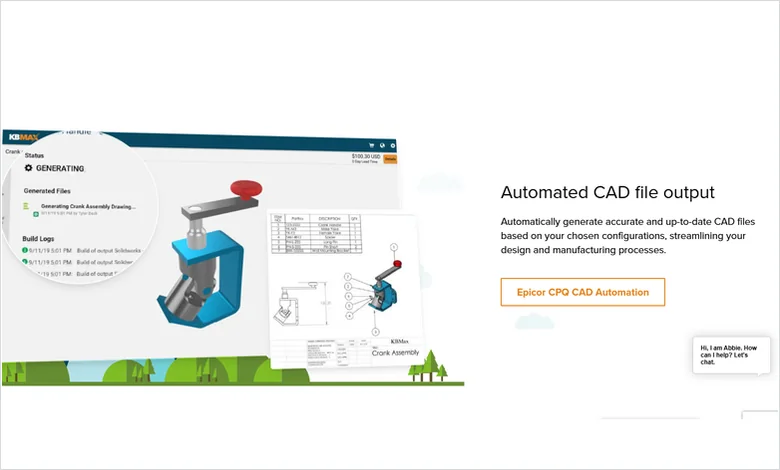
What it is: the former KBMax, now Epicor CPQ, a visual configurator that connects the configured order to CAD and the shop floor. Standout: visual logic-block rules, 2D, 3D, and AR output, automatic CAD generation for AutoCAD, SOLIDWORKS, and PTC Creo, and automatic BOMs and production documents that cut handoff errors. Starting price: quote-based; the per-user figures on third-party sites are not vendor-confirmed, so treat it as quote-based (confirmed June 2026). Rating: G2 4.5 across 98 reviews. Watch for: it can slow on very complex configurations, and the deepest value comes when it sits alongside Epicor ERP.
DriveWorks Pro: SOLIDWORKS design automation plus a web configurator
What it is: SOLIDWORKS-native design automation paired with an online 3D configurator, so an order can generate its own models, drawings, and documents. Standout: the best engineering output on this list for SOLIDWORKS shops, generating order-specific parts, assemblies, drawings, quotes, and BOMs from rules. Starting price: quote-based, licensed in modules with no public figure (confirmed June 2026). Rating: G2 4.5 across 52 reviews. Watch for: it is SOLIDWORKS-centric, the rules must be planned up front, and later logic changes are harder than they look. DriveWorks Solo is a design-automation tool that runs inside SOLIDWORKS, not a buyer-facing configurator, so confirm you are pricing Pro.
Configure One Cloud: configuration with guided selling, from Revalize
What it is: a cloud CPQ from Revalize built for configurable industrial products, with 3D visualization and guided selling. Standout: strong rules-based configuration and guided selling, with native links to Salesforce and NetSuite and optional CAD and BOM automation. Starting price: one of the few to surface a per-user rate, with third-party trackers listing around $150 per user per month on a 10-user minimum, but Revalize routes you to a demo rather than posting a number, so treat it as quote-based pending your configuration (confirmed June 2026). Rating: G2 4.5 across 122 reviews. Watch for: 3D visualization, CAD automation, and BOM generation are add-ons, so the real total varies. Sofon, another long-standing guided-selling CPQ, is now folded into Revalize.
Infor CPQ: configuration native to the Infor stack
What it is: a visual, rules-based CPQ built into Infor’s CloudSuite and Kinetic ERP rather than sold standalone. Standout: rules-driven configuration with 3D visualization, CAD and BOM automation across AutoCAD, SOLIDWORKS, and Creo, and guided selling tied tightly to Infor pricing and orders. Starting price: quote-based, bundled into wider Infor deals with no public figure (confirmed June 2026). Rating: named a Leader in the 2026 Gartner Magic Quadrant for CPQ. Watch for: it is not a standalone tool, so its value is real mainly if you run, or plan to run, Infor.
Best CPQ inside your CRM or ERP
These four configure and price well, but they are sales-and-revenue platforms first. None carries deep native manufacturing engineering, which is why they sit lower on the fit scorecard. Shortlist them when you are standardizing on that system of record and your configuration needs are moderate, and pair them with a real configurator if a BOM has to come out of the quote.
Salesforce Revenue Cloud: the suite CPQ that publishes a price
What it is: Salesforce’s rules-based configuration and quoting, now sold as Revenue Cloud after the legacy Salesforce CPQ reached end-of-sale to new customers in 2025. Standout: the configuration and quote-to-cash flow most shops already standardized on Salesforce will want, and the one platform here that posts per-user pricing. Starting price: Revenue Cloud Growth at $150 and Advanced at $200 per user per month, billed annually, on top of a required Sales Cloud license (as of June 2026). Rating: Capterra 4.2. Watch for: it is not manufacturing-native, with no CAD, BOM, or design-for-manufacturability, and migrating off legacy CPQ is a reimplementation, not an upgrade.
Oracle CPQ: enterprise configuration in the Oracle stack
What it is: Oracle’s enterprise CPQ inside Fusion CX, with deep variant management, approval workflows, and tight links to Oracle ERP. Standout: enterprise-grade configuration and pricing for make-to-configure manufacturers already on Oracle. Starting price: quote-based; Oracle publishes no standard per-user price (confirmed June 2026). Rating: a long-running Leader in the Gartner Magic Quadrant for CPQ, with Gartner Peer Insights at 4.2. Watch for: implementation cost and timeline run high, and manufacturing-specific configuration usually needs consulting.
SAP CPQ: variant configuration close to S/4HANA
What it is: SAP’s CPQ, the former CallidusCloud, leaning on SAP Variant Configuration so sales and manufacturing share one configuration model. Standout: for S/4HANA shops, the configured product and its BOM logic align front to back with no sales-to-production mismatch. Starting price: quote-based; the ranges on third-party sites are not vendor-published (confirmed June 2026). Rating: analyst-recognized in the CPQ market; public per-product review samples are thin. Watch for: its strength is real inside SAP and far weaker outside it, and the implementation is a project, not a setup.
Conga CPQ: sales-led quoting, now with PROS pricing
What it is: a multi-cloud, rules-based CPQ for complex sales quoting that, after Conga completed its acquisition of the PROS B2B business on February 2, 2026, now folds in PROS Smart CPQ and AI-driven price optimization. Standout: strong configuration, guided selling, and pricing intelligence across Salesforce, SAP, Oracle, and NetSuite. Starting price: quote-based (confirmed June 2026). Rating: recognized in the 2026 Gartner Magic Quadrant for CPQ, with Capterra at 4.2. Watch for: it is sales-led, not manufacturing-native, the post-acquisition integration is still settling, and PROS Smart CPQ is no longer sold standalone.
Best quoting software for manufacturing job shops
Job shops live in a different question. You are not configuring a catalog product; you are pricing a custom part to a customer’s print, fast and accurately, then turning it into work. This tier is quoting and estimating, not rules-based configuration, so we assess it on speed from RFQ to an accurate, manufacturable quote rather than on the configurator rubric. The Mastercam 2027 release is a useful downstream reminder: a fast quote still has to survive programming, setup validation, and the first real cut. Because that speed-and-accuracy problem is a category of its own, we scored it separately in the guide to the dedicated quoting and estimating software job shops actually run, where the configurator rubric gives way to time-from-RFQ and cost accuracy.
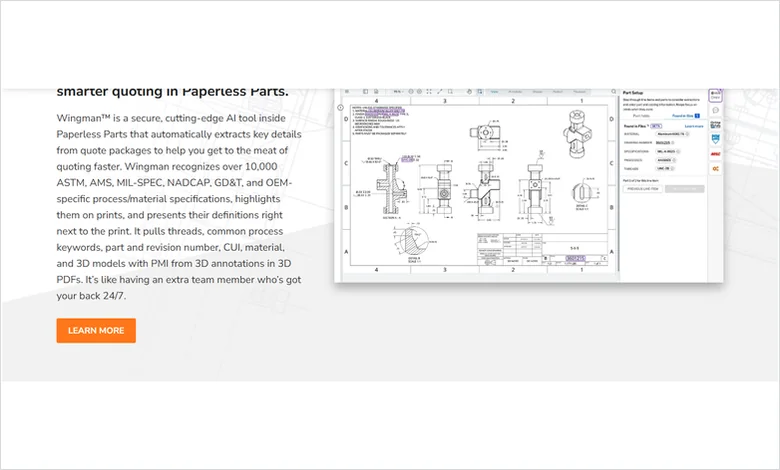
Paperless Parts: instant quoting from the CAD model
What it is: a quoting and estimating platform that reads a part’s CAD geometry to cost it, flag manufacturability issues, and produce a quote in minutes, built for machine shops, CNC and Swiss shops, sheet-metal fabricators, and contract manufacturers. Standout: geometry-driven costing, design-for-manufacturability flags, live material pricing, and a customer portal that compresses a multi-day estimate into a same-day quote. Starting price: quote-based; pricing is customized to shop size with no public figure (confirmed June 2026). Rating: Capterra 4.9 across 25 reviews, the highest in this tier. Watch for: it estimates from geometry rather than configuring an engineered product, so it is the wrong tool for a make-to-order configurator job.
MIE Trak Pro and JobBOSS²: estimating inside a job-shop ERP
What it is: two job-shop ERPs whose estimating modules quote work and then run it, covering scheduling, inventory, and job costing in the same system. Standout: formula and labor-rate estimating tied to the whole production system, so a quote becomes a work order, a schedule, and a cost record without re-keying. Starting price: MIE Trak Pro and JobBOSS² are both quote-based, with neither posting a list price on its own site (confirmed June 2026). Rating: MIE Trak Pro holds Capterra 4.6 across 155 reviews; JobBOSS² sits around an 83% satisfaction score across more than 1,000 reviews. Watch for: these are full ERPs, so the estimating is formula-based rather than CAD-geometry instant quoting, and you are buying a production system, not just a quoting tool.
Two vertical tools are worth a look if they match your work: Steelhead Technologies for metal-finishing shops (plating, powder coating, anodizing), and Luminovo for electronics and PCB assembly quoting, where the BOM and component sourcing drive the cost.
How to choose a manufacturing CPQ
Choose by what you build and where the configurator should live, not by brand recognition. Work down this list in order and ten platforms narrow to two or three. The forms and handoffs before the CPQ ever runs are their own discipline, so fix a slow quote path before you blame the tool. That slow path usually starts at intake, so designing the RFQ form that feeds the configurator is the first place to look.
- Choose an ETO configurator (Tacton, Epicor CPQ, DriveWorks, Configure One, Infor) when products are engineered or highly configurable and the quote needs a BOM, routing, or drawing.
- Choose a SOLIDWORKS-native tool (DriveWorks) when your engineering already lives in SOLIDWORKS and design automation is the prize.
- Choose a suite CPQ (Salesforce Revenue Cloud, Oracle, SAP, Conga) when you are standardizing on that CRM or ERP and configuration depth is moderate.
- Choose a job-shop quoting tool (Paperless Parts, MIE Trak Pro, JobBOSS²) when you quote custom parts from a print and speed from RFQ is the win.
- Avoid paying for an enterprise CPQ if you run a single product line with light configuration; a focused configurator or your ERP’s module will deploy faster and cost less.
The best manufacturing CPQ is the one that matches what you build and where your data already lives, not the one with the most options in the demo.
IMPORTANT
Run a scripted demo on your own hardest configurable order, the one with the most options, the tightest rules, or the trickiest BOM, before you sign. A configurator that looks clean in a sales deck can stall on the one rule that defines your business.
What manufacturing CPQ really costs
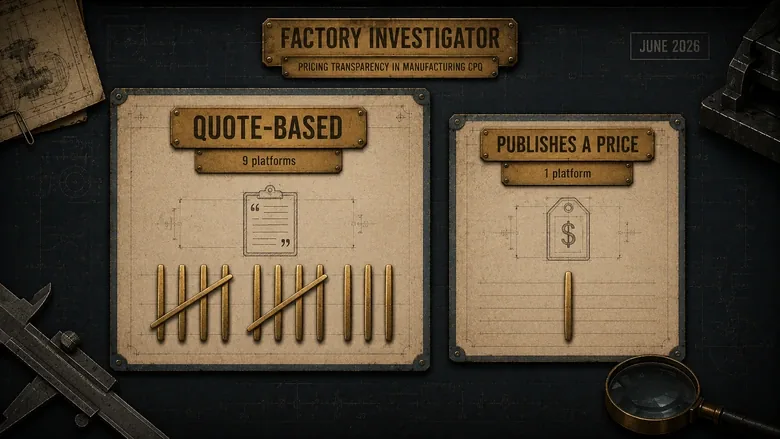
CPQ costs far more than its subscription line, and on this list you usually cannot even see the subscription line. Nine of the ten platforms are quote-based as of June 2026; only Salesforce Revenue Cloud posts per-user pricing, and even that rides on a required Sales Cloud license. Expect a discovery call and a custom quote shaped by your seats, your configuration complexity, and your integrations before anyone shows you a number.
The bigger number is everything around the license. Implementation, CAD and ERP connectors, rule modeling, data migration, and training routinely cost more than the software in year one, and a deep engineer-to-order configurator carries the heaviest setup of all because someone has to encode your product rules. Price the whole program, and read the broader manufacturing software cost breakdown before you compare quotes, because CPQ behaves like the rest of the category: gated, configuration-driven, and front-loaded with services.
First-year CPQ cost = (Subscription or license × 12) + Implementation + CAD/ERP connectors + Rule modeling + Training
The spend is rising because configured selling is where manufacturers are investing. The 2026 Gartner Magic Quadrant evaluated 16 CPQ vendors, the field keeps consolidating around the leaders, and Fictiv’s 2025 State of Manufacturing report found that 90% of manufacturers now see digital manufacturing platforms as essential. A configurator that turns a slow, error-prone RFQ into a same-day, buildable quote pays back faster than its quote suggests.
PRO TIP
Make every quote-based vendor itemize software, implementation, rule modeling, and annual support separately, in writing. A low license with a heavy configuration-build fee can cost more over three years than a higher subscription that deploys in weeks.
Frequently Asked Questions
CPQ in manufacturing is software that configures a product to a customer’s requirements, prices it against real cost and engineering rules, and generates a quote tied to a buildable spec. A true manufacturing CPQ also produces the bill of materials and routing and often the CAD drawing, so sales only quotes what the shop can make.
CPQ stands for configure, price, quote. In manufacturing, “configure” means applying engineering rules so only valid product combinations are allowed, “price” means costing that configuration accurately, and “quote” means producing the proposal, and often the BOM and drawings, that the customer and the shop floor both rely on.
Manufacturers use CPQ software to turn an RFQ for a configurable or engineered product into a fast, accurate, manufacturable quote. It removes invalid configurations, applies pricing and discount rules, generates the BOM, routing, and CAD output, and hands a clean order to the ERP, cutting quote turnaround and engineering rework.
It depends on what you build. In our June 2026 scoring, Tacton and Epicor CPQ led for engineer-to-order configuration, DriveWorks for SOLIDWORKS shops, and Configure One and Infor for configurable products on those stacks. Suite CPQs fit shops on Salesforce, Oracle, or SAP, and Paperless Parts leads job-shop quoting.
Most manufacturing CPQ is quote-based as of June 2026. Salesforce Revenue Cloud is the main exception, from $150 per user per month plus a Sales Cloud license. Everything else is priced by seats, configuration complexity, and modules, with implementation and rule modeling often costing more than the software in year one.
Choosing a CPQ is one half of turning more enquiries into orders; the other half is a website that delivers configurable-product buyers a clean path to the RFQ in the first place. If you want a clear read on where your site is losing quote requests before they ever reach your CPQ, request a free manufacturer website investigation and we will show you what to fix first.
