
An engineer sourcing a part decides whether your shop belongs on the shortlist before anyone picks up the phone. 6sense’s survey of 934 B2B buyers found they stay roughly 70% through the buying journey before they contact a seller. The page doing most of that qualifying is your capability page.
Manufacturer capability pages are where a buyer confirms you can actually make their part: the process, the material, the tolerance, the certification, and the spec sheet they can hand to their own team. Get the page right and a qualified request for quote follows. Bury the details, and you are cut from the list without ever knowing the enquiry existed.
There is a second reason this page gets muddled. Search for capability pages and half the results are about the capability statement, the one-page PDF manufacturers email to win government contracts. That document has its place, but it is not what an industrial buyer reads at 9pm while building a shortlist. This guide is about the web page that earns the RFQ, and where the statement fits inside it.
Below is the anatomy of a capability page that converts, a checklist of what a buyer must find before requesting a quote, and how to make the page citable by the search and AI engines buyers now start with.
Direct answer — What is a manufacturer capability page?
A manufacturer capability page is a web page that proves your shop can make a specific part, so an engineer or buyer can qualify you and request a quote without calling. It states the process, materials, tolerances, part-size limits, industries served, and certifications, and it links a downloadable spec sheet. It is not the same as a one-page capability statement, the PDF used to win government contracts. The goal of the page is a qualified RFQ.
Key Takeaways
- A capability page exists to answer one question: can you make my part? Build it for the buyer’s qualification, not for visual polish.
- The Capability-Page Anatomy has six parts: process, material, industry, tolerance, certification, and a downloadable spec.
- State real limits. The tightest tolerance you hold and the largest part you run pre-qualify the enquiry and raise RFQ quality.
- A capability page is not a capability statement. The statement is a contracting PDF; the page is a crawlable conversion asset that feeds your RFQ form.
- Do not gate specs, lead times, or CAD behind a form. Buyers who cannot qualify you in a minute move to the shop that let them.
What a manufacturer capability page is, and how it differs from a capability statement
A manufacturer capability page is a single web page that documents one set of production capabilities in enough detail that a buyer can match it to their part and decide to request a quote. It reads like a spec sheet, not a brochure, and it is built to be found in search and quoted by AI answer engines.
The confusion with the capability statement is worth clearing up first, because the two get treated as the same thing and they are not. A capability statement is a static one-page document, usually a PDF, built for contracting officers and prime contractors who are vetting a vendor. It leads with core competencies, past performance, differentiators, and company codes such as NAICS, CAGE, and UEI. It is emailed or attached, and it goes out of date the moment a code or a certification changes.
A capability page is the opposite kind of asset. It lives on your website, it is crawlable and updatable, and it is read by an engineer or procurement buyer who is self-qualifying you against a real part. The difference matters because the buyer behavior is different.
| Capability page | Capability statement | |
|---|---|---|
| What it is | A web page on your site | A one-page PDF document |
| Who reads it | Engineers and procurement buyers self-qualifying a supplier | Contracting officers and primes vetting a vendor |
| What it leads with | Process, material, tolerance, certification, spec sheet | Core competencies, past performance, codes (NAICS, CAGE, UEI) |
| Where it lives | Indexed and crawlable, found in search | Emailed or attached, not crawlable |
| Goes stale when | You forget to update it (rare, it is on your CMS) | Any code, cert, or contract changes (common) |
| Use it when | A buyer needs to qualify you and request a quote | You register for or bid on a government or prime contract |
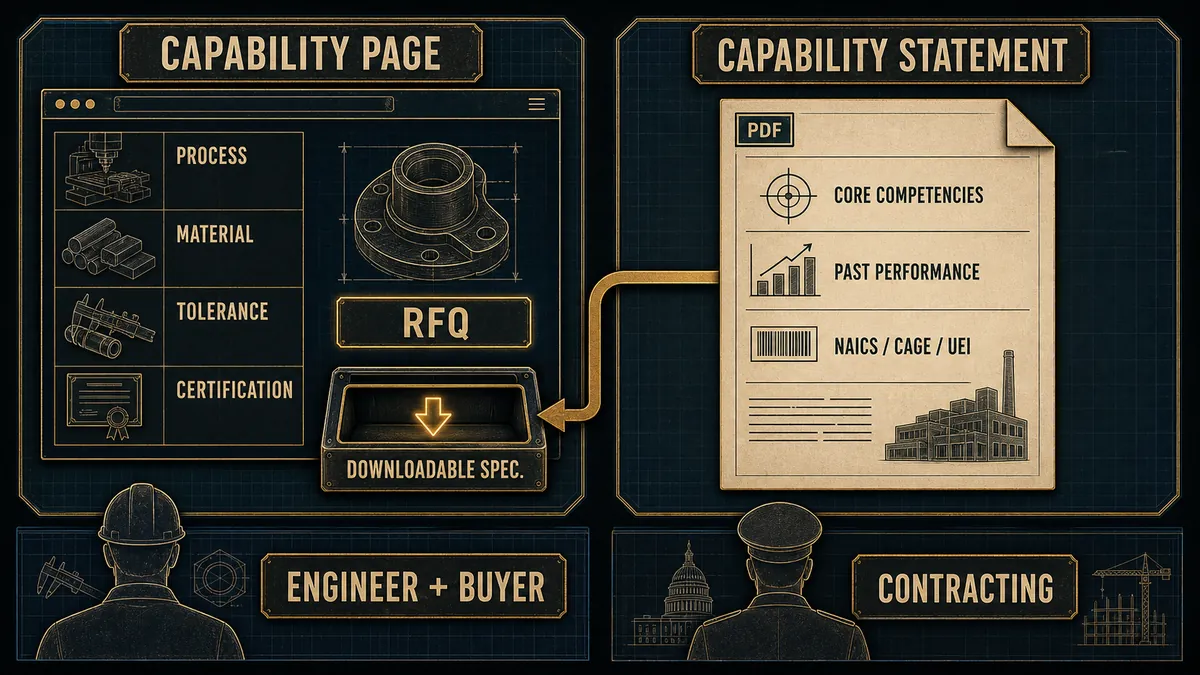
The two work together. The page captures the buyer in search and answers their questions in the open; the statement, offered as a downloadable spec sheet, is the file they save and forward to a colleague. Treat the statement as one component of the page, not as a replacement for it.
The Capability-Page Anatomy: six things a buyer needs before a quote
The Capability-Page Anatomy is the set of six components a buyer checks before requesting a quote: process, material, industry, tolerance, certification, and a downloadable spec. Each one answers a different qualification question, and a page missing any of them sends the buyer to a competitor who answered it. The page does the qualifying, but the enquiry still has to survive the last step, which is why an RFQ form that asks only what an estimator can quote matters as much as the page that feeds it.
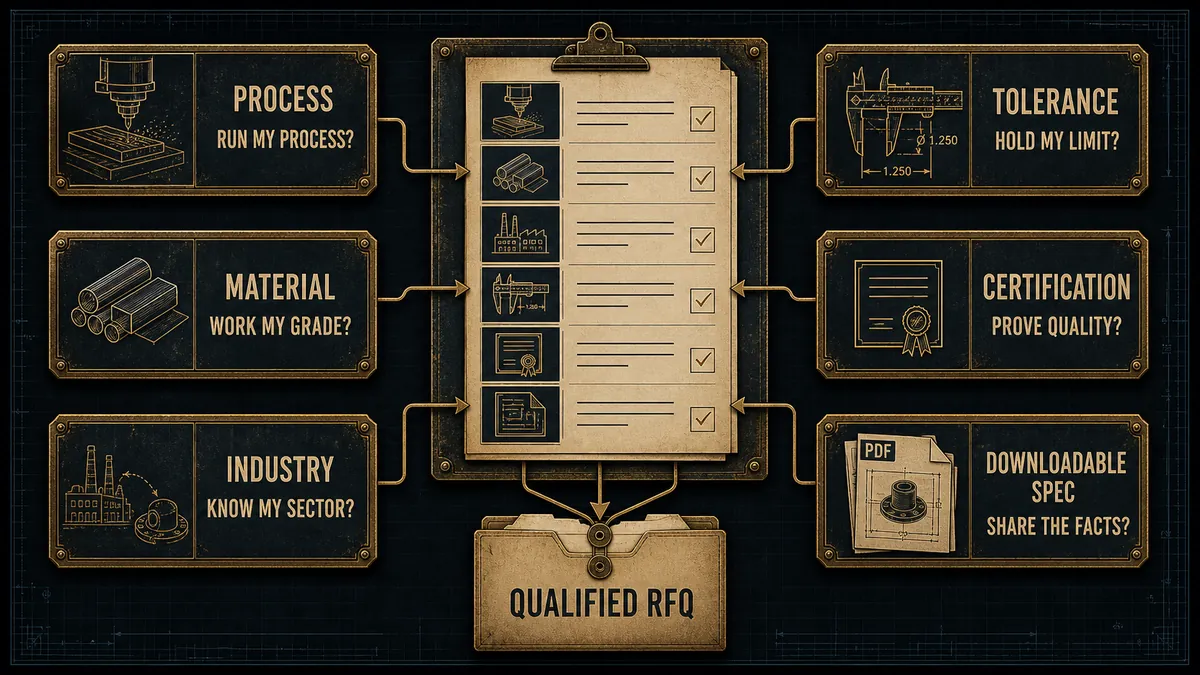
Process answers can you run my process. Name the specific processes you offer, each on its own page, with the equipment that runs them. Material answers do you work in my material: the grades and forms you run, and the ones you do not. Industry answers do you serve buyers like me, with example parts and the standards that industry expects. A sourcing team should turn those claims into hard gates on a supplier-qualification scorecard and request evidence for each one.
Tolerance answers can you hold my spec, stated as real numbers with units and the inspection that backs them. Certification answers can I trust your quality system, shown with scope and current dates. Downloadable spec answers can I save and forward this, in the form of a spec sheet or line card a buyer hands to their own team.
These six are also what make the page rank. Capability pages are the core asset of manufacturing SEO and AI-search visibility for an industrial shop, because each component matches the exact query an engineer types instead of a generic head term. The layout that arranges them so a buyer reads top to bottom is its own discipline, and our done-for-you manufacturing website design builds these pages when you would rather not build them in-house.
The capability-page checklist: what a buyer must find before a quote
Use this checklist as a buyer’s scorecard: print it, open your own capability page, and mark every row a buyer cannot answer in under a minute. The rows you fail are the RFQs you are losing. Before a full rebuild, a quick diagnostic helps you fix the right things first, which is what our five-lens review of manufacturer websites is built to do.
| What the buyer is asking | What to put on the page | Pass / fail signal |
|---|---|---|
| Process: can you run my process? | ||
| Do you offer the exact process I need? | Each process on its own page, named the way buyers search (for example, 5-axis CNC milling, not “machining services”) | Fail: one combined “Capabilities” paragraph listing every process |
| What machines actually run it? | An equipment list with make, model, and working envelope (axis travel, swing, table size) | Fail: “state-of-the-art equipment” with no specifics |
| Can you do the secondary work? | Finishing and secondary processes (heat treat, anodize, passivation, plating) named, in-house or partnered | Fail: finishing never mentioned, buyer assumes you cannot |
| Material: do you work in my material? | ||
| Do you run my grade? | Material families and grades you run (for example, 6061 and 7075 aluminum, 304 and 316 stainless), with notes | Fail: “all materials” or no materials page at all |
| Will my part size fit? | Forms and size limits (bar, plate, sheet; maximum part dimensions and weight) | Fail: no stated size or weight envelope |
| Tolerance: can you hold my spec? | ||
| How tight can you hold it? | Standard and tightest achievable tolerance, with units (for example, standard ±0.005 in, tightest ±0.0005 in) | Fail: “tight tolerances” with no number |
| Can you prove the part is in spec? | Inspection and measurement capability (CMM, GD&T, first-article and in-process inspection) | Fail: no quality-control or inspection detail |
| Industry: do you serve buyers like me? | ||
| Have you made parts like mine? | Industries served with example parts and the standards each expects (for example, aerospace brackets to AS9100) | Fail: generic “we serve many industries” |
| Can you handle my volume? | Capacity and run sizes (prototype, low, and high volume; typical lead time) | Fail: capability shown but capacity hidden, a separate question buyers always ask |
| Certification: can I trust your quality system? | ||
| Do you hold the cert my industry requires? | Certifications with scope, registrar, and current dates (ISO 9001, AS9100, IATF 16949, ISO 13485, ITAR registration) | Fail: a faded logo in the footer, no scope or date |
| Can I verify the certificate? | A link to the registrar lookup or a downloadable certificate | Fail: a claim with no proof a buyer can check |
| Downloadable spec: can I save and forward this? | ||
| Is there a file I can send to my team? | A downloadable capability or spec sheet (PDF line card) with processes, materials, tolerances, and certifications | Fail: nothing to download, the buyer rebuilds your specs by hand |
| Can I get the technical files I need? | CAD or STEP files and drawing templates where relevant, open, not gated | Fail: specs and files locked behind a “request access” form |
| How do I start the quote? | A visible “Request a Quote” button on the page itself | Fail: only a generic “Contact us” link in the header |
The download deserves more weight than most shops give it. TraceParts, in a survey of 45,555 professional designers, found that 88% consider buying the part after downloading its CAD model, so the file on your capability page is often the first real step of the sale, not an afterthought.
Write the capability page like a spec sheet, not a brochure
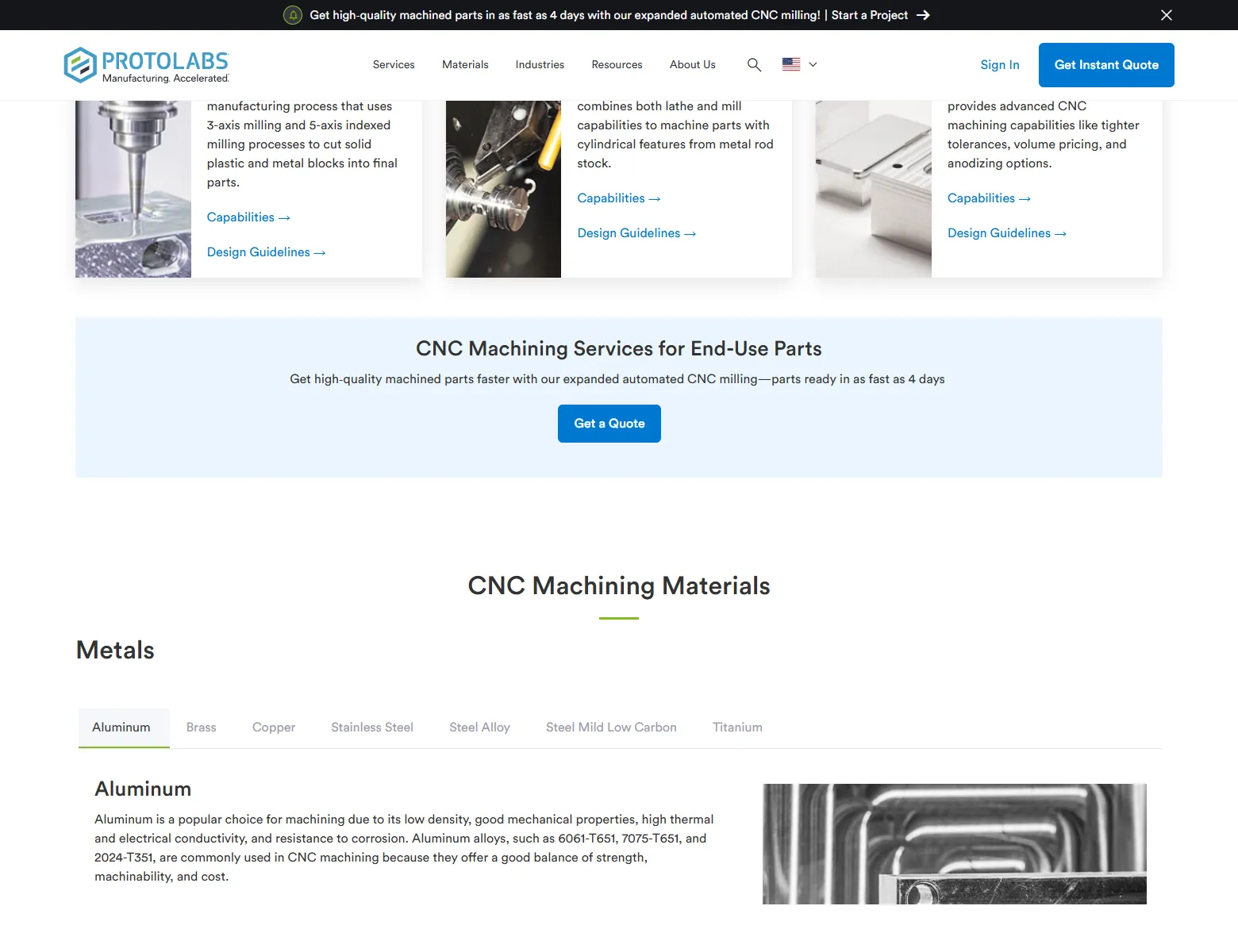
Write each capability page the way a buyer reads it: as a spec sheet they can act on, not a brochure they have to decode. State the largest part you can hold, the tightest tolerance you can certify, the volumes you run well, and the materials and finishes you support. Those specifics do two jobs at once. They help the page rank for the exact query an engineer types, and they pre-qualify the enquiry so your estimators stop quoting work you cannot win. Turning that qualified enquiry into a fast, accurate price is the job of a CPQ built for what you make.
This is where most manufacturer content goes wrong. In the Content Marketing Institute’s 2025 manufacturing report, based on 104 manufacturing marketers, only 20% called their content very effective and 47% said their content was not tied to the customer journey. A capability page written as a spec sheet is content tied to the exact moment a buyer is qualifying you, which is the part most blog calendars miss. Sequencing which pages to build before you write a single blog post is the heart of capability-first content for manufacturers.
PRO TIP
Build one capability page for each process-and-industry pair you genuinely want more of. A shop chasing aerospace machining work needs a page for exactly that, not a line buried in a combined list. Specific pages win specific quotes.
Lead each page with the qualifying facts, then add the supporting evidence. A buyer scanning for “316 stainless passivation to ASTM A967” should hit that answer in the first screen, not three paragraphs into a company history. The page can still tell your story, but the story goes below the specs, never in front of them. That same spec-first test is a quick way to judge outside help: an agency that fills a capability page with company history is the wrong one, and learning to spot that tell early is half of vetting an industrial marketing agency.
Certifications and the downloadable spec sheet
Certifications and a downloadable spec sheet are the two trust signals a buyer looks for before risking a quote request. For industrial buyers, certifications are gating filters: ISO 9001, AS9100, IATF 16949, and ISO 13485 decide whether you are even eligible to quote. Show each one with its scope and current dates, and link to the registrar so the buyer can verify it. A logo with no scope and no date reads as a claim, not proof. The same proof burden applies to Ultra-HDI capacity announcements: buyers need qualification scope, process limits, and current production evidence before treating a new facility as usable supply. CPSC’s domestic-manufacturer certificate changes show the same distinction between skipping an electronic filing step and still maintaining verifiable compliance proof.
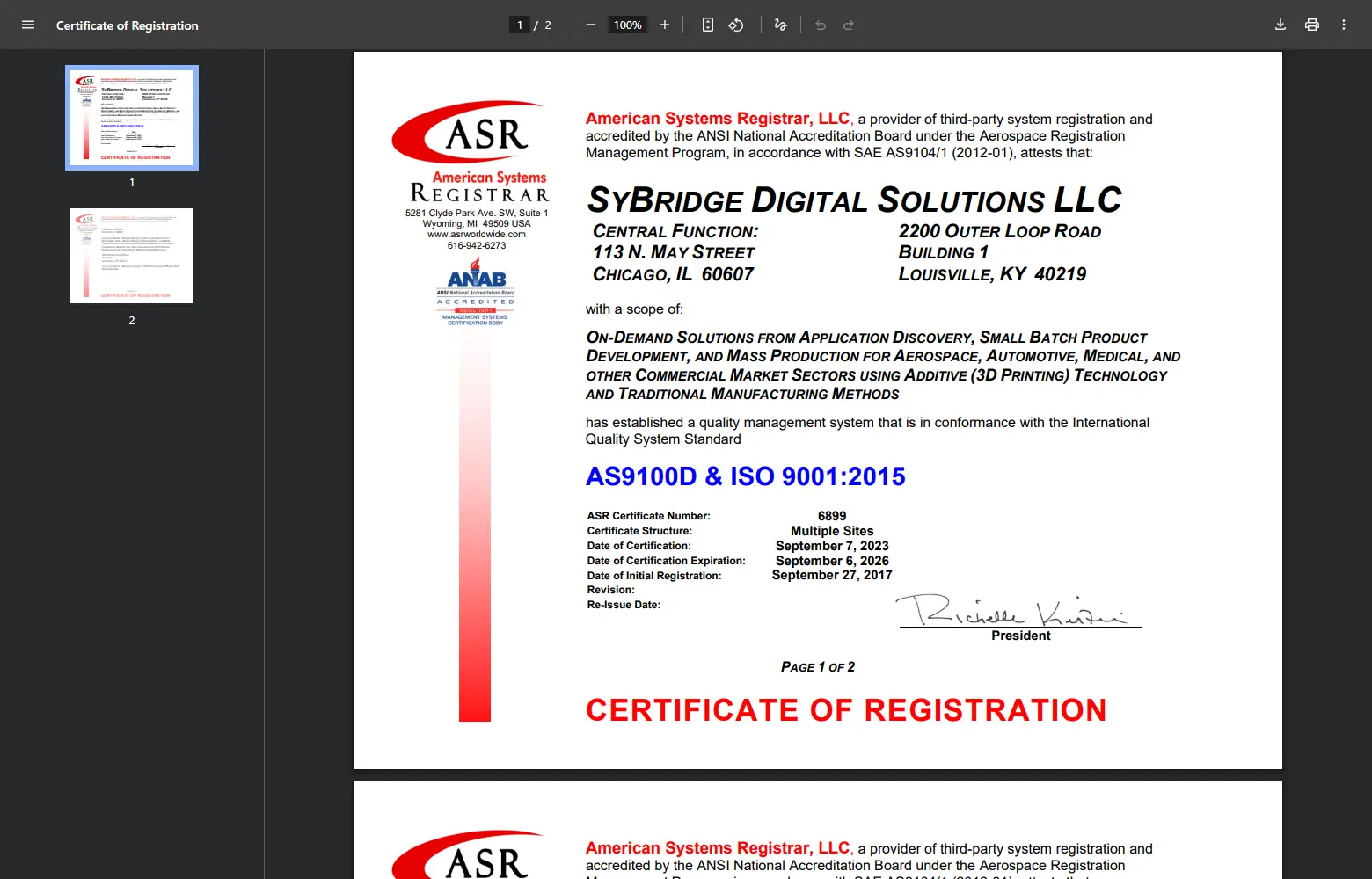
This is also where the capability statement earns its place inside the page. Offer the same proof as a downloadable one-page spec sheet or line card the buyer can forward to their team, carrying your processes, materials, tolerances, certifications, and, for government work, your NAICS and CAGE codes. The web page wins the search and the conversation; the downloadable sheet is the artifact that travels through the buyer’s organization.
Buyers expect to serve themselves before they ever contact you. In a March 2025 study of 100 US B2B buyers, Statista+ and Spryker found that 95% of buyers believe self-service options improve purchasing efficiency, and that buyers who use self-service portals are far more satisfied with the experience than those who do not, 86% against 32%. Sana Commerce’s 2025 B2B Buyer Report, a survey of 750 B2B buyers, found 85% hit significant barriers from outdated systems and inaccurate data. Gating your specs creates exactly that barrier. When the page also exposes material availability or lead time, those claims need controlled inventory data; otherwise self-service simply scales the error.
IMPORTANT
Do not gate specs, lead times, certificates, or CAD files behind a “request access” wall. A buyer who cannot qualify you in 60 seconds moves to the supplier who let them. Gating the exact facts a buyer needs costs you the exact RFQ you wanted.
Connect the capability page to the RFQ form that filters
A capability page only pays off when it leads cleanly into a request for quote, so treat the RFQ form as the page’s final component. A buyer who read a precise capability page and then hits a blank “Contact us” box will often leave, and the ones who submit hand your sales team almost nothing to act on.
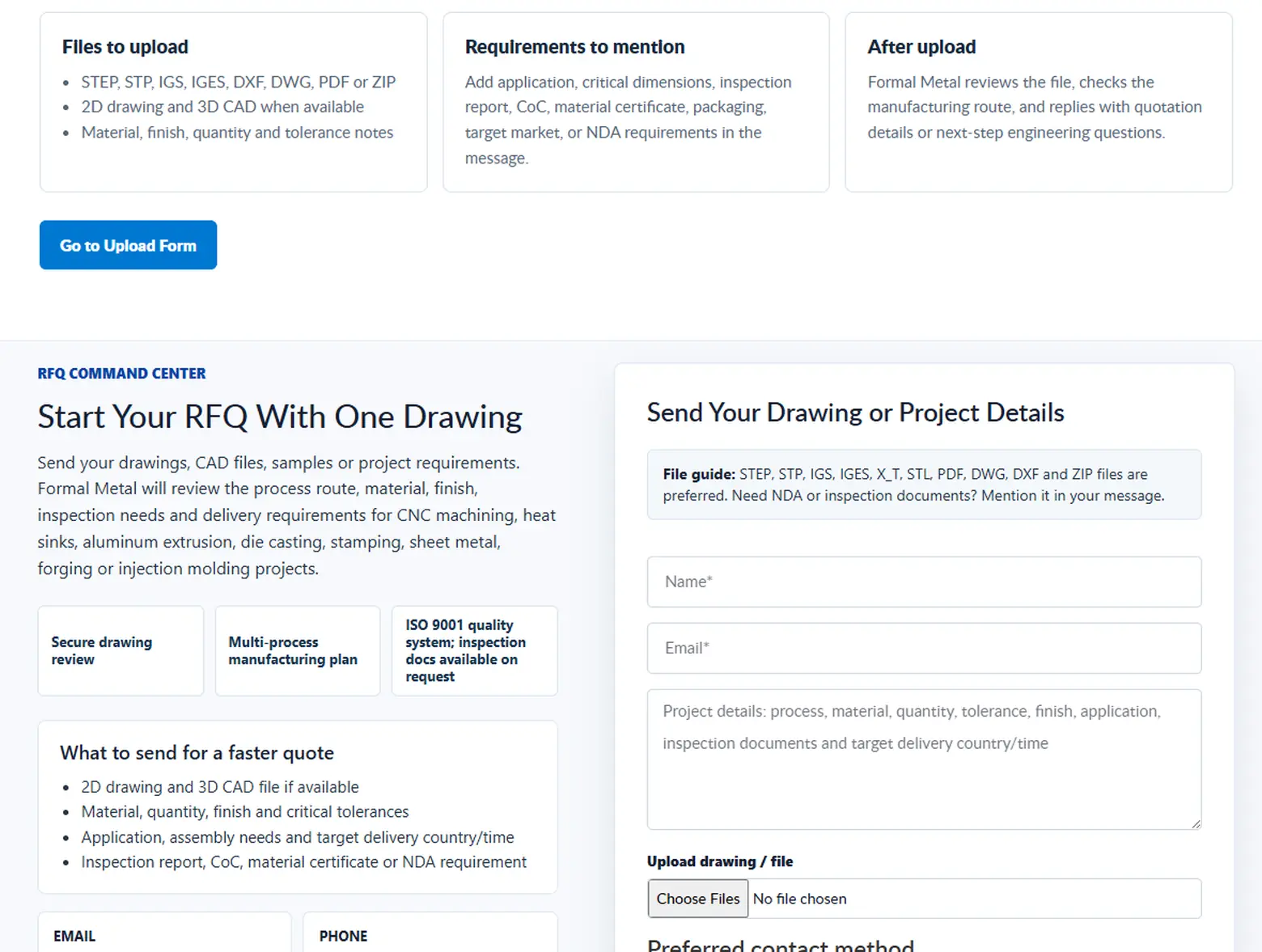
Design the form to qualify. Ask for material, quantity or volume, tolerance or spec, target timeline, and a drawing or file upload. Those fields raise the quality of every enquiry and quietly filter the tire-kickers who will not spend two minutes describing a real job. Tightening the form so it screens weak enquiries without scaring off good buyers is its own craft, and our guide to turning more visitors into qualified quote requests is where most of the recoverable revenue on a manufacturer site sits.
The best capability page is not the one that wins a design award. It is the one an engineer can use to qualify you, and quote you, in under a minute.
Make the capability page citable by search and AI engines
Findability decides whether your capability page is ever read, so build it to be ranked by search engines and quoted by AI answer engines. Buyers search the process, the material, and the tolerance, not your company name, and they increasingly start in an AI answer that summarizes a few sources and cites them. Search is only one of the channels that carry a buyer to this page, though, and choosing which to fund first on a finite budget is a separate decision, which is what our guide to digital marketing for manufacturers ranks channel by channel against the quote requests each produces.
The same structure that helps engines rank you also helps them quote you: a clean definition near the top, specs written as crawlable HTML tables rather than locked inside an image or a PDF, and a clear question-and-answer format. Mark up your products and specifications with Google’s Product structured data so details like specifications surface in results and give AI engines clean, labeled facts to lift. A capability page that states its tolerances as text, in a table, is one an engine can cite. A page that hides them in a brochure JPEG is one it skips.
Earning that citation for “ISO 9001 certified aluminum die casting” is worth more than a thousand stray visits, because the buyer reading it is mid-decision. First-party detail is what wins it. An AI model can summarize, but it cannot invent your tolerances or your certification scope, and those facts are exactly what make a manufacturer page both ranked and cited.
Where to start if you can only fix one page
Prioritize by what blocks a quote first. If you can only sharpen one capability page this quarter, repair it in this order and you will recover the most lost RFQs for the least effort.
- Add the RFQ button and a qualifying form to the page itself. Material, quantity, tolerance, timeline, and file upload. Cheapest change, largest effect on lead quality.
- State your tolerances and size limits as real numbers. Replace every “tight tolerances” with a figure and a unit.
- Surface certifications with scope and dates, and link the registrar so a buyer can verify them.
- Publish a downloadable spec sheet the buyer can save and forward, and open your CAD files instead of gating them.
- Put your specs in real HTML tables so search and AI engines can read and cite them.
Frequently Asked Questions
A capability page is a web page that documents one set of a manufacturer’s production capabilities in enough detail that an engineer or buyer can confirm you make their part and request a quote. It states the process, equipment, materials, tolerances, industries served, and certifications, links a downloadable spec sheet, and reads like a technical document rather than a brochure.
Include the six components a buyer checks before quoting: the named process with an equipment list, the materials and grades you run, the industries you serve with example parts, real tolerances with units and inspection capability, certifications shown with scope and dates, and a downloadable spec sheet. Add a visible “Request a Quote” button on the page so the buyer can act without hunting.
A capability page is a crawlable web page read by engineers and procurement buyers self-qualifying you for an RFQ; it leads with process, material, tolerance, and certification. A capability statement is a one-page PDF built for government and prime contracting that leads with core competencies, past performance, and codes like NAICS and CAGE. Use the page to win web buyers and offer the statement as a downloadable spec sheet inside it.
Long enough to answer the buyer’s qualification questions and no longer. One page per process is the right granularity: a single combined “capabilities” page cannot rank for a specific search or qualify a specific buyer. Lead with the specs in the first screen, keep paragraphs short, put tolerances and equipment in tables, and offer a downloadable one-page spec sheet for buyers who want a file to forward.
They look for proof you can make the part: the specific process, materials and grades, tolerances with real numbers, part-size limits, capacity and lead time, certifications with current scope, and a spec sheet or CAD file they can save. Most of this happens before any contact, so the supplier whose capability page answers these questions in the open wins the shortlist spot, and the RFQ.
If you want a clear read on which details your current capability pages are missing and which ones are costing you quotes, request a free manufacturer website investigation and we will show you exactly where buyers are dropping off and what to fix first.
