
Most manufacturers grow on two lead sources: the customers who refer them and the trade shows they have worked for years. Both are real, and both have a ceiling. A referral arrives when someone else decides it should, and a trade show fills the pipeline for a quarter, then goes quiet until the next badge scan.
Manufacturing lead generation is the system that runs in between those events, and it is where most shops leave revenue on the floor. By the time an engineer or buyer fills out your quote form, they have already done most of their homework. 6sense’s survey of 934 B2B buyers found they stay roughly 70% through the buying journey before they contact a seller, across an average cycle near 11 months. If your shop was not visible during those quiet months of research, you were never in the running.
So the real question is not how to collect more leads. It is how to be found by buyers who can purchase what you make, and how to turn that visibility into a qualified request for quote. That gap between lead volume and RFQ quality is the standard this guide holds every channel to.
Below is a channel-by-channel map of lead generation for manufacturers: what each channel is good for, when to use it, and when to leave it alone. It is written for an owner or operations leader deciding where the next dollar and the next hour should go.
Direct answer — What is manufacturing lead generation?
Manufacturing lead generation is the work of attracting industrial buyers and turning them into qualified requests for quote, using channels like search and RFQ-SEO, capability pages, industrial directories, technical content, and targeted outbound email. The goal is a buyer who can actually purchase what you make, not a raw lead count. Trade shows and referrals still work, but they cap out, so the channels that compound are the ones that earn RFQs between events.
Key Takeaways
- Lead generation for manufacturers is won on RFQ quality, not lead volume: one buyer who can purchase beats fifty badge scans.
- Trade shows and referrals still work, but they do not compound; the digital channels do the steady work between events.
- Five channels carry modern industrial lead generation: search and RFQ-SEO, capability pages, industrial directories, technical content, and targeted outbound.
- Capability pages are the multiplier; every other channel converts through them, so fix the pages before you spend on traffic.
- Measure cost per qualified RFQ, not cost per lead, and judge each channel by the quotes it produces.
What manufacturing lead generation actually means
Manufacturing lead generation is the practice of attracting industrial buyers and converting them into qualified quote requests, rather than collecting contact details that never turn into orders. It treats the RFQ as the finish line, and everything before it as the work of getting the right buyer to that form.
The trap is treating every form fill as a win. A distributor download, a student’s research request, and a procurement manager with a live program all land in the same inbox, and only one of them can sign a purchase order. Lead generation manufacturing teams that chase volume end up with a busy CRM and a quiet shop floor.
The disconnect is documented. In the Content Marketing Institute’s 2025 manufacturing research, only 20% of manufacturing marketers called their content strategy very effective, and 47% said their content was not tied to the customer journey. Generic lead-gen widens that gap. RFQ-focused lead-gen closes it.
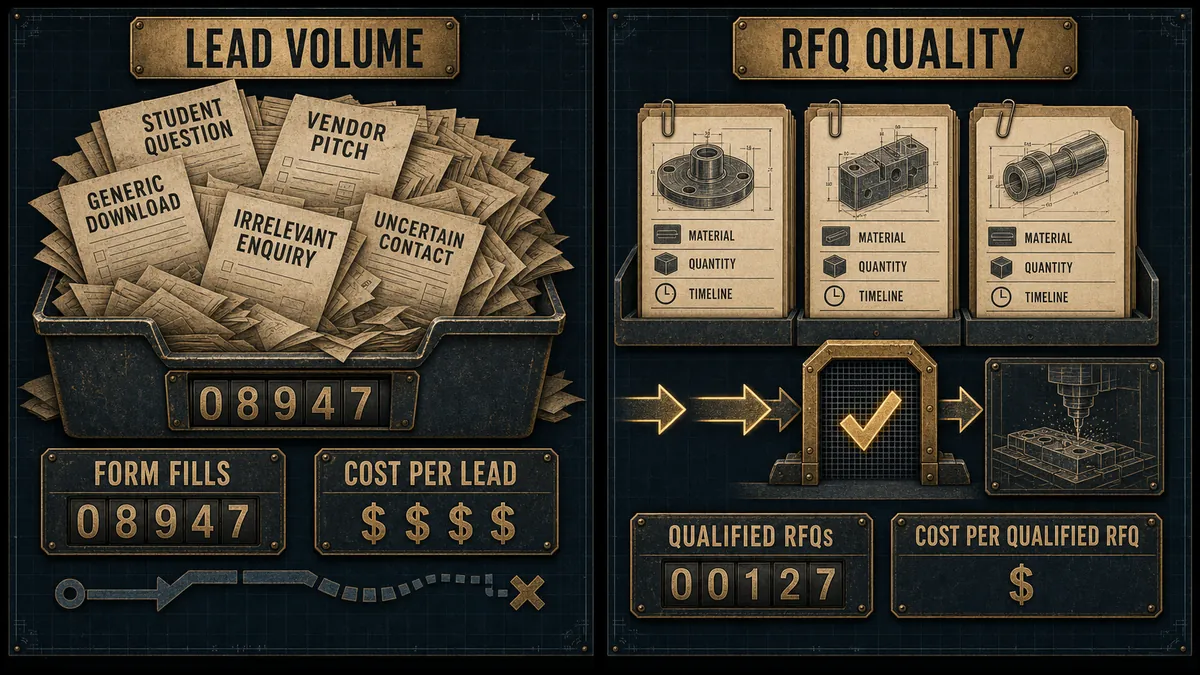
The table below is the difference in one view. Check your current program against the right-hand column.
| Dimension | Lead-volume mindset | RFQ-quality mindset |
|---|---|---|
| Goal | More form fills | Qualified quote requests |
| Target buyer | Anyone who converts | A buyer who can purchase your parts |
| Success metric | Cost per lead | Cost per qualified RFQ |
| The form | A short “contact us” box | Qualifying fields that filter |
| What you optimize | Traffic and clicks | Pipeline and won quotes |
The Manufacturer Lead-Channel Map
The Manufacturer Lead-Channel Map is a decision tool for choosing where to spend your lead-generation effort, channel by channel, based on the lead quality each one tends to produce and the conditions where it pays off. It is a planning grid, not a ranking.
There is no single best channel for every shop. There is the right channel for your stage, your margins, and how fast you need quotes. Read each row as a decision: use the channel when the left-hand conditions match your shop, and deprioritize it when the right-hand conditions do.
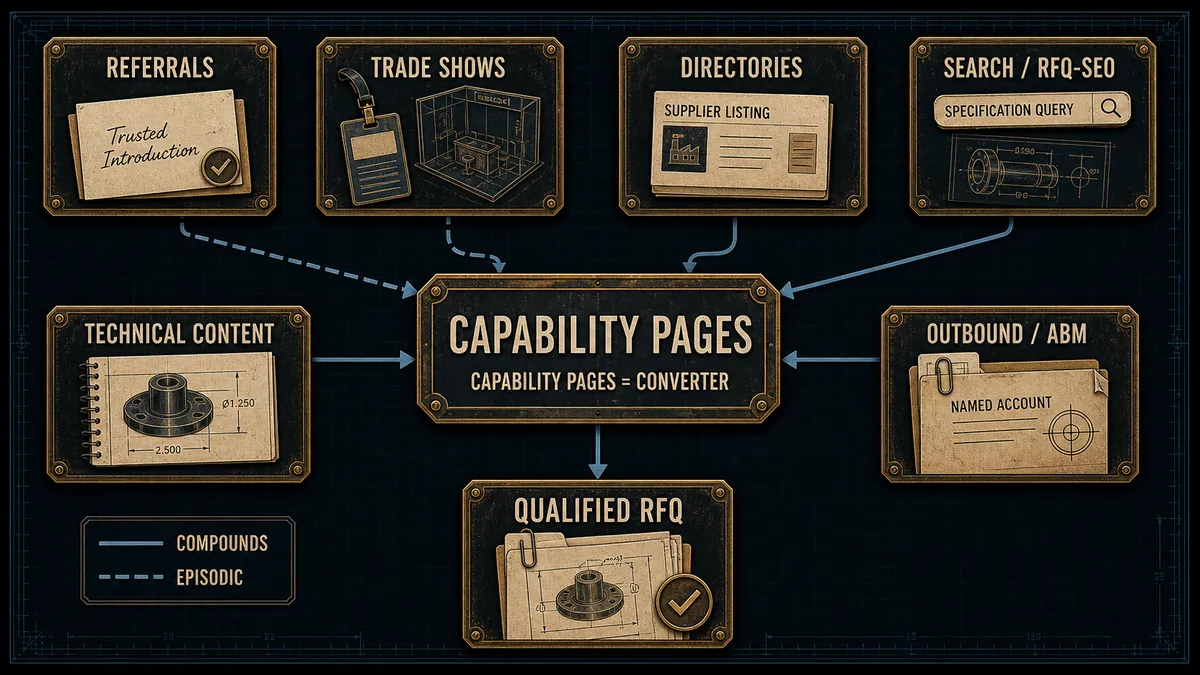
One caution before you read it. The lead-quality and time-to-first-RFQ columns are operator heuristics, not measured benchmarks. They reflect how these channels tend to behave for a small-to-mid manufacturer, and your own numbers will move with your niche, your margins, and your follow-up.
| Channel | Lead quality (heuristic) | Use this channel when… | Avoid or deprioritize when… | Time to first RFQ |
|---|---|---|---|---|
| Referrals & repeat orders | High: pre-trusted by a peer | You deliver well and ask for them on purpose | You need predictable, forecastable volume | Days to weeks, when they come |
| Trade shows & events | Medium: intent varies by attendee | You sell to a vertical with its own show, or are launching a line | You need cost-efficient, trackable pipeline | Weeks, on post-show follow-up |
| Industrial directories | Medium to high: active sourcing intent you rent | You need visibility this quarter and buyers source there | It becomes your only channel, or leads include too many competitors | Days to weeks |
| Search & RFQ-SEO | High: the buyer searched a specific spec | You have technical depth and can wait for the ramp | You need quotes this week and have no content | Three to six months, then compounding |
| Capability pages | High: converts the intent other channels send | Always; this is the engine every channel funnels into | Never skip it; weak pages leak every other channel | Weeks to months, as traffic lands |
| Technical content | Medium: educates earlier-stage buyers | You want authority and links that feed search | You need immediate quotes more than long-term trust | Months to quarters |
| Outbound email & ABM | Medium: you pick the account, but it is cold | You have a defined ICP and capacity to follow up | You have no clear ICP or no time to chase replies | Weeks, at a low hit rate |
PRO TIP
Pick two channels, not seven. A shop that runs search plus directories well will beat one that dabbles in all seven. Master one inbound channel and one outbound channel before you add a third. Which two you pick is really a budget question, and the same discipline scales up to the full marketing mix in our guide to where the whole marketing budget should go first.
Why trade shows and referrals stop scaling
Trade shows and referrals are the channels most manufacturers start with, and they share one limit: you cannot turn them up on demand. They are worth running, but they are not a plan you can forecast. That distinction matters upstream, because S&OP needs a consensus demand plan, not a collection of volatile channel anecdotes, before operations can commit capacity.
Referrals are the highest-quality leads you will ever get, because a peer already vouched for you. The catch is timing and volume. You do not control when a referral arrives, so a shop that depends on them rides a pipeline that rises and falls with other people’s decisions. Use referrals as the bonus on top of a system, and ask for them on purpose after every good job, but do not build your year on them.
Trade shows buy you relationships and a few days of real conversations, which is genuine value. They are also expensive per lead, and the intent of the person scanning your badge ranges from a serious buyer to a competitor collecting brochures. A booth can cost more than a year of search work and still depend on who happens to walk the aisle. Run shows where your specific vertical gathers, work the follow-up hard, and measure what they actually produce.
Neither channel is wrong. The mistake is treating them as the whole plan. The channels in the rest of this map are what give you a pipeline you can predict.
Search and RFQ-SEO: the compounding lead channel
Search and RFQ-SEO is the channel that earns leads from buyers actively looking for a process, material, tolerance, or certification you can deliver. It is the closest thing manufacturing lead generation has to an asset that keeps paying after you build it.
A buyer searching “316 stainless passivation to ASTM A967” is not browsing; they are qualifying a supplier against a real spec. Rank for that query with a page that answers it, and you have earned a place on the shortlist before a competitor knew the buyer existed. That is why search pays back twice: once when it ranks, and again every month after, with no new spend. Long-tail process and material terms convert far better than head terms like “industrial lead generation,” even though the head terms look bigger in a keyword tool.
Search is also the channel most worth handing to a specialist if you cannot staff it, because the technical setup compounds over time. Our approach to manufacturing SEO and AI-search visibility treats the qualified RFQ as the only metric that counts, which is the standard any search work should be held to. If you do bring in outside help, vet it hard: our guide to the criteria and red flags that separate real industrial specialists from generalists is built for exactly that call.
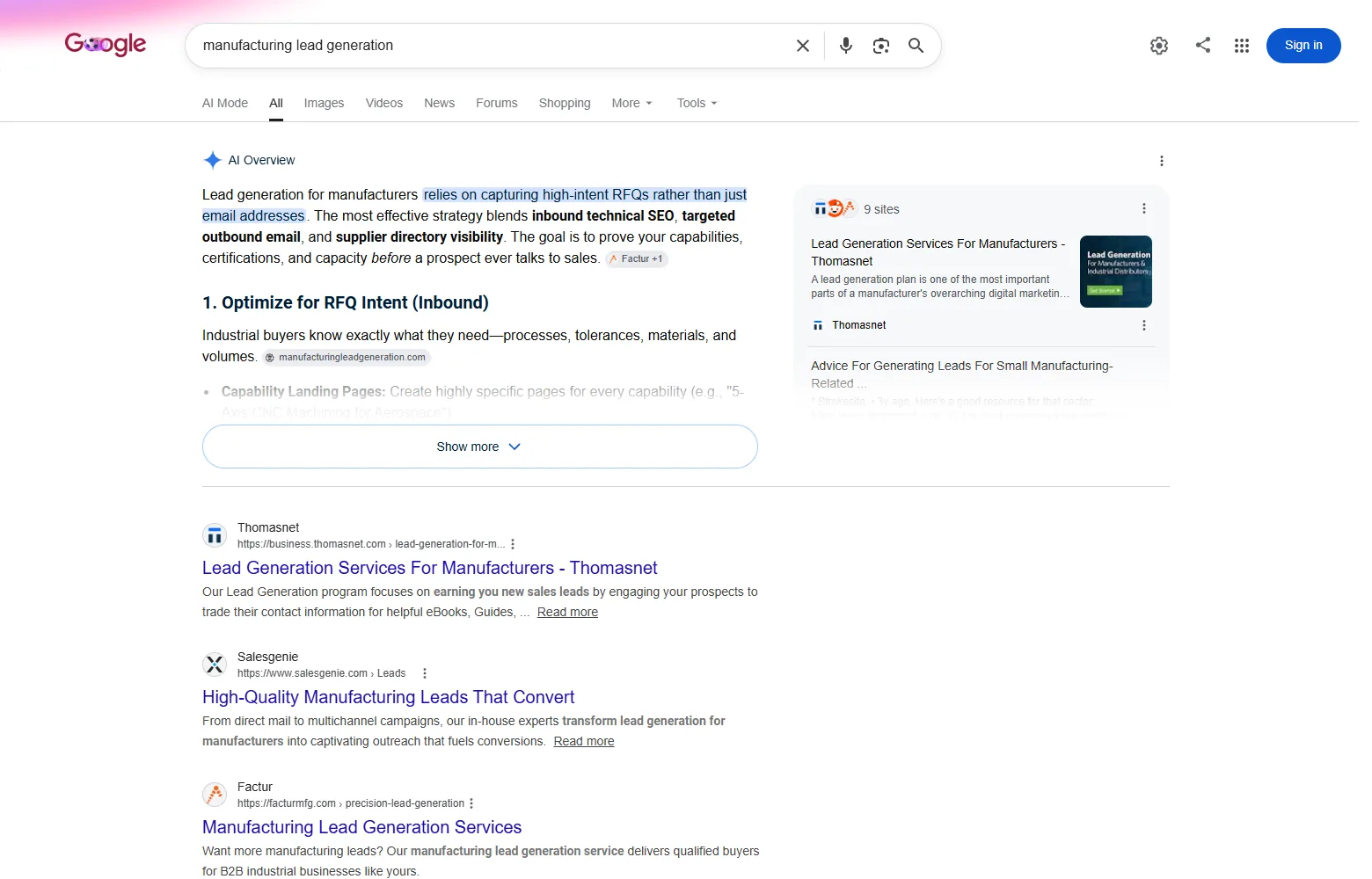
Search now includes the AI answer, and that matters more every quarter. A query like “manufacturing lead generation” returns a Google AI Overview that answers above the blue links and cites a handful of suppliers and sources. Structure your pages with clean definitions, real specs, and direct answers, and you can be the cited source rather than just another link. An AI engine recommending your shop for “ISO 9001 certified aluminum die casting” is worth more than a thousand stray visits.
Capability pages: where every channel converts into an RFQ
Capability pages are the product pages of a manufacturing site: each one states a process, the materials and tolerances you hold, the volumes you run, and the certifications behind them, so a buyer can qualify you in under a minute. They are where a visit becomes a quote request. What turns that request into a priced answer is the engine behind it, whether a job-shop quoting tool or a full configure-price-quote system for manufacturers.
This is the highest-impact channel because it multiplies the others. Directory traffic, search traffic, and a cold email all end on a page, and if that page reads like a brochure, the RFQ never comes. In a March 2025 study of 100 US B2B buyers across industries including industrial manufacturing, Spryker and Statista found 95% of buyers say self-service access improves their efficiency. A page that hides specs behind a “contact us” wall fails the first test a buyer runs.
Capability pages also decide which blog posts are worth writing, because technical content should point back to a page that converts, not to a dead end. Our take on capability-first content for manufacturers sequences which pages to build before you write a single blog post, so the lead-gen work compounds instead of scattering.
IMPORTANT
Do not gate your specs. Lead times, tolerances, and certifications behind a form or a PDF wall cost you the exact RFQ you wanted. A buyer who cannot qualify you in 60 seconds moves to the shop that let them. If line-side replenishment is part of the offer, spell out the VMI model just as clearly, including who triggers the order, when title transfers, and how shortages are escalated.
Industrial directories: rent versus own your demand
Industrial directories are platforms like Thomasnet and Salesgenie where buyers actively search for suppliers, letting you put your shop in front of sourcing intent you did not have to create. They are the fastest way to be found by a buyer who is sourcing right now.
The intent is real. The Thomas network alone lists more than 1.3 million registered industrial buyers, and Thomas reports that 93% of Fortune 1000 companies source suppliers there. For a shop that is invisible in search today, a directory profile is a way to show up in front of that demand within weeks.
The catch is that you rent it. A directory profile works while you pay, and the moment you stop, the visibility stops with it, which is the opposite of how search and capability pages compound into something you own. Directory leads also tend to arrive mixed: real buyers alongside competitors and tire-kickers, so the cost per qualified RFQ matters more here than the raw lead count.
Use directories to get found this quarter while your owned channels mature, and treat them as a complement to search, not a substitute. The goal is to graduate from renting demand to owning it.
Outbound email and ABM: targeting your ideal accounts
Outbound email and account-based marketing flip the model: instead of waiting to be found, you pick the accounts you want and reach the procurement, engineering, and operations contacts inside them. It is the only channel where you choose the buyer.
That control makes outbound powerful for a shop with a clear ideal customer profile and a few dozen dream accounts. It is also the channel with the lowest hit rate. Instantly’s 2026 cold-email benchmark, drawn from a year of campaigns across thousands of workspaces, put the average B2B reply rate at 3.43%. That number is fine when each account is worth five or six figures, and brutal when you are spraying a bought list.
The work is in the targeting, not the sending. Define your ICP by the parts and programs you win most, build a tight list with a tool like LinkedIn Sales Navigator, enrich it with a service like Clay or Hunter, and send a short, specific message about the exact part or program you can help with. The win is a booked conversation with a real account, not an open rate.
The best outbound email reads like it came from an engineer who studied the buyer’s part, not from a marketer who bought their email.
Turn lead generation into qualified RFQs
Every channel above ends at the same place: a request-for-quote form and the speed of your follow-up. This is where lead generation either pays off or leaks, and it is the cheapest thing on this page to fix. Most of that fix is which fields the form requires and how fast you route the submission, not a bigger ad budget.
A buyer who searched a precise query and read a precise page, then hit a vague “Contact us” box, will often leave. Design the form to qualify instead: ask for material, quantity or volume, tolerance or spec, target timeline, and a drawing upload. Those fields raise the quality of every enquiry and filter the buyers who will not spend two minutes describing a real job. The discipline of tightening an RFQ form so it filters weak enquiries without losing good buyers is where most of the recoverable revenue sits.
Then measure the outcome, not the activity. The single most useful number in manufacturing lead generation is the cost of producing one qualified quote request, tracked by channel.
Cost per Qualified RFQ = Channel Spend ÷ Qualified RFQsTrack that number by channel, and the map above stops being theory. The channel with the lowest cost per qualified RFQ gets the next dollar; the one with the highest gets fixed or cut. Sessions and open rates do not pay your shop floor; qualified quotes do.
Then move fast. A quote request that sits in an inbox overnight is one a competitor is already answering. Route every RFQ to a person, not a folder, and reply the same day, because speed of response is the part of lead generation that costs nothing and wins the most.
How to choose your first two channels
To choose your first two lead-generation channels, match your shop’s stage and constraints to the conditions in the map, then start with one inbound channel that compounds and one channel that produces quotes now. Two channels run well beat seven run badly.
- Start with search and capability pages when you have technical depth and the patience for a three-to-six-month ramp. This is the compounding core, and it improves every other channel you add later.
- Add industrial directories when you need quotes this quarter and your buyers already source on platforms like Thomasnet. They buy you visibility while the owned channels mature.
- Add outbound email and ABM when you have a defined ICP, high-value accounts, and the sales capacity to follow up within a day.
- Avoid running more than two new channels at once. A half-built channel produces half-qualified leads, and you will not know which one to trust.
Whichever two you pick, the order is the same: fix the capability pages first, because every channel converts through them, then turn on the traffic. Lead generation for manufacturing companies fails most often not for lack of leads, but because the page that was supposed to convert them could not answer the buyer’s first question.
Frequently Asked Questions
Lead generation in the manufacturing industry is the process of attracting industrial buyers and converting them into qualified quote requests through channels like search, capability pages, industrial directories, technical content, and outbound email. The aim is a buyer who can purchase your parts, measured in qualified RFQs rather than raw lead counts.
Costs vary widely by channel and niche, so judge it by cost per qualified RFQ rather than a flat price. Search and capability pages cost time up front and then compound; directories and outbound cost monthly fees or list spend. Track spend against qualified quotes, not raw leads, and shift budget to the channel producing the cheapest real RFQs.
The four “Ls” of lead generation are lead capture, lead magnets, landing pages, and lead scoring. For a manufacturer, that maps to a qualifying RFQ form, a useful technical asset like a spec sheet, a capability page that converts, and a way to rank enquiries so your team works the real buyers first.
ChatGPT can draft outreach, suggest keywords, and speed up research, but it cannot supply your real tolerances, certifications, or lead times, and those first-party facts are what make a manufacturer findable and citable. Use it to accelerate the work, and rely on your engineers for the specifications that win the quote.
There is no single best channel; there is the right one for your stage. Most small manufacturers get the strongest return from search and capability pages, which compound, paired with industrial directories for quotes this quarter. Outbound email and ABM suit shops with a defined ideal customer profile and the capacity to follow up fast.
If you want a clear read on where your current site is losing quotes, request a free manufacturer website investigation and we will show you which pages leak RFQs and which channel to fix first.
