
Searchers often type “s and op,” but the acronym is S&OP: sales and operations planning. The name sounds like a meeting. In practice, it is the monthly management cycle that decides which demand the factory will serve, which constraints it will accept, and which plan every function will use.
The failure S&OP is meant to stop is painfully familiar. Sales forecasts high to protect opportunity. Operations plans low to protect delivery. Finance discounts both and carries a third number. The meeting that should resolve the conflict becomes a status update, and the factory leaves with three plans instead of one.
Direct answer — What is S&OP?
S&OP, or sales and operations planning, is a recurring cross-functional process that balances expected demand with material, labor, equipment, inventory, and financial constraints. A five-step monthly cycle moves through product review, demand review, supply review, pre-S&OP reconciliation, and executive approval. Its output is one feasible consensus plan. Integrated business planning, or IBP, extends that discipline further into enterprise strategy and financial planning.
Key Takeaways
- S&OP is a decision process, not a forecasting meeting or a software category.
- The five-step monthly cycle converts separate functional plans into one approved demand-and-supply plan.
- Demand planning asks what the market is likely to buy; supply planning asks what the network can profitably deliver.
- A useful executive meeting approves choices, owners, and thresholds. It does not reopen every spreadsheet.
- IBP is the broader model: S&OP plus deeper financial integration, strategy, and enterprise-wide trade-offs.
What Is S&OP in Supply Chain?
S&OP in supply chain management is the recurring executive process that reconciles a consensus demand plan with available supply and approves one feasible plan for the business. It sits between annual strategy and detailed execution, where aggregate choices about product families, capacity, inventory, and service become operating commitments.
The ASCM/APICS definition describes S&OP as bringing sales, marketing, development, manufacturing, sourcing, and financial plans into one integrated set. That wording matters: S&OP is not owned by supply chain alone, even when a supply-chain leader coordinates the calendar.
| Planning layer | Main question | Typical horizon | Primary output |
|---|---|---|---|
| Forecast | What demand is likely? | Near to medium term | Unconstrained demand estimate |
| S&OP | What demand will we serve with available resources? | Rolling tactical horizon | Feasible consensus plan |
| S&OE | How do we handle short-term deviations? | Days to weeks | Execution response |
| IBP | How do operational choices support strategy and financial goals? | Tactical to strategic | Enterprise business plan |
Most manufacturers run S&OP at product-family level rather than SKU level. Oracle places the process in master planning and describes an 18-to-36-month planning horizon. Detailed orders, work centers, and purchase lines belong downstream in master scheduling, MRP, procurement, and shop-floor execution.
Why Manufacturers Need One Consensus Plan
Manufacturers need S&OP because demand moves before capacity, material, and labor can move with it. A forecast can describe the market, but only a cross-functional decision can say which mix to accept, what inventory to build, when to add a shift, or which customer promise must change.
Recent U.S. order data shows why a single extrapolated forecast is fragile. The U.S. Census Bureau reported that durable-goods new orders rose 0.3% in June 2026 after a 4.0% May decline. One month does not define your market, but that reversal is a useful reminder: the plan needs scenarios and decision thresholds, not one confident line on a chart.
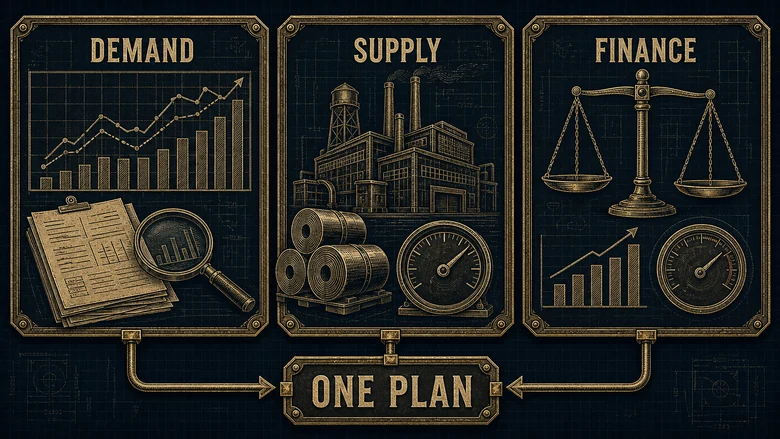
The “one number” principle does not mean one person invents the right forecast. It means sales, operations, finance, and product leaders leave the cycle using the same approved assumptions, volume plan, and financial view. They may keep functional detail, but those details must reconcile to the shared plan.
Inventory often absorbs disagreement first. Sales protects service with extra stock while operations protects utilization with longer runs, and working capital quietly carries the compromise. A disciplined manufacturing inventory management practice can expose that buffer, but S&OP decides whether the buffer is worth funding.
IMPORTANT
A consensus plan is not the average of the sales number and the operations number. It is an explicit choice between scenarios, with the commercial, service, capacity, inventory, and cash consequences visible before approval.
The Five-Step S&OP Process
The S&OP process is a five-step monthly sequence: product review, demand review, supply review, pre-S&OP reconciliation, and executive S&OP. SAP describes a closely aligned flow from preparation through demand, supply, reconciliation, and final release in its current S&OP overview. The labels vary, but the decisions should not.
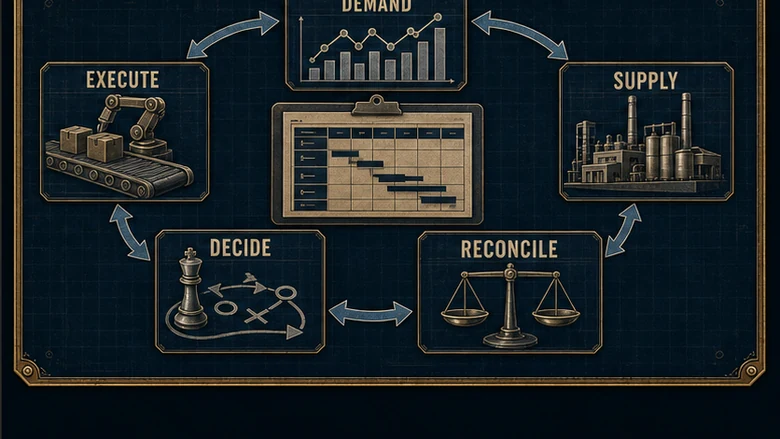
| Step | Who owns it | Input | Output | Typical failure |
|---|---|---|---|---|
| 1. Product review | Product or commercial leader | Launches, phase-outs, engineering changes, portfolio assumptions | Agreed portfolio and timing changes | Obsolete items remain in the baseline |
| 2. Demand review | Sales or demand-planning leader | History, orders, pipeline, promotions, market intelligence | Consensus unconstrained demand plan | Targets are presented as forecasts |
| 3. Supply review | Operations or supply-planning leader | Capacity, labor, materials, inventory, supplier constraints | Feasible supply scenarios and gaps | Constraints are hidden until the executive meeting |
| 4. Pre-S&OP | S&OP process owner and finance | Demand-supply gaps, scenarios, financial effects | Recommendation and unresolved decisions | The team escalates data disputes instead of choices |
| 5. Executive S&OP | General manager, president, or COO | Decision packet with scenarios and trade-offs | Approved plan, owners, thresholds, and escalations | Executives review slides but approve nothing |
1. Product Review Sets the Planning Perimeter
Product review decides what belongs in the plan. The owner confirms launches, end-of-life dates, engineering changes, substitutions, and product-family definitions before sales forecasts demand for items that operations should not build.
The output is a dated portfolio assumption set. If a launch slips or a phase-out accelerates, the change must flow into demand, material exposure, inventory disposition, and revenue. Otherwise every later review starts from a different product universe.
2. Demand Review Builds an Unconstrained View
Demand review builds the best evidence-based view of what customers are likely to request, before capacity is allowed to suppress it. The demand owner combines order history, open orders, qualified pipeline, promotions, customer intelligence, losses, and known events, then records assumptions separately from management targets.
Sales owns customer intelligence, but it should not own the final number alone. Marketing demand, distributor signals, and direct RFQs have different conversion patterns. The review should expose the range and the reasons for overrides, not hide uncertainty inside a single cell.
3. Supply Review Tests Feasibility
Supply review tests whether plants, suppliers, people, and inventory can meet the unconstrained demand plan. Operations identifies bottlenecks by product family, models overtime or subcontracting, checks critical materials, and quantifies the service and cost effect of each response.
Supplier decisions belong in this review when lead time or risk constrains the plan. A consistent strategic sourcing and supplier-selection method improves the options presented, while vendor-managed inventory may shift replenishment responsibility without removing the need to agree on demand assumptions.
4. Pre-S&OP Reconciles the Choices
Pre-S&OP converts gaps into choices an executive can decide. Finance checks revenue, margin, cash, and inventory effects; the process owner confirms that every scenario uses the same baseline; functional leaders resolve what they can and escalate only decisions outside their authority.
A useful packet is short because the work happened earlier. It shows the baseline, the material exceptions, two or three scenarios, a recommendation, and the consequence of waiting. Approved sourcing decisions then move into the procure-to-pay process; S&OP should not become a substitute for execution control.
5. Executive S&OP Approves One Plan
Executive S&OP approves the plan and authorizes trade-offs. The general manager, president, or COO should decide capacity changes, inventory exposure, service exceptions, major supplier actions, and demand-shaping moves that functional teams cannot settle.
The meeting output is not “alignment” as a vague feeling. It is a version-controlled plan, a decision log, named owners, due dates, and thresholds that trigger an out-of-cycle escalation. If no decision changed and no assumption was challenged, the meeting was probably a presentation.
Demand Planning vs Supply Planning
Demand planning estimates what customers are likely to buy, while supply planning determines what the manufacturing network can deliver under real constraints. S&OP preserves both views long enough to expose the gap, then reconciles them through scenarios and executive decisions.
| Dimension | Demand planning | Supply planning |
|---|---|---|
| Starting point | Orders, history, pipeline, customer and market signals | Inventory, capacity, labor, materials, suppliers, lead times |
| First question | What is likely to be requested? | What can be fulfilled, when, and at what cost? |
| Primary owner | Demand planning with sales and marketing | Operations or supply planning with procurement |
| Uncertainty | Forecast error, mix, timing, conversion | Yield, uptime, labor, supplier and transport constraints |
| Output to S&OP | Consensus unconstrained demand plan | Feasible scenarios, gaps, and constraint costs |
Keep the layers distinct after approval. S&OP decides aggregate volume and trade-offs; master scheduling and MRP translate that plan into dated requirements. The boundary between those systems is easier to see in our MRP versus ERP explanation, where planning logic and the system of record do different jobs.
Software should improve version control, scenario speed, and visibility, but it cannot decide which assumption deserves trust. Start with the process and data definitions. Then use your manufacturing inventory software, ERP, CRM, and planning tools as connected evidence sources rather than competing forecast owners.
When S&OP Is Worth It
S&OP is worth the effort when demand, product mix, lead times, or capacity create trade-offs that one functional forecast cannot resolve. A simple forecast is enough when the operation is small, stable, visible to one decision-maker, and corrections can be made without cross-functional consequences.
| Use a simple forecast when | Use a formal S&OP cycle when |
|---|---|
| One site and a narrow, stable product mix | Several product families, sites, channels, or regions |
| Short replenishment and production lead times | Long material or capacity commitments |
| One leader can see demand and constraints directly | Sales, operations, procurement, and finance hold different inputs |
| Inventory and backlog stay within agreed limits | Service, inventory, margin, or backlog repeatedly miss plan |
| Exceptions are cheap and reversible | Choices require hiring, overtime, tooling, supplier, or capital decisions |
What a Good S&OP Meeting Produces
A good S&OP meeting produces decisions that change how the business will act. The minimum output is:
- One approved demand plan by product family and period.
- One feasible supply response with visible constraints.
- Approved inventory, backlog, service, revenue, and margin expectations.
- Named actions for demand shaping, capacity, suppliers, or product changes.
- Decision owners and due dates.
- Thresholds that trigger escalation before the next cycle.
PRO TIP
Set tolerance bands before the cycle begins. A small forecast change may stay with the planner; a service, margin, or capacity breach above the agreed threshold should force an explicit decision. This keeps the executive meeting focused on exceptions.
How to Run Your First S&OP Cycle
To run a first S&OP cycle, define ownership and product families before asking teams for forecasts. Use one data cut, force demand and supply assumptions to reconcile, and reserve the executive meeting for choices that require authority.
Workflow · 30-day cycle
How to run your first S&OP cycle
A six-step launch sequence that turns functional forecasts into one approved plan without buying new software first.
Name the sponsor and process owner
Assign one executive who can approve trade-offs and one coordinator who owns the calendar, data cut, packet, and decision log.
Define families, horizon, and measures
Group products around shared demand and resources. Set the periods and the service, inventory, capacity, revenue, and margin measures every scenario must show.
Freeze one baseline data cut
Reconcile item, customer, and calendar definitions before review meetings. Record known data gaps instead of allowing each function to repair the baseline privately.
Run product and demand reviews
Confirm portfolio changes, build the unconstrained demand view, document overrides, and separate the expected case from the commercial target.
Test supply and reconcile scenarios
Model the constrained base case and credible alternatives. Finance checks each option on the same assumptions before the process owner writes the recommendation.
Approve, publish, and track decisions
Ask executives to choose, assign owners, and set escalation thresholds. Publish the approved version and compare actuals with plan at the next cycle.
Do not begin by buying S&OP software. A spreadsheet can prove the meeting cadence and expose data ownership for an initial cycle. Once version conflict, scenario speed, or network complexity becomes the bottleneck, evaluate planning tools against the process you have already made visible.
S&OP Maturity, Software, and IBP
S&OP maturity is the progression from disconnected functional forecasts to a decision-led planning system with shared data, scenarios, financial consequences, and measured adherence. Software can support each level, but governance and decision rights determine whether the cycle changes behavior.
| Level | Operating pattern | Main improvement to make next |
|---|---|---|
| 1. Reactive | Sales, operations, and finance keep separate numbers; shortages drive meetings | Create one calendar, baseline, and owner |
| 2. Coordinated | Monthly reviews occur, but reconciliation is manual and decisions are weak | Define family-level measures, scenarios, and authority |
| 3. Integrated | Demand, supply, inventory, and finance reconcile to one approved plan | Measure plan adherence and automate exception analysis |
| 4. Decision-led | Scenarios are fast, thresholds are explicit, and strategy shapes the cycle | Extend the model into enterprise IBP where useful |
What S&OP Software Should Actually Do
S&OP software should create one version of the baseline, preserve assumptions, support family-level scenarios, show financial and service effects, manage approvals, and connect decisions to execution. It should not merely display a more attractive forecast.
Your ERP remains the transaction backbone, and specialized planning software may sit above it. Smaller firms can first test whether an ERP suited to a small manufacturer gives them clean inventory, order, BOM, and capacity inputs. Buy a dedicated planning layer only when the decision process, data governance, and owner already exist.
IBP vs S&OP
IBP extends S&OP by connecting operational plans more deeply to enterprise strategy, financial forecasts, capital choices, and cross-business objectives. SAP describes S&OP as part of the broader IBP approach in its IBP comparison. The distinction is scope, not a mandatory software upgrade or a new meeting name.
| Dimension | S&OP | IBP |
|---|---|---|
| Center of gravity | Balance demand and supply | Align strategy, operations, and financial plans |
| Core decisions | Mix, capacity, inventory, service, sourcing | Those decisions plus portfolio, investment, and enterprise priorities |
| Financial integration | Tests plan feasibility and impact | Uses finance as a continuous planning dimension |
| Best next step | Make one monthly plan reliable | Broaden a reliable S&OP process where strategy needs it |
Do not rename a weak S&OP meeting “IBP” and expect maturity to appear. First make the monthly cycle produce one approved, feasible plan. Broaden the scope only when leaders can use the added financial and strategic detail to make better decisions.
Frequently Asked Questions
S&OP is sales and operations planning, a recurring process that aligns expected demand with supply, capacity, inventory, and financial constraints. Product, demand, and supply reviews feed a reconciliation step, then executives approve one feasible plan. It is a management decision cycle, not simply a forecast or software dashboard.
The S&OP process usually follows five steps: product review, demand review, supply review, pre-S&OP reconciliation, and executive S&OP. Each step has an owner, a defined input, and a decision-ready output. The cycle ends with one approved plan, named actions, and thresholds for escalating exceptions.
S&OP centers on balancing demand and supply through a feasible tactical plan. IBP extends that discipline into deeper financial planning, strategy, capital allocation, and enterprise-wide objectives. A manufacturer should first make S&OP reliable, then broaden it into IBP when the added scope will improve real decisions.
An executive such as the president, general manager, or COO should sponsor S&OP because only that role can approve cross-functional trade-offs. A supply-chain or planning leader often owns the process calendar and packet. Sales, operations, finance, product, and procurement remain accountable for their inputs and actions.
S&OP is commonly run as a monthly cycle because product, demand, supply, finance, and executive reviews need time to build on one another. Short-term exceptions should not wait for that meeting; they belong in weekly or daily execution control, often called S&OE, with thresholds for escalation.
