
Ask five manufacturers for the best MES software and you get five answers, because the question is missing its second half. A manufacturing execution system that runs a high-volume automotive line will smother a custom job shop in screens it never needs, and the platform a regulated medical device plant relies on for electronic batch records is wasted on a metal fabricator that just wants live machine data.
So this guide does not crown one winner. It shortlists nine manufacturing execution systems by the thing that actually decides fit: the environment you build in. We grouped them by discrete, process and batch, regulated life sciences, and complex industrial production, verified every published price against the vendor’s own page in June 2026, and labeled the rest quote-based rather than guessing.
MES is a heavily gated market, so expect a sales call before a number on most of this list. Find your environment, read the three or four systems that fit it, and skip the rest.
Direct answer — What is the best MES software?
There is no single best MES software; the right manufacturing execution system follows your production environment and regulatory load. Discrete and mixed shops fit Tulip, Siemens Opcenter, Rockwell Plex, or Critical Manufacturing. Medical device and pharma makers fit MasterControl or Tulip. Aerospace, defense, and complex industrial equipment fit iBASEt or 42Q. Most MES pricing is quote-based as of June 2026; Tulip is the main vendor that publishes a rate, from $100 per interface per month.
Key Takeaways
- There is no universal best MES software. The right system follows your production environment and how heavily you are regulated.
- Most MES pricing is quote-based as of June 2026. Tulip is the main vendor that publishes a rate, from $100 per interface per month; treat every other figure as a sales conversation.
- Discrete and mixed-discrete shops have the most choice: Tulip for no-code speed, Siemens Opcenter and Rockwell Plex for depth, Critical Manufacturing for high-mix electronics.
- Regulated makers should shortlist on compliance first. MasterControl and Tulip build electronic batch records and 21 CFR Part 11 controls in; iBASEt and 42Q carry the genealogy aerospace and defense demand.
- The license is the small number. Budget implementation, integration, validation, and training before you sign, because together they usually cost more than the software.
Methodology
How this comparison was conducted
- Scope
- 9 MES platforms scored by manufacturing environment and regulatory fit, selected from a wider field of systems marketed to mid-market manufacturers. Inclusion required a real manufacturing execution suite with enough public product detail to assess. Enterprise-only suites aimed at very large multinationals were named where relevant but not scored.
- Sources reviewed
- Official vendor product and pricing pages; G2, Capterra, and Gartner Peer Insights review aggregates; Gartner MES Market Guide and IDC MarketScape recognition; and ABI Research vendor rankings.
- Date range
- Pricing, positioning, and ratings were verified against official sources in June 2026. Figures change; check the vendor page before you buy.
- Tools used
- A manufacturing-environment and regulatory-fit rubric, scoring each system on best-fit environment, core MES capability (real-time data, traceability and genealogy, quality and SPC, scheduling, work instructions), compliance depth (21 CFR Part 11, EBR, DHR where relevant), deployment, pricing transparency, and verified user and analyst ratings.
- Limitations
- This is a documentary comparison, not a hands-on deployment. No system was implemented or tested first-hand. MES pricing is heavily gated, so most figures here are quote-based and will vary by configuration, site or interface count, and negotiation. Some enterprise vendors have thin public-review samples, so analyst recognition is weighed where star counts are unreliable. Ratings reflect a moment in time.
- Editorial independence
- No vendor paid for placement, ranking, or coverage, and no rankings were shared with any vendor before publication. Our full editorial policy explains how we keep scored guides independent.
- Conflicts of interest
- Factory Investigator sells manufacturer website and SEO services, not MES software. None of the systems reviewed were Factory Investigator clients at the time of writing.
What is MES (manufacturing execution system) software?
MES (manufacturing execution system) software is the layer that runs and records production on the shop floor in real time. It collects machine and operator data, enforces work instructions and routings, tracks work in process, manages quality checks, and builds a traceable genealogy of every unit, sitting between your ERP planning system and the equipment on the line. If humanoid robots in production move beyond pilots, this record layer becomes more important, not less, because flexible robots still need clean task, quality, exception, and completion data. The Agility Robotics SPAC makes that handoff test concrete for Digit-style material movement near production work.
That position, one level above the machines and one level below the business system, is what separates MES from the systems people confuse it with. The table below places it next to ERP and MRP so you can see which job each one does.
| System | What it is | Layer it runs at | Primary job | When you need it |
|---|---|---|---|---|
| MES | Shop-floor execution and record | Real time (seconds to minutes) | Run, monitor, and trace actual production | You need live production visibility, quality, traceability, and OEE |
| ERP | Business-wide planning system | Business speed (hours to days) | Plan and coordinate finance, orders, inventory, and purchasing | You want the whole company on one system of record |
| MRP | Material and production planning | Demand-driven (daily to weekly) | Calculate what to make and buy, and when | You need materials and capacity ready for orders |
Two more systems sit nearby. MOM (manufacturing operations management) is the wider umbrella that links MES with quality, maintenance, and inventory operations. SCADA controls and monitors equipment signals in real time, at the machine level. So no, MES is not the same as SCADA: SCADA controls the machine, while MES sits a level above it and turns that machine data into work orders, genealogy, and reporting. Schneider and HPE’s 2026 automation-modernization service belongs even lower in that stack, where control infrastructure, hybrid cloud, and lifecycle support decide what MES can reliably consume. Increasingly, some of what it consumes is visual, because a station that reads and grades each part hands the MES a pass or fail to record beside the genealogy. Schneider and HPE’s 2026 automation-modernization service belongs even lower in that stack, where control infrastructure, hybrid cloud, and lifecycle support decide what MES can reliably consume.
What MES software does on the shop floor
Whatever the vendor, a real manufacturing execution system covers a recognizable core set of jobs, mapped to Level 3 of the ISA-95 automation hierarchy. Use this as your capability checklist when you sit through demos. The rise of software-defined automation cells does not remove that MES test; it makes the data handoff from robot cell to production record more important. New domestic Ultra-HDI capacity has a similar traceability test: advanced production claims only matter if work orders, quality checks, genealogy, and release records can support them. The rise of software-defined automation cells does not remove that MES test; it makes the data handoff from robot cell to production record more important.
- Real-time production tracking and OEE: live status of every job, machine, and operator, with availability, performance, and quality rolled into an OEE figure you can act on.
- Work instructions and routings: digital, step-by-step guidance that enforces the right process at each operation and error-proofs the floor.
- Traceability and genealogy: an as-built record linking every unit to its materials, machines, operators, and tests, which is what recalls and audits depend on.
- Quality and SPC: in-line inspections, nonconformance handling, and statistical process control that catch drift before it becomes scrap.
- Scheduling and dispatching: sequencing jobs against real capacity and pushing the next task to the right station as the floor changes.
- Integration up and down: a clean link to ERP for orders and inventory and to machines or SCADA for live data, so the floor and the business share one source of truth.
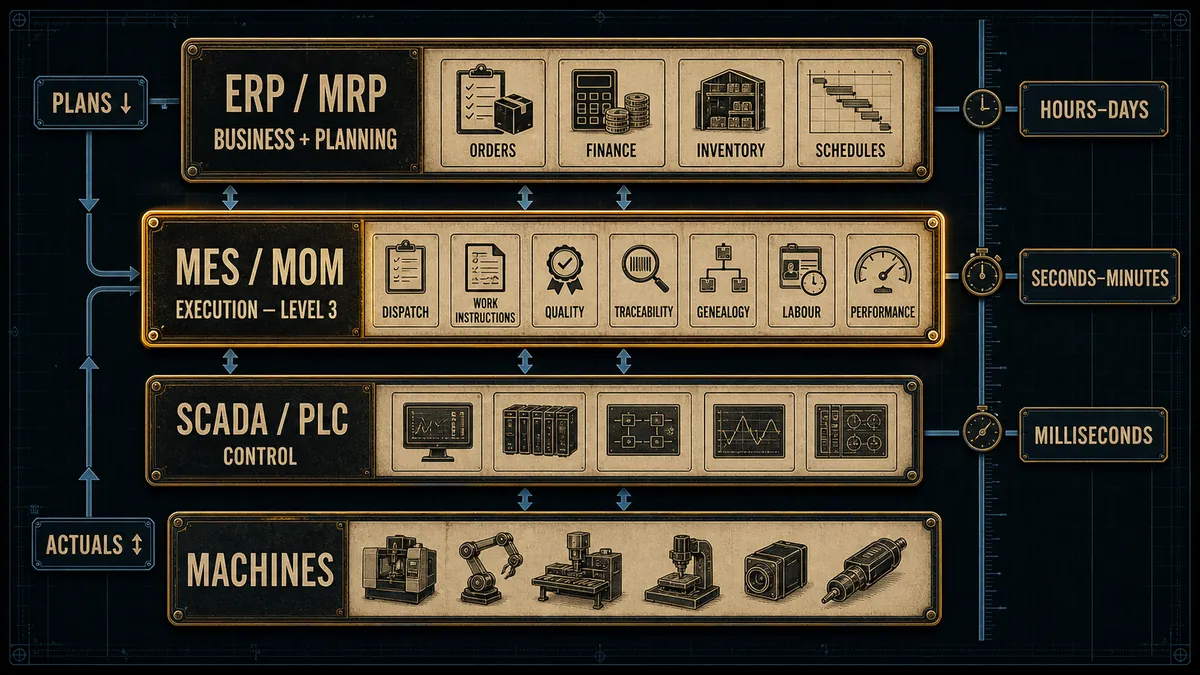
MES vs ERP: where each one runs your factory
MES and ERP are not competitors; they run different layers of the same factory. ERP decides what to make, when, and at what cost, working in hours and days across finance, sales, and inventory. MES makes that plan happen on the floor, working in seconds and minutes to dispatch jobs, capture machine data, enforce quality, and report what actually got built. Maintenance runs on a layer of its own again: an MES records the downtime when a machine stops, but scheduling the repair and the spare parts behind it falls to a CMMS built for maintenance, feeding the same floor from the side. Detailed sequencing is a layer of its own too: MES dispatches jobs against capacity, but for true finite-capacity optimization many shops hand it a plan from dedicated production scheduling software that the ERP was never built to produce.
Most mid-market manufacturers run both and integrate them, so the ERP sends the order down and the MES sends the as-built record back up. If you only have budget for one and you are still flying blind on the floor, MES is what gives you live production control. If your real problem is planning, costing, and finance, that is an ERP project, and the right MES can wait until the planning layer is solid. CAI’s PlanetTogether APS move sits in that planning gap: it does not replace MES, but it can decide which constrained schedule MES is asked to run. And when the gap is really stock accuracy rather than floor visibility, an inventory system solves that for far less than an MES.
Match MES to your manufacturing environment first
Your manufacturing environment is the best predictor of which MES will fit, because the hard problems differ by how you build. A discrete assembler needs work instructions and genealogy; a process plant needs recipe and batch control; a regulated maker needs electronic signatures and audit trails. Match the system to the way your floor actually runs and most of the feature debate answers itself. Before you match a system to your floor, it helps to know exactly where MES ends and its neighbors begin, since MES sits between ERP planning above it and the PLC and SCADA layer below, and much of the feature overlap you will meet is really an ERP or QMS job. Knowing the layers is only half of it; seeing the flow is the other half, because mapping the whole value stream shows where the lead time hides and usually names the constraint a new system actually has to fix.
| Manufacturing environment | What the MES must do well | Systems that tend to fit |
|---|---|---|
| Discrete and mixed-discrete (machining, assembly, fabrication, electronics) | Work instructions, routings, WIP tracking, OEE, machine-data capture | Tulip, Siemens Opcenter, Rockwell Plex, Critical Manufacturing, Epicor Advanced MES |
| Process and batch (chemicals, food and beverage, CPG) | Recipe and batch control, SPC, continuous-data historians | AVEVA, GE Vernova Proficy |
| Medical device, pharma, and life sciences | Electronic batch records, device history records, 21 CFR Part 11, e-signatures | MasterControl, Tulip, Körber PAS-X |
| Aerospace, defense, and complex industrial equipment | As-built genealogy, change management, nonconformance, deep traceability | iBASEt, 42Q |
PRO TIP
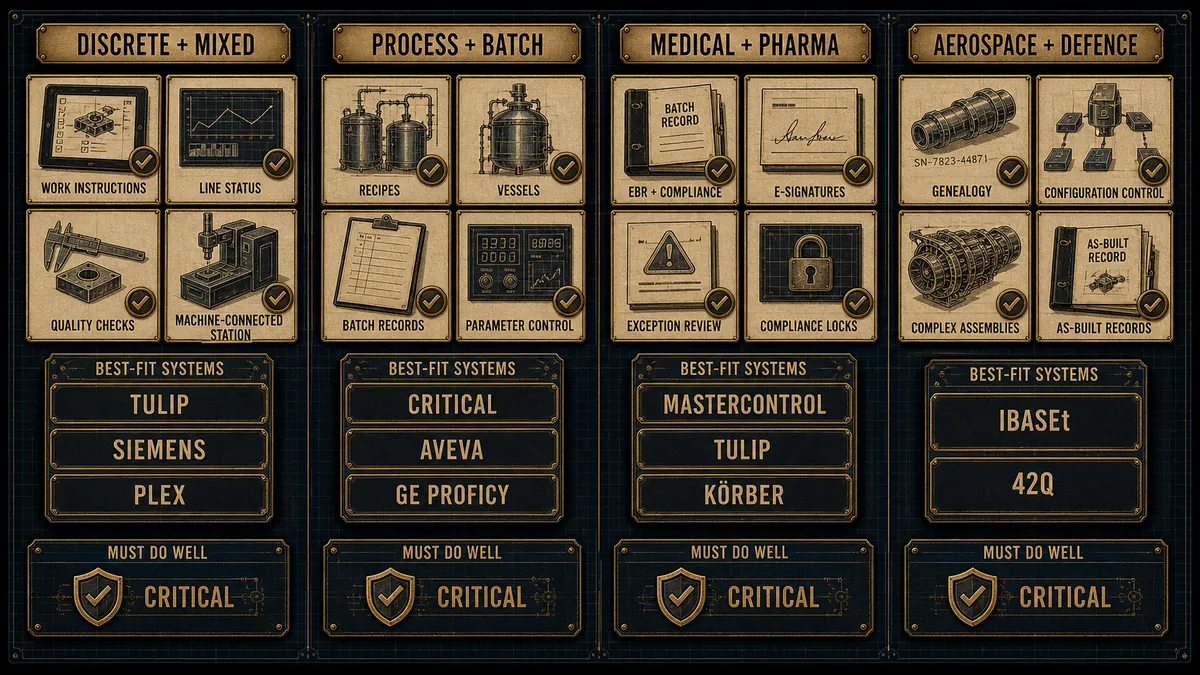
If you run more than one environment, say a discrete line plus a small batch process, shortlist a broad platform like Siemens Opcenter or AVEVA from the start. Bolting batch control onto a pure discrete tool later is harder than growing into a system that already does both.
The best MES software at a glance
The table below is the shortlist in one view: nine manufacturing execution systems, the environment each fits best, deployment, the starting price as verified in June 2026, and the rating. Vendor names link to the official product page; “quote-based” means the vendor does not publish a number and routes you to sales.
| MES software | Best-fit environment | Deployment | Starting price (as of June 2026) | Best for | Rating |
|---|---|---|---|---|---|
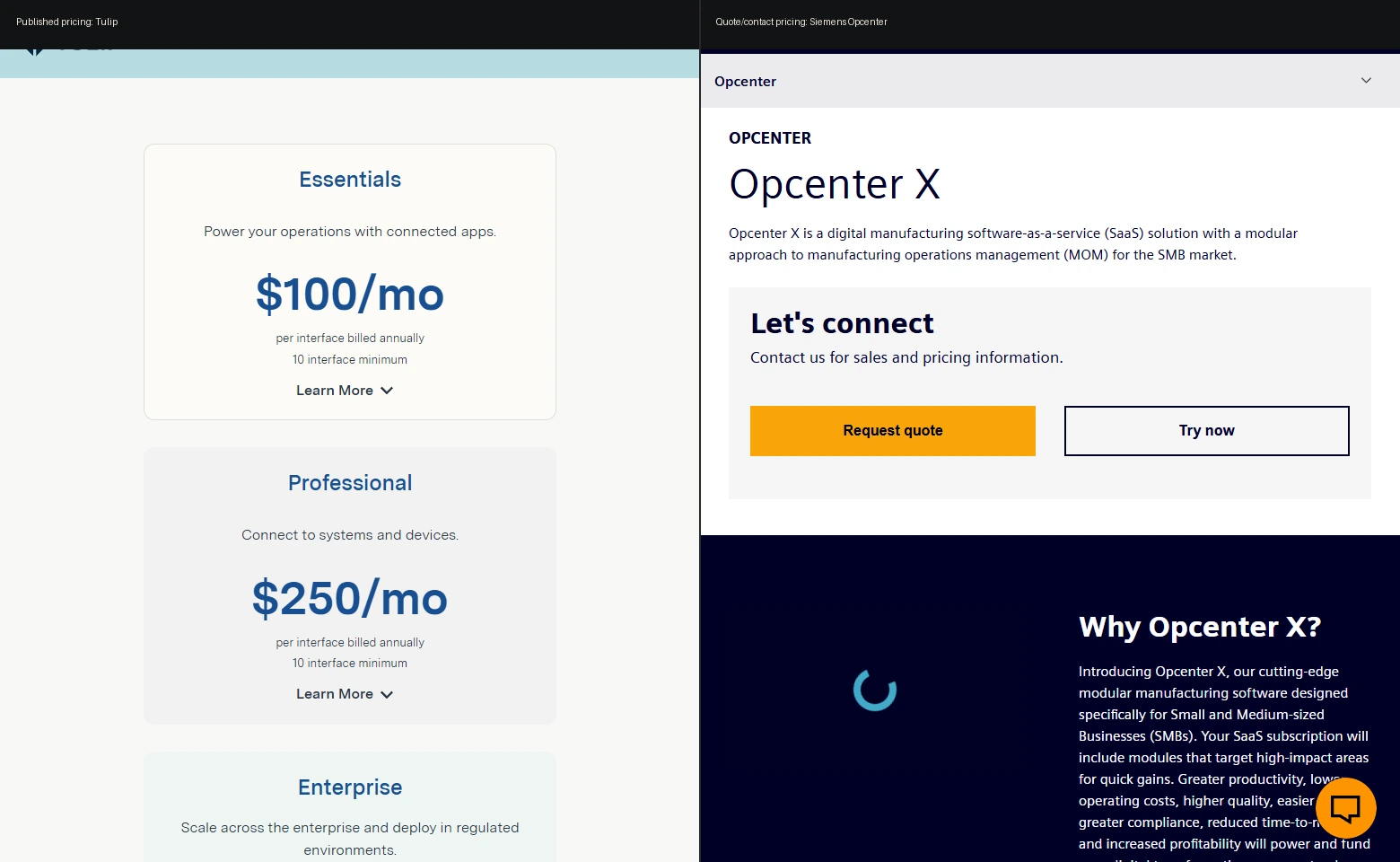
| Tulip | Discrete, regulated | Cloud | From $100/interface/mo (10-interface min) | No-code MES and fast pilots | G2 4.5 |
| Siemens Opcenter | Discrete, process, hybrid | Cloud, on-prem, hybrid | Quote-based | Broad enterprise MOM depth | Gartner 4.4 |
| Rockwell Plex MES | Discrete, hybrid | Cloud | Quote-based | Cloud-native ERP and MES | G2 3.9 · Capterra 4.3 |
| Critical Manufacturing | High-mix discrete, electronics | Cloud, on-prem, hybrid | Quote-based | Semiconductor and electronics | Gartner Market Guide vendor |
| Epicor Advanced MES | Discrete, multi-industry | Cloud, on-prem | Quote-based | Real-time machine data and SPC | Analyst-recognized |
| AVEVA | Process, batch, hybrid | Cloud, on-prem, hybrid | Quote-based | Unified HMI, SCADA, and MES | Gartner 4.0 |
| MasterControl | Medical device, pharma | Cloud | Quote-based | Electronic batch records | G2 4.5 · Capterra 4.6 |
| iBASEt (Solumina) | Aerospace and defense | Cloud, on-prem | Quote-based | Complex A&D genealogy | Capterra 4.0 |
| 42Q | Multi-plant discrete | Cloud | Quote-based | Rapid cloud multi-plant rollout | Gartner 4.4 |
Only one of these nine publishes a real starting price. That split is the first honest signal about who sells to mid-market manufacturers directly and who sells through a quote and a sales cycle. We break each system down by environment next.
Best MES for discrete and mixed-discrete manufacturers
Discrete and mixed-discrete manufacturers, the machine shops, assemblers, fabricators, and electronics makers, should prioritize work instructions, routings, real-time machine data, and OEE. These five systems are built around running and recording individual units and jobs. This is also the deepest part of the market, which is why the best MES solutions for discrete manufacturing span a no-code starter to full enterprise MOM. That OEE reading is only as trustworthy as the math beneath it, so it is worth knowing how the OEE formula turns availability, performance, and quality into one score before you judge a line by the number on the dashboard. That same live machine data is also what a focused kaizen event runs on, showing where the losses hide before the week starts and proving whether the week’s changes actually moved the number. Most of the availability that number measures is won upstream of the MES, on the maintenance floor, where a disciplined preventive maintenance checklist keeps the machines from stopping in the first place. The same real-time machine data an MES captures is what feeds predictive maintenance software that forecasts a failure before it stops the line, so the two systems increasingly share one data stream. Those OEE figures only climb when the unplanned share of downtime shrinks, which is downstream of the maintenance strategy behind planned versus unplanned downtime. Increasingly, some of that real-time machine data comes from the cell itself, because a cobot tending a CNC overnight keeps the spindle, and the MES record, running through the shifts a person would otherwise leave dark.
Tulip: no-code MES for fast pilots
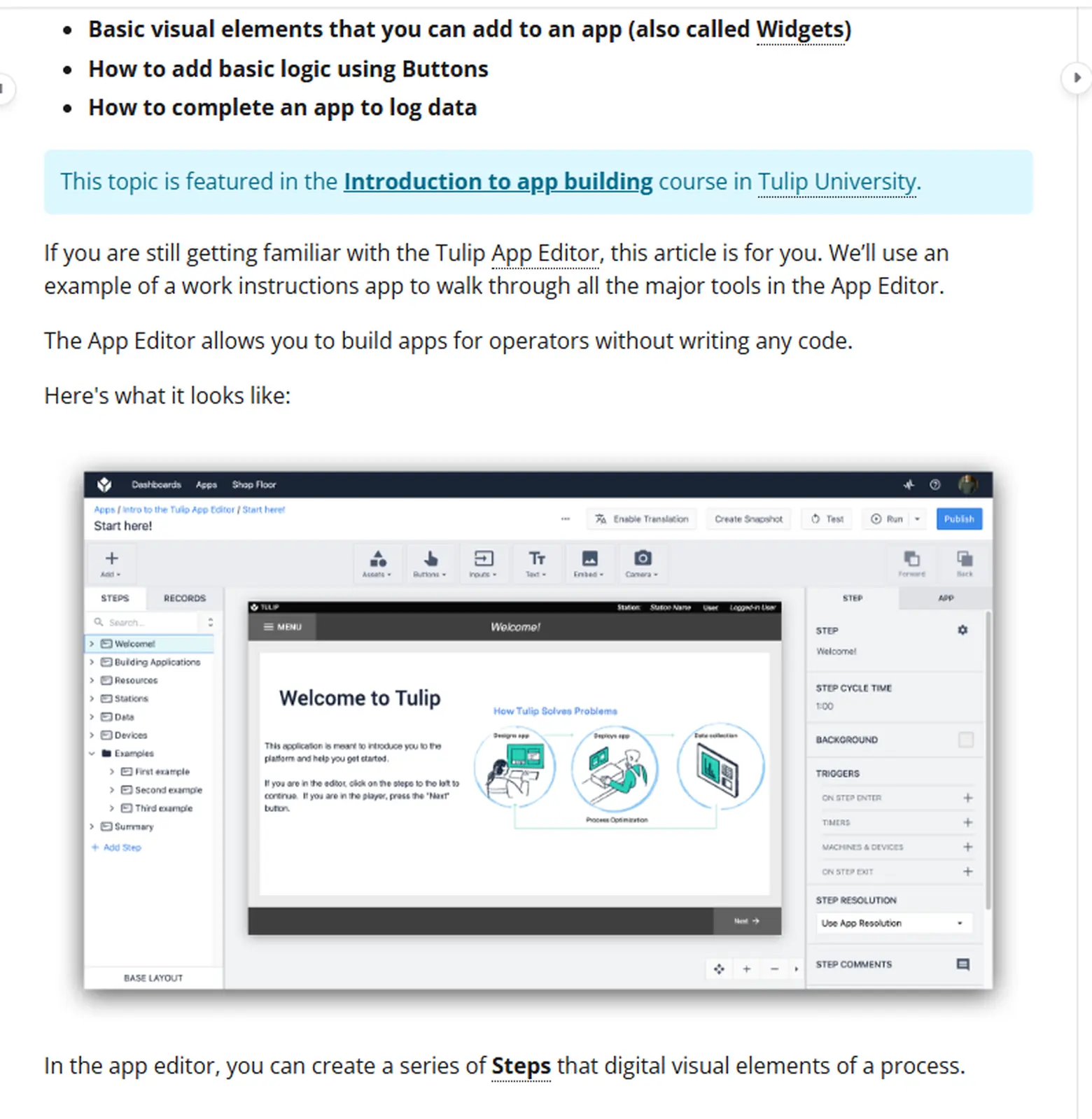
What it is: a cloud, no-code platform for building manufacturing apps and a composable MES, aimed at shops that want to digitize one line or work cell quickly without a long IT project. Standout: a drag-and-drop app builder, built-in connectivity to machines and devices, and 21 CFR Part 11 support for regulated work. Starting price: from $100 per interface per month on Essentials and $250 on Professional, both billed annually with a 10-interface minimum; Enterprise and Regulated Industries are quote-based (verified June 2026). Rating: G2 4.5. Watch for: pricing is per active interface, not per user, so a large plant with many stations can add up faster than the headline rate suggests.
Siemens Opcenter: enterprise MOM depth
What it is: Siemens’ manufacturing operations management suite, with execution, scheduling, quality, and intelligence modules that cover discrete, process, and hybrid plants. Standout: breadth and depth, plus tight links to Siemens PLM and automation for a full digital thread; ABI Research ranks it the overall market leader in discrete MES. Starting price: quote-based; Siemens publishes no list price and routes buyers to sales (confirmed June 2026). Rating: Gartner Peer Insights 4.4 across 100 reviews. Watch for: the capability comes with implementation cost and complexity that a small single-site shop rarely needs yet.
Rockwell Plex MES: cloud-native ERP and MES
What it is: a cloud-native smart manufacturing platform from Rockwell Automation that combines MES, quality, and ERP in one SaaS system, strong for discrete and hybrid manufacturers. Standout: a true multi-tenant cloud architecture with unlimited users and deep Allen-Bradley connectivity. Starting price: quote-based; Plex uses a sales-led subscription with no public figure (confirmed June 2026). Rating: G2 3.9, Capterra 4.3. Watch for: some users rate its MRP and BOM handling below its shop-floor strengths, so map those workflows carefully in the demo. Rockwell’s June 2026 ResilientEdge edge layer adds a separate continuity question for Plex buyers: where execution runs when cloud connectivity drops. Allen-Bradley is Rockwell’s PLC line, so plants drawn to that connectivity should be clear-eyed about how those controllers get programmed and who owns the code.
Critical Manufacturing: high-mix electronics and semiconductor
What it is: a modern, modular MES built for complex, high-mix discrete manufacturing, with deep roots in semiconductor, electronics, and medical devices. Standout: digital twin, IoT connectivity, and an apps marketplace that extend the core without heavy custom code. Starting price: quote-based; no public figure (confirmed June 2026). Rating: named a Representative Vendor in Gartner’s MES Market Guide and a Leader in IDC’s MES MarketScape; public review samples are thin, so weigh the analyst view over star counts. Watch for: it is enterprise-grade and built for complexity, so a simple shop will pay for capability it will not use.
Epicor Advanced MES: real-time machine data
What it is: the former Mattec MES, now Epicor Advanced MES, focused on real-time machine monitoring, OEE, and statistical process control across discrete industries from plastics to metals. Standout: automatic machine-data capture and SPC/SQC that surface downtime and scrap as they happen. Starting price: quote-based, sold by users, modules, and deployment with no public figure (confirmed June 2026). Rating: public MES review samples are limited, but Epicor is a long-standing, Gartner-recognized ERP vendor, which is the more useful signal here. Watch for: it shines as a data and monitoring layer, especially alongside Epicor ERP, more than as a full paperwork-and-genealogy MES. That live machine and scrap data is exactly what most factory-floor AI feeds on, because the predictive-maintenance and machine-vision models behind real AI use cases on the plant floor are only as good as the shop-floor data an MES like this captures. Monitoring that surfaces downtime is only useful if something acts on it, and turning those signals into scheduled fixes is the job of preventive maintenance software, not the MES.
Best MES for medical device, pharma, and regulated life sciences
Regulated manufacturers should shortlist on compliance before features, because the system has to produce electronic batch records, device history records, e-signatures, and an audit trail that survives an FDA inspection. With Class I medical device recalls at a 15-year high, traceability is not paperwork, it is risk control. The FDA’s proposed hub-and-spoke registration model extends that proof problem across equivalent units at separate locations. These are the best MES for medical device manufacturers and their pharma neighbors.
MasterControl Manufacturing Excellence: electronic batch records done right
What it is: a cloud MES purpose-built for regulated life sciences, pharma, medical device, and cell and gene therapy, centered on electronic batch records and quality. Standout: EBR and review-by-exception that cut paper and error, with 21 CFR Part 11 controls built in, backed by the strongest user-review base on this list. Starting price: quote-based, tiered by users and modules with no public figure (confirmed June 2026). Rating: G2 4.5 across 141 reviews, Capterra 4.6 across 186. Watch for: validation and configuration take real time, and it is tuned for quality teams more than for raw floor speed.
Tulip is the other strong regulated option when you want no-code flexibility rather than a built-for-pharma suite; it carries the same 21 CFR Part 11 support and, unusually for this market, publishes its price. For pharma operations standardizing on a dedicated batch system, Körber PAS-X is the long-established specialist worth a look alongside these two. The same regulated-first logic governs the quality system that sits beside the MES, where a validated QMS for ISO 13485 and FDA 21 CFR Part 11 is a different tool from a general ISO 9001 system.
Best MES for aerospace, defense, and complex industrial equipment
Aerospace, defense, and complex industrial equipment makers, the people building aircraft, satellites, and engineered-to-order machinery, need as-built genealogy, change management, nonconformance handling, and traceability deep enough to satisfy AS9100 and government contracts. These are the best MES for industrial equipment manufacturers running high-complexity, low-volume work. The Rolls-Royce SMR Pioneer Works plan shows the same record burden in factory-built nuclear: fixtures, inspection status, process evidence, and supplier readiness have to be proven before modules repeat.
iBASEt (Solumina): built for aerospace and defense
What it is: the Solumina platform, the only major MES whose customer base is majority aerospace and defense, built for complex, highly regulated discrete production and sustainment. Standout: deep as-built genealogy, change and configuration management, and Solumina AI for A&D shops. Starting price: quote-based; iBASEt publishes no list price on its own site, and the per-user figures floating on third-party sites are not vendor-confirmed, so treat it as quote-based (confirmed June 2026). Rating: Capterra 4.0 across 42 reviews. Watch for: the depth carries a learning curve, and it is overkill outside complex regulated discrete work.
42Q: rapid cloud MES across plants
What it is: a cloud-only MES built by contract manufacturer Sanmina and hardened across its own plants, aimed at multi-site discrete manufacturers in regulated sectors. Standout: fast rollout, multi-plant visibility, and compliance for medical (FDA QSR), automotive (IATF 16949), and aerospace (AS9100). Starting price: quote-based, a usage-based subscription with no public figure (confirmed June 2026). Rating: Gartner Peer Insights 4.4 across 45 reviews. Watch for: it is cloud-only, so plants needing on-premise control or offline operation should confirm that fits.
Best MES for process and batch manufacturing
Process and batch manufacturers, the chemical, food and beverage, and CPG plants, need recipe and batch control, statistical process control, and historians that capture continuous data, not just discrete units. The field here is narrower, and two names lead it.
AVEVA: unified operations control
What it is: AVEVA’s MES, part of an operations platform that unifies HMI, SCADA, and MES, with heritage in process industries and the former Wonderware line. Standout: one platform from machine signals up to production records, with no tag, I/O, or server licensing limits in the newer model. Starting price: quote-based; figures quoted on third-party sites are not vendor-confirmed, so treat it as quote-based (confirmed June 2026). Rating: Gartner Peer Insights 4.0 across 46 reviews. Watch for: it is a large, configurable platform, so plan for integration effort and a partner. GE Vernova Proficy is the other strong process and batch contender, especially in GMP-regulated plants, and belongs on the same shortlist.
How to choose MES: a decision framework
To choose the best MES software for your plant, match the system to your environment and compliance load first, then to your size and integration needs. Work down this list in order and nine systems narrow to two or three.
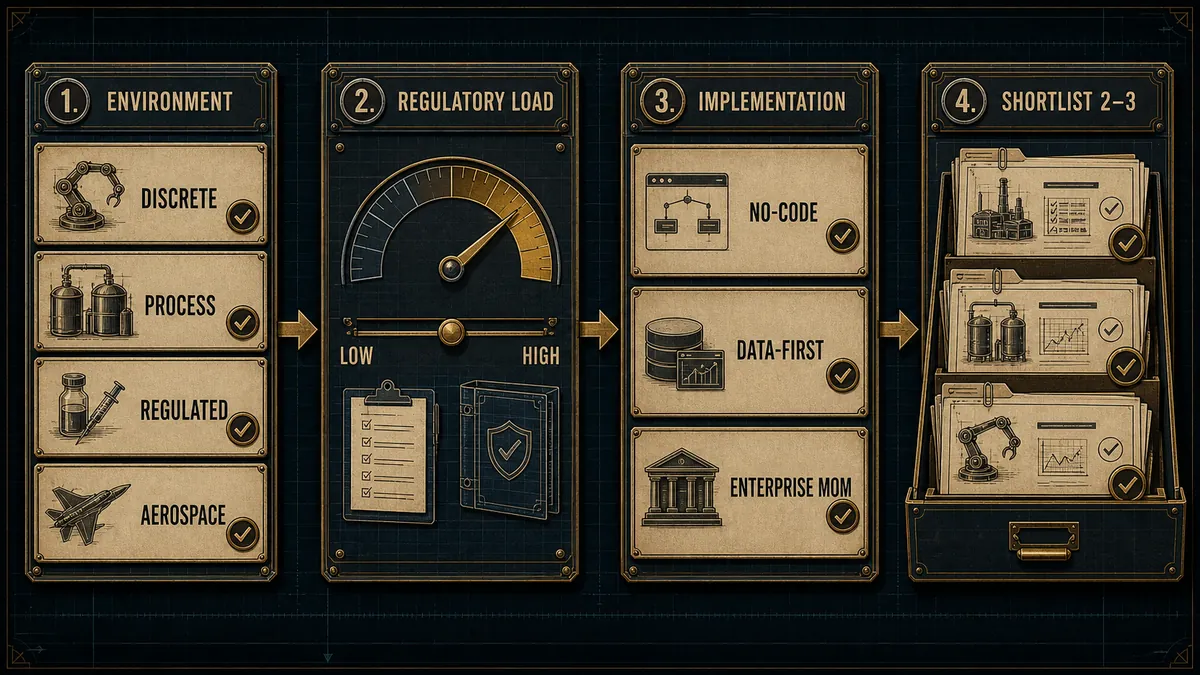
- Choose a no-code platform (Tulip) if you want to digitize one line fast, prove value, and avoid a long IT project before committing.
- Choose a regulated-first MES (MasterControl, or Tulip for no-code) if electronic batch records, e-signatures, and 21 CFR Part 11 decide the purchase.
- Choose an aerospace and defense MES (iBASEt, 42Q) if as-built genealogy, change management, and AS9100 traceability are non-negotiable.
- Choose a broad enterprise MOM (Siemens Opcenter, Rockwell Plex, AVEVA) if you run multiple environments or sites and want one platform to scale on.
- Choose a data-first MES (Epicor Advanced MES, Critical Manufacturing) if your first goal is live machine data, OEE, and SPC rather than full paperwork replacement.
- Avoid paying for enterprise MOM if you run a single discrete line and just need work instructions and machine data; a no-code or data-first tool will deploy faster and cost less.
The best MES is the system that matches how you build and how you are regulated, not the most powerful one a vendor can demo.
IMPORTANT
Whatever you shortlist, run a scripted demo on your own hardest job, the part with the most operations, the tightest tolerance, or the heaviest compliance, before you sign. A platform that looks clean in a sales deck can stall on the one routing that defines your business. The same rule applies to a Mastercam 2027 upgrade test: measure the jobs that expose setup and toolpath risk, not the jobs that already run clean. The same rule applies to a Mastercam 2027 upgrade test: measure the jobs that expose setup and toolpath risk, not the jobs that already run clean.
What MES really costs (and why most vendors won’t tell you)
MES costs far more than its subscription line, and on this list you usually cannot even see the subscription line. Eight of the nine systems are quote-based as of June 2026; only Tulip publishes a rate, from $100 per interface per month. That gating is the first thing to plan around: expect a discovery call and a custom quote shaped by your site count, users, and modules before anyone shows you a number.
The bigger number is everything around the license. Implementation, integration with your ERP and machines, data migration, validation for regulated plants, and operator training routinely cost more than the software in year one. A single-line cloud deployment can be running in weeks, while a multi-site enterprise rollout can run nine to twenty-four months before it is fully live. Price the whole program, not the sticker.
First-year MES cost = (Subscription or license × 12) + Implementation + Integration + Validation + TrainingThe spend is rising because the payback is real. The MES market is projected to grow from $15.95 billion in 2025 to $25.78 billion by 2030, and Siemens puts the cost of unplanned downtime at roughly $1.4 trillion a year across the world’s 500 largest companies, up to $2.3 million an hour on an idle automotive line. A system that turns machine stoppages into live alerts and a traceable record pays back faster than its quote suggests.
PRO TIP
Make every quote-based vendor itemize software, implementation, validation, and annual support separately, in writing. A low license with a heavy implementation fee can cost more over three years than a higher subscription that deploys in weeks.
Frequently Asked Questions
MES (manufacturing execution system) software runs and records production on the shop floor in real time. It captures machine and operator data, enforces work instructions and routings, tracks work in process, manages quality, and builds a traceable record of every unit, bridging your ERP and the equipment on the line.
ERP plans and coordinates the business, finance, orders, and inventory, in hours and days. MES executes and records what actually happens on the floor in seconds and minutes. ERP says what to make and when; MES makes sure it gets built and sends back the as-built record. Most manufacturers run both and integrate them.
Most MES software is quote-based as of June 2026, priced by users, modules, sites, and deployment, often five to six figures a year once implementation is added. Tulip is the main vendor publishing a rate, from $100 per interface per month. Budget implementation, integration, validation, and training as separate line items.
No. SCADA monitors and controls equipment signals in real time, at the machine level. MES sits a level above it, turning that data into work orders, quality records, and product genealogy across the whole production process. They integrate, but SCADA controls the machine while MES manages the production.
For medical device and pharma makers, MasterControl is the strongest purpose-built choice, with electronic batch records, device history records, and 21 CFR Part 11 controls built in. Tulip is a strong no-code alternative with the same compliance support and published pricing. Shortlist on audit-ready traceability before features.
Choosing an MES is one half of turning a tighter shop floor into more orders; the other half is a website that converts the buyers your new visibility helps you serve faster. If you want a clear read on where your site is losing quote requests, request a free manufacturer website investigation and we will show you what to fix first.
