
Walk any trade show in 2026 and you’ll hear that AI in manufacturing changes everything. Walk the plant floor afterward and you’ll find something quieter: a vibration sensor flagging a worn bearing, a camera rejecting a bad weld, a scheduler resequencing jobs around a late steel delivery. The distance between the keynote and the machine is where most of the confusion lives.
This guide skips the hype and shows what factory AI actually does today: which use cases are running in real plants, which are still early, and where the money shows up first. Every example here is deployed, named, and sourced.
Direct answer — How is AI used in manufacturing?
AI in manufacturing is the use of machine learning, computer vision, and generative and agentic AI to sense, predict, inspect, design, and schedule production. The deployed use cases are predictive maintenance, machine-vision quality control, demand forecasting, production scheduling, generative design, and, increasingly, agentic workflow assistants. Most of it is narrow, task-specific AI attached to existing machines and software, not a general “smart factory” brain running the plant on its own.
Key Takeaways
- Six use cases carry most of the real value today: predictive maintenance, vision-based quality control, demand forecasting, scheduling, generative design, and agentic assistants.
- Predictive maintenance and machine-vision inspection are the fastest, lowest-risk places to start, because both attach to equipment you already run.
- The U.S. Department of Energy pegs predictive maintenance savings at up to 40% over reactive maintenance; the World Economic Forum’s most advanced factories report a 41% drop in defects.
- Adoption is wide but shallow: 51% of manufacturers report using AI, yet fewer than 10% have scaled AI agents (McKinsey, 2025).
- Generative and agentic AI are real but early. Treat 2026 as a pilot year for both, not a rip-and-replace.
- Most factory AI lives inside tools you may already own: MES, CMMS, ERP, and vision systems, not a separate “AI platform.”
What “AI in manufacturing” actually means on the plant floor
AI in manufacturing is a set of narrow, task-specific technologies, machine learning, computer vision, generative models, and autonomous agents, that read factory data and act on it to cut downtime, catch defects, and plan production more accurately. It is not one system, and it is rarely the general “thinking factory” the marketing implies.
Four families cover almost everything you’ll meet on a real floor. Machine learning spots patterns in numbers: it learns what a healthy motor sounds like and flags the anomaly. Computer vision does the same for images, reading a weld or a painted panel the way a trained inspector would. Generative AI produces something new, a part geometry or a block of PLC code, from a goal you set. Agentic AI is the newest: software that doesn’t just answer a question but carries out a multi-step task on its own.
The distinction that matters is narrow versus general. Nearly every win in a plant today comes from narrow AI doing one job well, not a single model orchestrating the factory. Each of these tools also sits on the same foundation, machines instrumented and networked enough to produce data worth analyzing, which is why factory AI and the broader move toward connected industrial automation tend to arrive together rather than one at a time. The Noetra physical-AI timeline reinforces the gap: national model infrastructure arrives years before plant-specific deployment proof.
The AI use cases that are actually deployed
The AI use cases with the most plant-floor traction fall into six buckets, each tied to a specific job: keeping machines running, catching defects, forecasting demand, sequencing work, designing parts, and assisting operators. The table below sorts them by how mature each one is in real production, not in a demo.
| Use case | What it does | Maturity | Deployed example |
|---|---|---|---|
| Predictive maintenance | Reads sensor and machine data to flag equipment failures before they cause downtime | Mature, widely deployed | DOE: up to 40% savings vs reactive maintenance |
| Machine-vision quality control | Inspects parts and surfaces with cameras and deep learning at line speed | Mature, widely deployed | BMW AIQX: AI inspection at every plant worldwide |
| Demand forecasting & inventory | Predicts demand and rebalances stock from sales history and market signals | Established | Built into most modern ERP and MRP suites |
| Production scheduling | Resequences jobs and balances constraints as conditions change | Growing | AI-assisted advanced planning and scheduling (APS) |
| Generative design | Generates optimized part geometries to weight, strength, and cost goals | Established in design, niche in production | GM + Autodesk bracket: 40% lighter, 20% stronger |
| Agentic AI assistants | Autonomous agents that query data and execute workflow steps | Early, piloting | Siemens Industrial Copilot and AI agents (2025) |
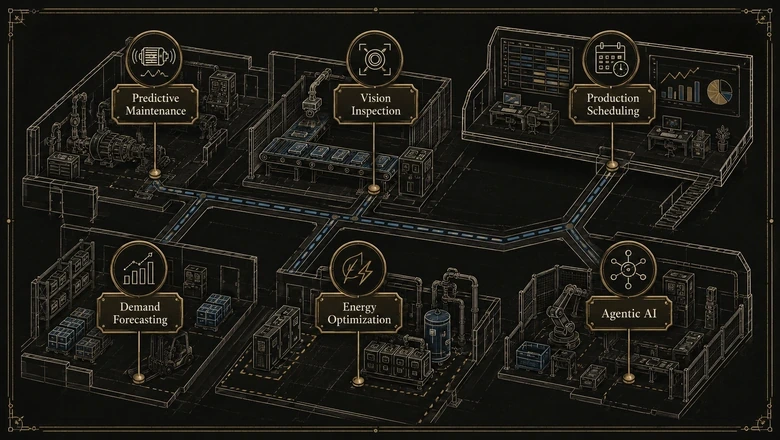
Predictive maintenance and condition monitoring
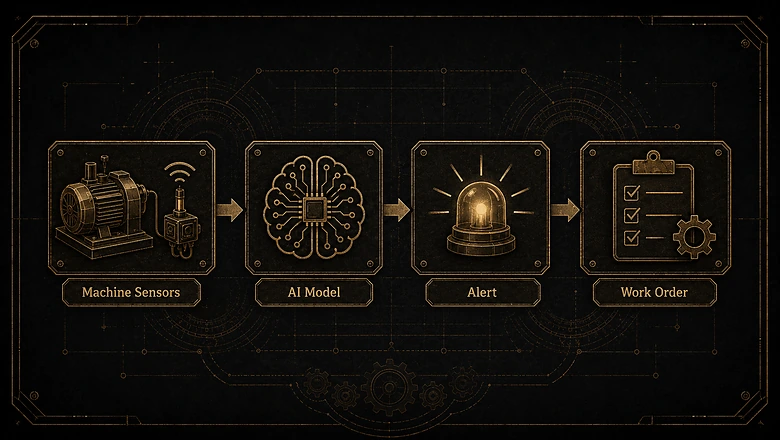
Predictive maintenance uses sensor data, vibration, temperature, current draw, acoustics, and a model trained on failure patterns to predict when a specific asset will fail, so you fix it on your schedule instead of at 2 a.m. It is the most proven AI use case in manufacturing, and the numbers are why. The U.S. Department of Energy’s maintenance benchmarks put predictive programs at roughly 8–12% cheaper than scheduled preventive work and up to 40% cheaper than running assets to failure, with far fewer unplanned breakdowns. Whether that gap justifies the sensors and software is the preventive-versus-predictive call every maintenance team eventually has to make.
The catch is that prediction only helps if the maintenance work behind it is organized. A model that forecasts a pump failure is useless if no one schedules the repair or stocks the part, which is why predictive tooling pays off most when it feeds a CMMS that turns the alert into a work order. The dedicated predictive maintenance platforms that sit on top of that add the condition-monitoring models and sensor integrations a general maintenance system doesn’t, so which one you actually need depends on how much of your equipment is already instrumented.
Machine-vision quality control
Machine-vision quality control uses cameras and deep-learning models to inspect parts, welds, surfaces, and assemblies at line speed, catching defects that move too fast or sit too subtle for a human eye. This is the second most-deployed AI use case, and the reference case is well documented. BMW runs its AIQX vision platform across every plant worldwide, analyzing camera and sensor data in real time to flag defects, including ones invisible to the human eye, before the vehicle moves further down the line.
What makes vision so deployable is that it bolts onto existing lines: a camera, a light, an edge computer, and a trained model. You don’t re-tool the plant. The harder part is the model itself, which needs enough labeled images of both good and bad parts to stay reliable. Get the pairing of camera, lighting, and inference right and the accuracy holds; get it wrong and the false-reject rate eats the savings, which is the trade-off our look at industrial machine-vision systems walks through for a first line.
Demand forecasting and production scheduling
AI-driven demand forecasting predicts what you’ll need to make and buy by learning from sales history, seasonality, and external signals, then feeds that into scheduling so the plan reflects reality instead of last quarter’s guess. Forecasting is the more mature of the two: it’s been embedded in ERP and planning tools for years, and modern models handle far more variables than a spreadsheet. Better forecasts flow straight into the inventory system that sets reorder points and safety stock, which is where poor demand signals usually turn into either stockouts or dead capital.
Scheduling is catching up. AI-assisted advanced planning and scheduling tools resequence jobs when a machine goes down or a rush order lands, balancing due dates, changeovers, and capacity in seconds rather than by a planner’s overnight rebuild. It’s genuinely useful, but it’s also where over-promising is common, so pilot it on one constrained work center before trusting it plant-wide.
Generative design and engineering
Generative AI in manufacturing shows up first in engineering, where generative design tools produce hundreds of optimized part geometries from goals you set: weight, strength, material, and fabrication method. The headline example is still the clearest one. Working with Autodesk, General Motors used generative design to consolidate eight components into a single seat bracket that came out 40% lighter and 20% stronger than the original.
The honest read: generative design is established in the design studio but still niche on the production line, because many of its organic geometries only make sense to build with additive manufacturing. Generative AI also drives the copilots creeping into engineering work, drafting code, summarizing machine logs, and documenting changes. Treat it as a strong assistant for your engineers in 2026, not an unattended designer.
Agentic AI on the factory floor
Agentic AI in manufacturing means autonomous software agents that don’t just respond to a prompt but execute a multi-step task, understanding intent, pulling data, calling tools, and completing a workflow with a human supervising rather than steering. This is the frontier, and the vendors are moving. At Automate 2025, Siemens introduced AI agents for industrial automation, with an orchestrator that deploys specialized agents across the value chain and an Operations Copilot aimed at shop-floor operators and maintenance engineers.
Early field results, at sites like thyssenkrupp Automation Engineering, point to faster code and fewer manual steps. But agentic AI is the least mature use case on this list by a wide margin. The right posture for 2026 is a supervised pilot on a bounded task, maintenance troubleshooting or code generation, with clear guardrails, not autonomous control of anything that can hurt a person or scrap a batch.
Cobots, physical AI, and digital twins
Beyond software, AI increasingly steers physical systems: collaborative robots that adjust to a human working beside them, and digital twins, live virtual models of a line that let you test a change before touching the real one. Cobots use vision and force sensing to pick, place, and assemble safely alongside people, while digital twins let engineers simulate a new sequence or stress-test a layout in software first. Which of those cobot jobs actually earns its keep is its own decision, and our guide to collaborative robots in manufacturing works through payload, speed, safety, and the point where a caged robot still wins.
These are where AI meets hardware, and they lean heavily on connected sensors and data pipelines to work, the same backbone that powers the wider shift to IIoT and Industry 4.0 on the factory floor. Digital twins in particular are maturing fast because they multiply the value of every other model: a twin is a safe place to let predictive and scheduling AI make mistakes.
Where AI pays off first
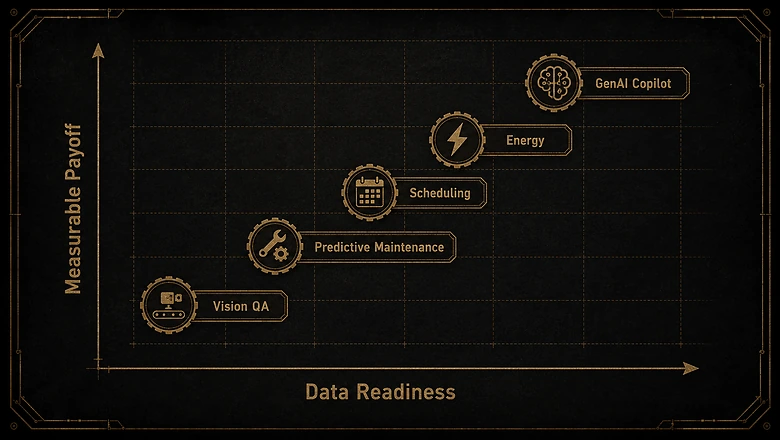
To decide where to start with AI, rank candidate use cases by two things: how much clean data you already collect, and how measurable the payoff is. The projects that clear both bars, sensor-rich equipment and a hard number attached to the outcome, are where the first dollar of AI spend does the most work.
Start with predictive maintenance and machine-vision quality control. Both attach to assets you already run, both produce a defect count or a downtime figure you can put on a board, and both have years of deployed evidence behind them. Demand forecasting is a strong third if your sales and inventory data are reasonably clean. Scheduling, generative design, and agentic assistants are worth piloting, but treat them as experiments with a defined success metric, not core bets.
PRO TIP
Score each candidate on a simple two-axis test before you buy: data readiness (do we already collect this signal cleanly?) and measurability (can we prove the result in one number?). Fund the projects that score high on both first. Everything else is a pilot.
Use AI when the problem is repetitive, data-rich, and expensive to get wrong: inspection, failure prediction, forecasting. Avoid leading with AI when the underlying data is thin or manual, because a model trained on bad data fails quietly and expensively. The constraint is almost never the algorithm.
The benefits of AI in manufacturing
The benefits of AI in manufacturing show up as less downtime, fewer defects, tighter inventory, and faster decisions, not as wholesale automation of the workforce. The clearest evidence comes from the plants furthest along. The World Economic Forum’s Global Lighthouse Network, its roster of the most advanced factories, reports its latest cohort averaging a 40% jump in labor productivity and a 41% drop in product defects, with AI enabling up to half of their top use cases.
That’s the ceiling, though, not the average. Here is the opinionated part: for most manufacturers the biggest constraint isn’t the model, it’s the data feeding it. A 2025 survey behind the National Association of Manufacturers found 51% of manufacturers already using AI in some form, yet the same body reports that a majority struggle with data quality and an AI-ready workforce. The benefit is real; capturing it depends less on buying a cleverer algorithm than on collecting cleaner data and training the people who run it.
Adoption is wide but shallow. McKinsey’s 2025 State of AI found that while roughly 79% of organizations use generative AI, fewer than one in ten have scaled AI agents in any function, and only a small minority see material financial returns yet.
Manufacturing AI software: buy, build, or already in your stack
Most manufacturing AI software is not a separate product you buy once; it’s AI features embedded in the systems you already run, plus a few specialized platforms for vision and predictive analytics. That framing saves money and grief. Before you shop for an “AI platform,” check what your current stack already does: modern MES, ERP, CMMS, and quality tools increasingly ship AI features you’re paying for whether you use them or not.
Where does each capability live? Predictive maintenance rides on your maintenance system and condition-monitoring sensors. Vision inspection usually needs a dedicated camera-plus-model system on the line. Forecasting and scheduling sit inside planning and ERP. Machine-level analytics often come from the MES that already collects run-time and scrap data on the floor, which is why an MES with clean data is frequently the best foundation for a first AI project. When you do evaluate standalone tools, judge them on data readiness and integration, not demo polish.
IMPORTANT
An AI feature is only as good as the data it reads. If your machine data is manual, incomplete, or trapped in spreadsheets, fix data capture first. Buying an AI module on top of bad data is the fastest way to a stalled pilot and a skeptical team.
The future of AI in manufacturing
The future of AI in manufacturing points toward agentic systems that don’t just predict but act, orchestrating maintenance, scheduling, and quality decisions with a human in the loop. The direction is clear from where the leaders and vendors are investing: the Lighthouse factories are already scaling analytical, generative, and agentic AI together, and platform vendors are shipping agent frameworks built for the plant.
Be realistic about the timeline. The same data shows agentic AI is barely scaled anywhere yet, and generative AI’s share of production use cases, while growing, is still a minority. The manufacturers who win the next few years won’t be the ones who chase every launch; they’ll be the ones who nail predictive maintenance and vision now, get their data house in order, and are therefore ready when agentic tooling matures. Boring foundations beat flashy pilots.
Frequently Asked Questions
The two clearest examples are predictive maintenance and machine-vision quality control. Predictive maintenance reads sensor data to flag failures before they stop a line, saving up to 40% over reactive repair. Machine vision inspects parts with cameras and deep learning; BMW runs its AIQX system across every plant worldwide to catch defects the human eye misses.
Agentic AI in manufacturing means autonomous software agents that don’t just answer questions but carry out multi-step tasks, such as querying machine data, diagnosing an error, and drafting the fix. Siemens began rolling out shop-floor AI agents in 2025. It’s promising but early, so treat 2026 deployments as supervised pilots.
Yes, but mostly in engineering and support roles rather than on the line. Generative AI in manufacturing powers generative design, where software creates optimized part geometries; GM and Autodesk used it to cut a bracket’s weight by 40%. It also drives copilots that write code and summarize machine data.
Mostly it changes jobs rather than removing them. AI takes over inspection, data crunching, and scheduling math, while people handle judgment, setup, and exceptions. The bigger near-term problem is a skills gap: most manufacturers tell the NAM they lack AI-ready talent, which slows adoption more than automation displaces workers.
It varies widely. Much of it is bundled into software you already pay for, such as AI features inside MES, ERP, or CMMS platforms, so the marginal cost is low. Standalone vision or predictive-analytics systems run from a few thousand dollars per line into six figures. The hidden cost is almost always data readiness.
