
Walk any factory floor and most of what you see looks like work. Forklifts moving, machines running, racks filling with parts. Lean manufacturing makes an uncomfortable claim: a large share of that motion adds no value a customer would ever pay for. The 8 wastes of lean manufacturing are a checklist for spotting exactly that, the activity that eats time, labor, and cash while the part sits no closer to done.
Toyota’s engineers gave this idea a name, muda, and a discipline for hunting it down. Seven wastes became eight when lean spread beyond the car plant, and the modern list is easy to remember as DOWNTIME. None of it needs new equipment. Every waste you remove hands back capacity you already own.
This guide defines all eight wastes, gives each one a real factory example, and shows how to spot it and cut it. You will also get the DOWNTIME and TIMWOODS memory aids, the difference between the seven and eight wastes, and a simple way to walk your own floor and find the biggest offender first.
Direct answer — What are the 8 wastes of lean manufacturing?
The 8 wastes of lean manufacturing are defects, overproduction, waiting, non-utilized talent, transportation, inventory, motion, and extra-processing, remembered by the acronym DOWNTIME. Each is a form of muda: activity that consumes time, labor, or material without adding value the customer will pay for. Toyota’s Taiichi Ohno defined the original seven; non-utilized talent was added later as the eighth. Cutting them frees capacity without new equipment.
Key Takeaways
- The eight wastes are muda, work a customer would never pay for. Removing them frees capacity you already own, with no new machines required.
- DOWNTIME and TIMWOODS name the same list. DOWNTIME adds the eighth waste, non-utilized talent, to Taiichi Ohno’s original seven.
- Overproduction is the most dangerous waste because it manufactures the other seven: extra inventory, motion, waiting, transport, and hidden defects.
- You find waste on the floor, not in a spreadsheet. A gemba walk and a value stream map expose it faster than any report.
- Every waste you cut shows up in a hard number: higher OEE, fewer defects, shorter lead time, and lower cost per part.
What is waste (muda) in lean manufacturing?
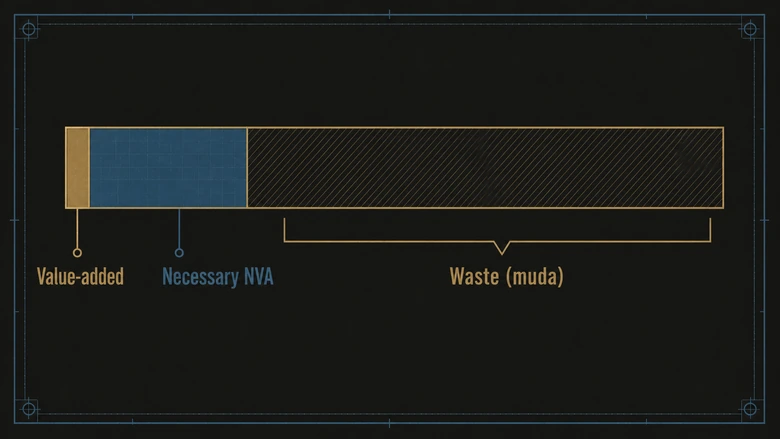
Waste in lean manufacturing, called muda in Japanese, is any activity that consumes resources without adding value the customer is willing to pay for. Lean sorts every step of a process into one of three buckets, and only one of them earns its keep.
A step is value-added if it changes the product toward what the customer ordered, the customer would pay for it, and it is done right the first time. Everything else is either pure waste that you eliminate, or necessary non-value-added work that the business requires but the customer does not value, like a compliance inspection, which you minimize rather than remove. In a typical process, the value-added steps make up a surprisingly small share of total lead time; most of the clock is the part sitting, moving, or waiting.
Muda is one of the three Ms of the Toyota Production System, alongside mura (unevenness) and muri (overburden). The Lean Enterprise Institute treats the three as linked: an uneven schedule (mura) overburdens machines and people (muri), which then produces defects and waiting (muda). The eight wastes are how muda shows up where you can actually see and count it.
The 8 wastes at a glance (DOWNTIME and TIMWOODS)
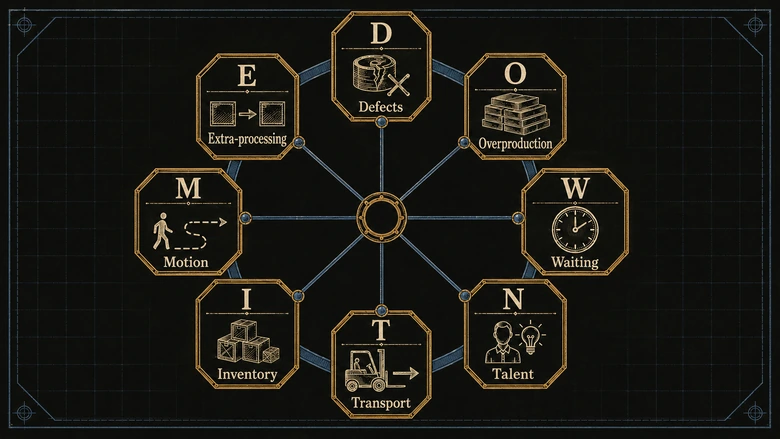
The eight wastes are easiest to remember as DOWNTIME, an acronym that spells out Defects, Overproduction, Waiting, Non-utilized talent, Transportation, Inventory, Motion, and Extra-processing. The table below defines each one, gives a factory example, and names the first move to cut it.
PRO TIP
DOWNTIME spells the eight wastes: Defects, Overproduction, Waiting, Non-utilized talent, Transportation, Inventory, Motion, Extra-processing. An older mnemonic, TIMWOODS, covers the same list in a different order (Transport, Inventory, Motion, Waiting, Overproduction, Over-processing, Defects, Skills). TIMWOOD without the final S is the original seven, before non-utilized talent joined.
| Waste (DOWNTIME) | What it is | Factory example | How to cut it |
|---|---|---|---|
| Defects | Parts that fail spec and need rework, scrap, or return | A stamping cell ships 400 out-of-tolerance brackets that assembly sends back | Mistake-proof the step; catch defects at the source with SPC |
| Overproduction | Making more, sooner, or faster than the next step needs | Molding runs a shift ahead of assembly to stay busy, filling racks | Pull to real demand; level the schedule |
| Waiting | Idle people or machines waiting on the previous step | Three operators stand idle while one CNC finishes a long changeover | Balance the line; cut changeover time with SMED |
| Non-utilized talent | Skills, ideas, and problem-solving left unused | The operator who knows the fix is never asked; engineering redoes it slowly | Ask the floor; run improvement with the people closest to the work |
| Transportation | Moving material the process step does not need | Welded frames travel 300 feet across the plant and back between two cells | Co-locate sequential steps; map the value stream |
| Inventory | Raw, WIP, or finished stock beyond what flow requires | Six weeks of WIP sits between paint and assembly, hiding a quality issue | Shrink batch sizes; pull with kanban |
| Motion | Unnecessary movement of people reaching, walking, searching | An assembler takes 12 steps per cycle to a far fastener bin | Apply 5S; bring tools and parts to the point of use |
| Extra-processing | More work or precision than the customer needs | Machining a hidden surface to a mirror finish no one will see | Match the spec to the requirement; remove redundant steps |
The 8 wastes of lean manufacturing, explained
Each of the eight wastes shows up differently on the floor, and each has its own fastest fix. Here is what to look for, with a real example and the first move to make.
Defects
Defects are products or parts that do not meet spec and must be reworked, scrapped, or returned. They are the most expensive waste per unit, because a defect burns the material, labor, and machine time already spent, then demands more of all three to fix.
Picture a stamping cell running a worn die that ships 400 out-of-tolerance brackets a shift. Assembly catches them, sends them back, and the cell reworks parts it already counted as finished. The scrap is visible; the hidden cost is the capacity the line spent twice. The fix is to catch defects where they happen, not at final inspection: in-line checks, mistake-proofing (poka-yoke), and statistical process control stop a bad part from traveling. That is the job of a quality system that flags the defect at the source rather than at the loading dock.
Overproduction
Overproduction means making more than the next step needs, earlier than it needs it, or faster than it can use. Lean treats it as the worst of the eight, because it hides and feeds the other seven: everything you overmake has to be moved, stored, counted, and inspected.
A molding department that runs a full shift ahead of assembly to keep its machines busy and its utilization high is the classic case. The racks fill, the floor clogs, and when a defect surfaces there are now 5,000 suspect parts instead of 50. The cure is to make to actual demand, not to keep machines running. A pull system and a level schedule stop the line from racing ahead, and a manufacturing execution system that shows real downstream demand replaces the instinct to overproduce with a signal to follow.
IMPORTANT
Overproduction is the root waste, so do not start by cutting inventory. Trim the stock without slowing the pace of production and you just starve the line, then refill it. Fix production to real demand first, and the inventory, waiting, and transport it created shrink on their own.
Waiting
Waiting is idle time, whenever people or machines stand by for the previous step, for materials, for instructions, or for a repair. It is the easiest waste to see and the one most often blamed on someone else.
When one CNC in a cell drops into a 40-minute changeover and three downstream operators have nothing to do until it finishes, that idle time is planned and paid; the line simply is not using it. Two moves help: balance the work across the cell so no station starves, and attack the stops that cause the wait. Faster changeovers and fewer breakdowns both count, which is why a maintenance system that shrinks unplanned downtime pays back in recovered run time.
Non-utilized talent
Non-utilized talent is the eighth waste: the skills, ideas, and problem-solving of your people left unused. It is the only waste on the list that walks in the door every morning, and the only one that compounds when you ignore it.
The operator who runs a machine every day usually knows the real cause of a recurring jam. If no one asks, engineering spends a week rediscovering what the operator could have said in a sentence. Building the routines that pull those ideas out, daily huddles, visible problem boards, and improvement work led by the people closest to the job, is what turns this waste into your cheapest source of gains. Treat the floor as the first place to look for answers, not the last.
Transportation
Transportation is the waste of moving material the process does not require, between machines, cells, buildings, or the warehouse and back. Every extra move adds handling damage, forklift traffic, and time, without changing the part at all.
When welded frames leave one cell, travel 300 feet to a shared paint line, then come back across the plant to the same aisle for assembly, the frames gain nothing on the trip; the plant just pays for the miles. Put sequential steps next to each other and question every long move. Mapping the value stream turns this hidden travel into a diagram you can measure and shorten.
Inventory
Inventory waste is any raw material, work in process, or finished stock beyond what flow actually needs. Lean is suspicious of inventory because it ties up cash and, worse, hides problems: a big buffer lets a quality issue run for days before anyone notices.
Six weeks of work in process parked between paint and final assembly “just in case” is money asleep on the floor. When a paint defect appears, six weeks of parts are already suspect, and the cash in that buffer could have funded the fix ten times over. Shrink batch sizes and pull with kanban so stock matches demand. Seeing the true position comes first, which is where software that tracks real stock and WIP earns its place.
Motion
Motion is unnecessary movement of people: reaching, bending, walking, and searching for tools or parts. It is a close cousin of transportation, but motion is about the operator’s body, not the material.
An assembler who takes a dozen steps every cycle to a shared fastener bin across the aisle walks a marathon over a shift to build parts that never needed the walk. Organize the workspace with 5S and bring tools and parts to the point of use. When everything the operator needs is within arm’s reach, the motion disappears and the cycle gets faster.
Extra-processing
Extra-processing, sometimes called over-processing, is doing more work or adding more precision than the customer actually needs. It is the most insidious waste because it often looks like diligence, and it is the pair people most often confuse with overproduction: overproduction is making too many, extra-processing is doing too much to each one.
A shop that machines a hidden mounting surface to a mirror finish no one will ever see or spec is paying in tool life, cycle time, and energy for quality the customer never asked for. Match the work to the requirement: confirm the real spec, remove redundant approvals and duplicate data entry, and stop gold-plating features nobody values.
7 wastes vs 8 wastes: what changed
The 7 wastes of lean manufacturing are Taiichi Ohno’s original list from the Toyota Production System; the eighth, non-utilized talent, was added in the 1990s as lean spread beyond Toyota. The mechanics are identical either way, so the count is really a question of whether you make the human waste explicit.
Ohno, the chief engineer behind the Toyota Production System, devised the seven wastes as part of that system: Transport, Inventory, Motion, Waiting, Overproduction, Over-processing, and Defects, spelled TIMWOOD. His list was written for the shop floor and focused on how material and machines lose value.
As lean took hold in Western industry, practitioners added an eighth waste, non-utilized talent, sometimes called skills, to name the loss Ohno’s factory list understated: the ideas and problem-solving that go unused when management does not ask. That is why you see both counts in the wild, and why the eight-waste version maps to DOWNTIME while the original seven map to TIMWOOD. In practice the eighth waste is the one most plants still skip, which makes it a good place to look for gains no capital budget can buy.
How to find the 8 wastes on your factory floor
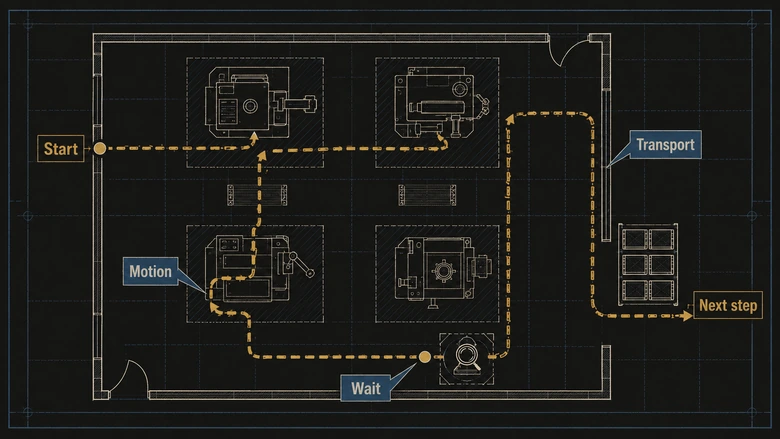
You find the eight wastes by going to where the work happens and watching one process from end to end, not by auditing a spreadsheet. Two habits do most of the work: a gemba walk for the detail and a value stream map for the big picture.
A gemba walk means going to the floor and following a single part through every step, marking each place it waits, moves, or gets handled without changing. A value stream map zooms out to the whole flow, exposing the waiting, inventory, and transport that pile up between steps rather than inside them. When a defect resists the simple fixes, a structured project earns its keep: a set of six sigma tools like a fishbone diagram and a control chart drive the root cause out into the open.
Workflow · 90 min
How to run a waste walk on one process
A structured floor walk that surfaces the eight wastes on a single process and ranks them by size, so you fix the biggest one first.
-
Pick one process and walk its real path
Choose a single product family and one process, from raw material to the next customer step. Walk the route the part actually takes, not the one on the layout drawing.
-
Follow one part, not the people
Track a single part or batch through every step. Note each place it waits, moves, or gets handled without changing toward the finished product.
-
Tally the eight wastes at each step
Carry the DOWNTIME list and mark which wastes appear at each station. Count the steps, measure the distances, and time the waits with a stopwatch.
-
Ask the operators what slows them down
At each station, ask the person doing the work what gets in their way. This surfaces non-utilized talent and the real cause behind the waiting and motion you just timed.
-
Rank the wastes by size, not by annoyance
Add up the time and distance for each waste and rank them. Resist starting with the one people complain about most; start with the largest.
-
Fix the biggest waste, then walk again
Attack the top waste with one change, measure the result, and repeat the walk. Waste elimination is a loop, not a one-time audit.
From waste to metrics: OEE, quality, and cost
Every waste you remove shows up in a number you already track, which is why the eight wastes double as an improvement map for your plant’s metrics. The trick is knowing which waste drives which number.
Waiting and breakdowns cut availability, overproduction and motion and slow cycles cut performance, and defects cut quality, so every one of those losses lands in your OEE score. Read the three OEE factors and you can point to the exact wastes dragging them down, then walk the floor to confirm it.
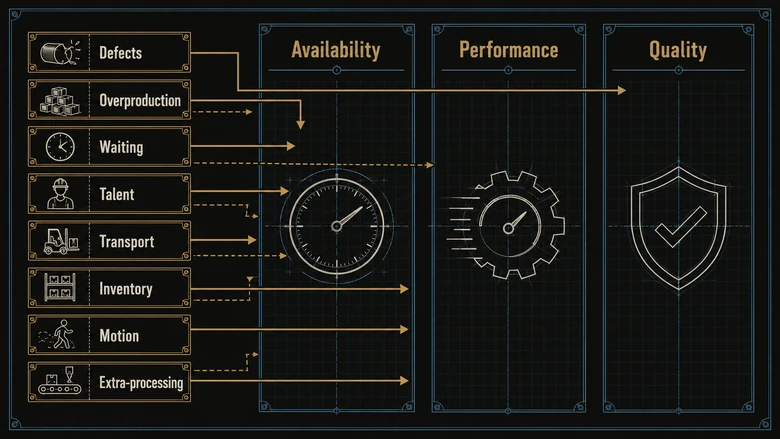
Quality and cost tell the same story from a different angle. Defects and extra-processing pull down first-pass yield and push up cost per part, while inventory quietly ties up the cash that would fund the fix. None of these numbers move because you memorized eight words. They move because you walked the floor, found the biggest waste, cut it, and then did it again. The plants that pull ahead treat the eight wastes as a weekly habit, not a poster on the wall.
Frequently Asked Questions
The 8 wastes of lean manufacturing are defects, overproduction, waiting, non-utilized talent, transportation, inventory, motion, and extra-processing. They are remembered by the acronym DOWNTIME. Each is a form of muda, meaning activity that uses time, labor, or material without adding value the customer will pay for.
The 7 wastes are Taiichi Ohno’s original list from the Toyota Production System: transport, inventory, motion, waiting, overproduction, over-processing, and defects (TIMWOOD). The 8th waste, non-utilized talent, was added in the 1990s to capture the unused skills and ideas of workers. That eighth item is the only difference.
Muda is the Japanese word for waste, and in lean it means any activity that consumes resources without adding value for the customer. It is one of the three Ms of the Toyota Production System, alongside mura (unevenness) and muri (overburden). The eight wastes are the categories of muda you can see and count.
DOWNTIME stands for Defects, Overproduction, Waiting, Non-utilized talent, Transportation, Inventory, Motion, and Extra-processing. It is a memory aid for the eight wastes of lean manufacturing. An older acronym, TIMWOOD, covers the original seven wastes before non-utilized talent was added.
The 8th waste is non-utilized talent, sometimes called skills. It is the waste of failing to use the knowledge, ideas, and problem-solving ability of your people. Added to Ohno’s original seven in the 1990s, it is the only waste that involves people rather than material or machines.
