
Ask ten shop owners for the best ERP for manufacturing and you get ten answers, because the question is missing its second half. The system that runs a make-to-stock parts supplier beautifully can bury a custom job shop in fields it will never fill, and the platform a 300-person discrete manufacturer relies on is usually overkill for a 20-person shop still running QuickBooks and spreadsheets.
So this guide does not crown one winner. It shortlists ten ERP systems by the thing that actually decides fit: your production model. We grouped them by make-to-stock, make-to-order, and mixed-mode, verified every published price against the vendor’s own page in June 2026, and flagged the ones that hide pricing behind a sales call. Where a vendor would not show a number, we say so rather than guess.
The goal is a buyer’s shortlist you can act on this quarter, not a feature encyclopedia. Find your production model, read the three or four systems that fit it, and ignore the rest.
Direct answer — What is the best ERP for manufacturing?
There is no single best ERP for manufacturing; the right system follows your production model. Make-to-stock shops fit inventory-led tools like Fishbowl or Katana. Make-to-order job shops fit MRPeasy, JobBOSS², or Epicor Kinetic. Mixed-mode and scaling small manufacturers fit Microsoft Dynamics 365 Business Central, Acumatica, or Oracle NetSuite. For most small shops, cloud MRP such as MRPeasy, from $49 per user per month as of June 2026, is the lowest-risk place to start.
Key Takeaways
- There is no universal best ERP for manufacturing. The right pick follows your production model: make-to-stock, make-to-order, or mixed-mode.
- For genuinely small shops, cloud MRP like MRPeasy (from $49/user/month) or Katana (free starter tier) gives real manufacturing control without enterprise cost.
- Mixed-mode and scaling SMBs are better served by Dynamics 365 Business Central ($110/user/month, and manufacturing needs the Premium tier) or Acumatica’s consumption-based APEX bundle (from under $2,185/month).
- Enterprise names, Oracle NetSuite, Epicor Kinetic, and SAP, are quote-only and often too heavy for a single-site shop under roughly 50 staff.
- The sticker price is not the real cost. Budget implementation, data migration, and integrations as separate line items before you sign.
Methodology
How this comparison was conducted
- Scope
- 10 manufacturing ERP systems scored by production model, selected from a wider review of systems marketed to small and mid-market manufacturers. Inclusion required a manufacturing suite (MRP, bill of materials, and work orders) with enough public product detail to assess. Enterprise-only tiers aimed at large multinationals (SAP S/4HANA, Infor CloudSuite) were left out.
- Sources reviewed
- Official vendor product and pricing pages; G2 and Capterra verified-review aggregates; and SelectHub and Practical Machinist practitioner discussions for shop-floor sentiment.
- Date range
- Pricing and specifications were verified against official sources in June 2026. Figures change; check the vendor page before you buy.
- Tools used
- A production-model rubric, make-to-stock / make-to-order / mixed-mode, scoring each system on best-fit production model, core manufacturing modules (MRP, BOM, work orders, scheduling), pricing transparency, deployment, and verified user ratings.
- Limitations
- This is a documentary comparison, not a hands-on deployment. No system was implemented or tested first-hand. ERP pricing is frequently gated, so several figures here are quote-based and will vary by configuration, partner, and negotiation. Ratings reflect a moment in time.
- Editorial independence
- No vendor paid for placement, ranking, or coverage, and no rankings were shared with any vendor before publication. Our full editorial policy explains how we keep scored guides independent.
- Conflicts of interest
- Factory Investigator sells manufacturer website and SEO services, not ERP software. None of the systems reviewed were Factory Investigator clients at the time of writing.
Start with your production model, not the vendor list
Your production model is the way you turn demand into finished goods, and it is the single best predictor of which ERP will fit. Pick the system that matches how your shop actually runs, and most of the feature debate answers itself.
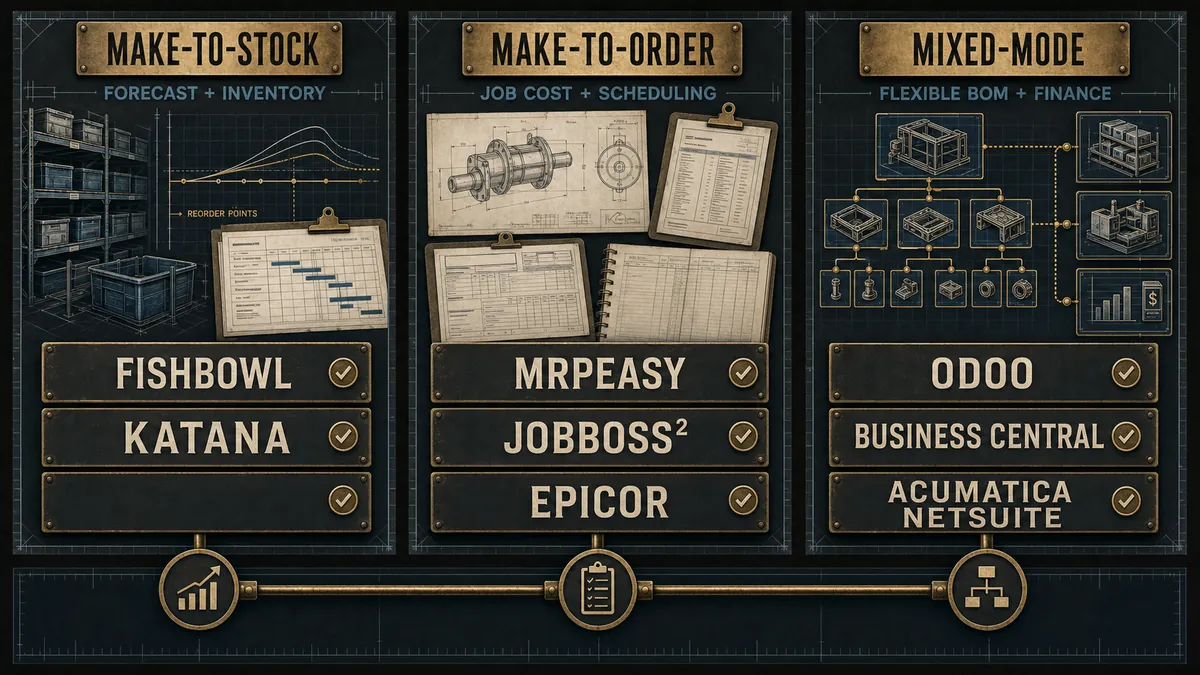
Three models cover almost every small manufacturer. Make-to-stock builds to a forecast and sells from inventory. Make-to-order builds only after a customer order or RFQ lands. Mixed-mode runs both, often adding engineer-to-order for custom work. The table below maps each model to what the ERP must do well, and to the systems that tend to fit. That same production model predicts your automation, not just your ERP: the high-mix, make-to-order shops that need flexible software also tend to fit a cobot better than a fixed robot cell, because both the system and the robot have to change with the job. For make-to-order and engineer-to-order shops the job starts one step before the ERP, with the software that turns that RFQ into a costed, buildable quote, and how accurate that estimate is decides whether the won job makes money.
| Production model | What it means | What the ERP must do well | Systems that tend to fit |
|---|---|---|---|
| Make-to-stock (MTS) | Build to a forecast, sell from finished inventory | Demand forecasting, inventory optimization, lot and expiry tracking, reorder points | Fishbowl, Katana |
| Make-to-order (MTO) | Build only after an order or RFQ is confirmed | Quoting and RFQ, per-order BOMs, job costing, capacity scheduling | MRPeasy, JobBOSS², Epicor Kinetic |
| Mixed-mode | Both stocked and custom work, sometimes engineer-to-order | Flexible BOMs, forecast and order workflows together, multi-site and finance depth | Odoo, Business Central, Acumatica, SAP Business One, NetSuite |
PRO TIP
If you genuinely run both stocked and custom work, shortlist mixed-mode systems from the start. Buying a pure make-to-order tool and bolting on inventory later is harder than buying a flexible platform and growing into it. The same logic governs the factory floor those systems plan, where the winning move is to start with one measured cell rather than an integrated plant, then grow the automation as the payback proves out.
The best ERP for manufacturing at a glance
The table below is the shortlist in one view: ten manufacturing ERP systems, the production model each fits best, the starting price as verified in June 2026, and the user rating. Published prices link to the vendor’s own page; “quote-based” means the vendor does not publish a number and routes you to sales.
| ERP system | Best-fit model | Starting price (as of June 2026) | Deployment | Best for | User rating |
|---|---|---|---|---|---|
| MRPeasy | Make-to-order, mixed | $49/user/mo (2-user min) | Cloud | Small shops wanting real MRP, cheaply | G2 4.6 · Capterra 4.5 |
| Katana | Make-to-stock, make-to-order | Free tier; Core from $299/mo | Cloud | Inventory-led makers and D2C brands | Capterra 4.6 · G2 4.4 |
| Fishbowl | Make-to-stock, inventory-led | $229/mo (Essentials, 2 users) | Cloud or on-prem | QuickBooks shops adding light manufacturing | Capterra 4.2 · G2 4.0 |
| ECI JobBOSS² | Make-to-order, job shop | Quote-based | Cloud or on-prem | Job shops and make-to-order machine shops | Capterra 4.2 · G2 3.8 |
| Epicor Kinetic | Make-to-order, discrete | Quote-based | Cloud or on-prem | Scaling discrete and mixed-mode mid-market | G2 3.9 · Capterra (175+ reviews) |
| Odoo | Mixed-mode, modular | Free (one app); paid per user, all-apps | Cloud or on-prem | Tech-comfortable shops wanting a modular ERP | Capterra 4.2 · G2 4.3 |
| Dynamics 365 Business Central | Mixed-mode, discrete | $110/user/mo (Premium; mfg needs Premium) | Cloud | Microsoft-stack SMBs needing real manufacturing | G2 4.0 · Capterra 4.1 |
| Acumatica | All models (ETO; process via add-on) | APEX bundle from under $2,185/mo | Cloud | Growing SMBs that don’t want per-seat fees | Capterra 4.4 · G2 4.4 |
| SAP Business One | Mixed-mode (lighter native mfg) | Quote-based (partner-priced) | Cloud or on-prem | SMBs wanting a big-name platform to scale on | G2 4.3 · Capterra 4.3 |
| Oracle NetSuite | All models | Quote-based | Cloud | Multi-entity and fast-scaling manufacturers | Capterra 4.2 · G2 4.1 |
Half of these publish a real starting price and half do not. That split is the first honest signal of who sells to small shops directly and who sells through a quote and a sales cycle. We break each system down by production model next.
Best ERP for make-to-stock and inventory-led shops
Make-to-stock manufacturers should prioritize inventory accuracy, demand forecasting, and tight reorder logic over heavy job costing. If you build to a forecast and sell from a shelf, these two systems give you manufacturing control without the weight of a full ERP. And if a full ERP is still more than you need, a dedicated inventory system can cover the stock side on its own, tying raw materials, work-in-progress, and finished goods to your BOM.
Katana: inventory-led manufacturing for small makers
What it is: a cloud manufacturing and inventory platform built for small makers and direct-to-consumer brands that produce to stock and to order. Standout: a live visual production and inventory view that small teams actually use, plus clean Shopify and QuickBooks links. Starting price: a free tier covering 30 SKUs, with the Core plan from $299/month and add-ons such as Manufacturing Management at $199/month (verified June 2026). Rating: Capterra 4.6, G2 4.4. Watch for: usage-based charges for extra orders and locations can lift the real monthly cost above the headline.
Fishbowl: manufacturing for shops living in QuickBooks
What it is: an inventory-first system that adds manufacturing and warehouse modules, aimed at shops that have outgrown spreadsheets but want to keep QuickBooks for accounting. Standout: deep inventory and multi-location tracking with a long QuickBooks integration track record. Starting price: $229/month for the Essentials tier with two users, billed annually, scaling to $729/month for Scale with ten users (verified June 2026). Rating: Capterra 4.2, G2 4.0. Watch for: practitioners consistently rate dedicated MRP tools like MRPeasy ahead of Fishbowl for true production work, so it fits inventory-led shops better than complex job shops. If warehouse location and 3PL strategy are also in flux, treat manufacturer warehouse footprint changes as an operating-model question before you choose inventory software.
Best ERP for make-to-order shops and job shops
Make-to-order manufacturers should prioritize quoting, per-order bills of materials, job costing, and scheduling, because every job starts from a customer order or RFQ rather than a forecast. These three systems are built around that order-first reality. The quote that starts the job is a separate engine, though: a configurator that turns an RFQ into a priced, buildable spec before the ERP ever opens the order. CAI’s 2026 PlanetTogether APS acquisition is a signal that scheduling is becoming its own layer between quoted demand and ERP execution.
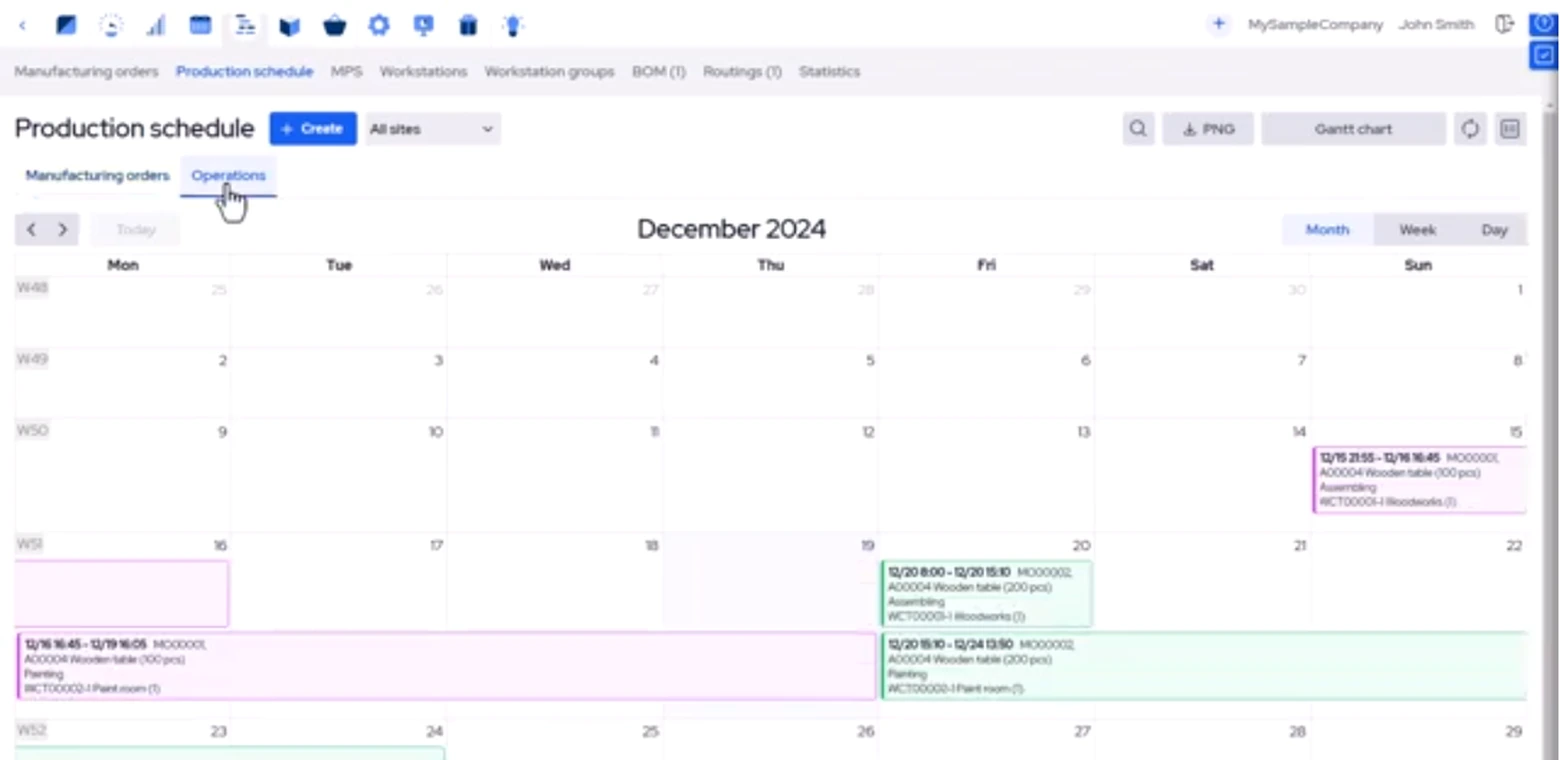
MRPeasy: the small-shop default for real MRP
What it is: cloud MRP and light ERP designed for small manufacturers, roughly 10 to 200 employees, who need production planning, BOMs, and stock control without enterprise overhead. Standout: genuine MRP, scheduling, and shop-floor reporting at a price small shops can approve quickly. Starting price: $49/user/month on the Starter tier (two-user minimum), rising to $149/user/month for Unlimited, with extra users billed in blocks (verified June 2026). Rating: G2 4.6, Capterra 4.5. Watch for: advanced reporting is thin, so data-heavy operations may outgrow it. One caveat if sequencing is your real bottleneck: MRPeasy’s scheduling is a module, and its finite-capacity depth is lighter than a standalone production scheduler built only for that job.
ECI JobBOSS²: built for job shops and custom work
What it is: a job-shop ERP, the merged JobBOSS and E2 product, aimed squarely at make-to-order and contract machine shops that quote, route, and cost every job. Standout: quote-to-cash and job costing tuned to the way small machine shops actually work. Starting price: quote-based, sold per user per year across Silver, Gold, and Platinum tiers with no public figure (confirmed June 2026). Rating: Capterra 4.2, G2 3.8. Watch for: practitioners on forums like Practical Machinist call it a fine low-cost starter but flag a dated interface and a learning curve as shops scale.
Epicor Kinetic: the step up for scaling discrete manufacturers
What it is: a mid-market ERP for discrete and mixed-mode manufacturers, strong in make-to-order and engineer-to-order, that shops adopt after outgrowing entry-level job-shop tools. Standout: deep manufacturing functionality, MES, and quality modules that handle complex routings. Starting price: quote-based; Epicor publishes no list price and routes buyers to a sales conversation (confirmed June 2026). Rating: G2 3.9 across 569 reviews. Watch for: the depth comes with implementation cost and complexity that a sub-50-person shop rarely needs yet. That depth reaches into maintenance too, yet plants where uptime is the binding constraint usually run a dedicated CMMS alongside the ERP rather than lean on the module.
IMPORTANT
High-mix machine shops chasing quality compliance often shortlist ProShop ERP, which practitioners rate highly on review sites like SelectHub. It earns praise for depth but is repeatedly described as premium-priced and implementation-heavy, so weigh the onboarding effort before you commit. Where an ERP’s quality module cannot satisfy an auditor on its own, a standalone QMS chosen by the standard you must hold carries the document control and CAPA depth a certification demands.
Best ERP for mixed-mode and scaling manufacturers
Mixed-mode manufacturers should prioritize flexible BOMs, both forecast and order workflows in one system, and the finance depth to support multiple sites or entities. These five platforms span the range from a modular small-shop option to full mid-market ERP. Flexible BOMs are also where ERP starts brushing against the systems next to it, since the engineering BOM is really owned by PLM and executed by MES, so it is worth knowing where ERP ends and MES, PLM, and QMS take over before you expect one suite to do all of it.
Odoo: modular ERP for tech-comfortable shops
What it is: an open-core ERP whose Manufacturing and MRP apps sit alongside finance, sales, and inventory in one modular suite. Standout: strong configurability and per-app modularity, so you switch on only what you use. Starting price: a free One App plan with unlimited users; paid Standard and Custom plans are priced per user, all-apps, billed annually. Odoo localizes its pricing page by region and did not display a US-dollar figure at the time of checking, so confirm the current rate for your country on its pricing page (checked June 2026). Rating: Capterra 4.2, G2 4.3. Watch for: getting the manufacturing setup right usually needs technical hands or a partner.
Microsoft Dynamics 365 Business Central: manufacturing on the Microsoft stack
What it is: a full SMB ERP that adds production orders, BOMs, and capacity planning to finance and supply chain, fitting shops already standardized on Microsoft 365. Standout: native Microsoft 365, Power BI, and Teams integration that lowers the training curve. Starting price: $110/user/month for the Premium plan, billed annually, and manufacturing is exclusive to Premium; the $80 Essentials tier excludes it (verified June 2026). Rating: G2 4.0, Capterra 4.1. Watch for: the per-user license adds up across a larger team, and deeper manufacturing often needs a partner add-on.
Acumatica: consumption pricing for growing SMBs
What it is: a cloud ERP with a real manufacturing edition spanning make-to-stock, make-to-order, and engineer-to-order, with process manufacturing available as an add-on. Standout: resource-based licensing with unlimited users, so growth does not mean buying more seats. Starting price: the APEX for Manufacturing bundle, software, implementation, and support, starts under $2,185/month; core Acumatica licensing remains quote-based (verified June 2026). Rating: Capterra 4.4, G2 4.4. Watch for: consumption-based pricing rewards careful sizing, so model your transaction volume before committing.
SAP Business One: a big name sized for SMBs
What it is: SAP’s small-business ERP, distinct from S/4HANA, aimed at smaller manufacturers that want the SAP name and ecosystem with lighter native manufacturing. Standout: a mature finance core and a global partner network. Starting price: quote-based and sold exclusively through SAP partners, with named-user licensing available on-premise or as a cloud subscription; SAP publishes no list price (confirmed June 2026). Rating: G2 4.3, Capterra 4.3. Watch for: native manufacturing is lighter than purpose-built shop systems, so production-heavy shops usually need add-ons.
Oracle NetSuite: full ERP for multi-entity manufacturers
What it is: a cloud ERP suite with a manufacturing edition covering every production model, aimed at companies that need finance, inventory, and operations unified across sites or entities. Standout: one system of record from order to ledger, strong for multi-location and multi-currency operations. Starting price: quote-based; NetSuite combines a base platform license, per-user licenses, and module add-ons, with no published figure (confirmed June 2026). Rating: Capterra 4.2, G2 4.1. Watch for: practitioners repeatedly call NetSuite and SAP overkill for small single-site shops, citing cost and implementation effort. Maintenance is one function these suites cover only shallowly; when uptime is the binding constraint, plants schedule upkeep in software built only to schedule that upkeep rather than lean on the ERP module.
How to choose: a production-model decision framework
To choose the best ERP for your manufacturing business, match the system to your production model first, then to your size and budget. Work down this list in order and you will narrow ten systems to two or three.
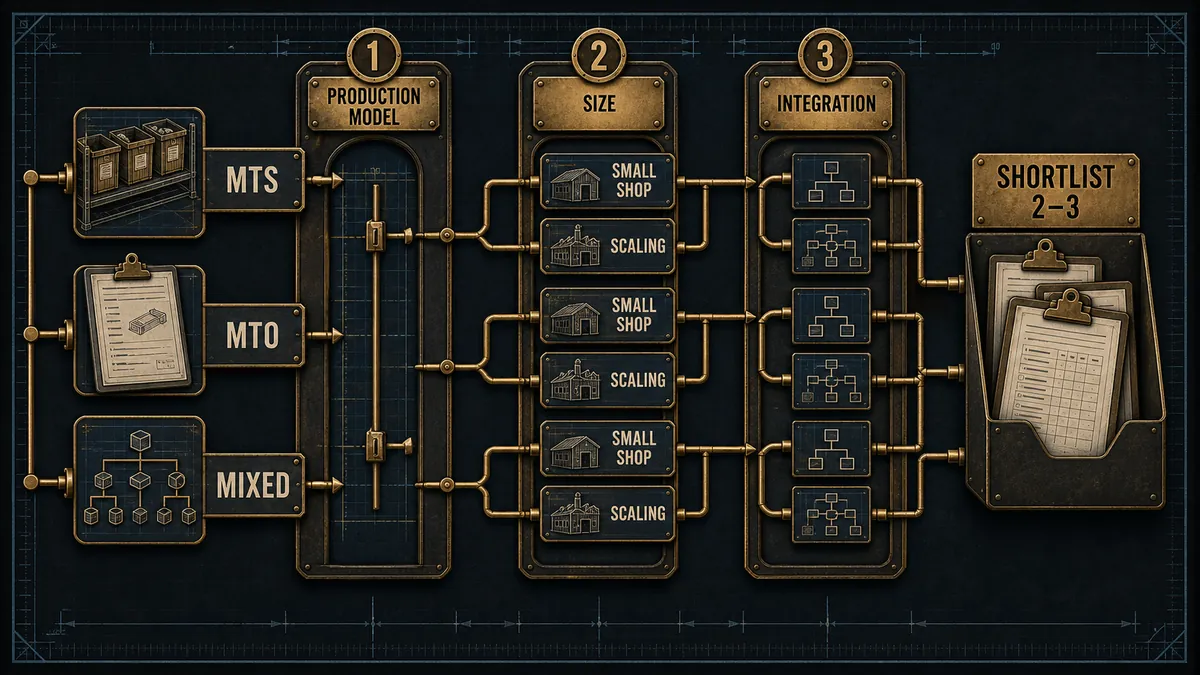
- Choose a make-to-stock system (Fishbowl, Katana) if you build to a forecast and your real pain is inventory accuracy, not job costing.
- Choose a make-to-order system (MRPeasy, JobBOSS²) if every job starts from a quote or RFQ and you need per-order BOMs, routing, and job costing.
- Choose a mixed-mode platform (Odoo, Business Central, Acumatica) if you run both stocked and custom work today, or expect to within two years.
- Step up to Epicor Kinetic or NetSuite when you outgrow seat-based tools, run multiple sites or entities, or need deep MES and quality.
- Do not pay enterprise prices (SAP, NetSuite) for a single-site shop under roughly 50 staff unless a customer mandate or compliance requirement forces it.
The best ERP for manufacturing is the cheapest system that still fits how you build, not the most powerful one you can afford.
What ERP really costs a small manufacturer
Manufacturing ERP costs far more than its subscription line, and the gap between sticker price and total cost is where small-shop budgets break. Two systems with similar monthly fees can differ by tens of thousands of dollars once implementation, data migration, and integrations are counted. That matters more when demand is rising: ISM’s June 2026 manufacturing forecast points to revenue and capacity growth with only modest hiring, making ERP implementation discipline a throughput issue. The 2026 Schneider HPE service model shows the same budget lesson in controls: OpEx packaging does not remove integration scope. That matters more when demand is rising: ISM’s June 2026 manufacturing forecast points to revenue and capacity growth with only modest hiring, making ERP implementation discipline a throughput issue.
Start with the published spread. Verified in June 2026, entry-level cloud MRP starts at $49 per user per month with MRPeasy, Dynamics 365 Business Central lists $110 per user per month for its manufacturing-capable Premium tier, and Acumatica’s bundled APEX package starts under $2,185 per month flat. Above that, the enterprise tier goes quiet: NetSuite, Epicor Kinetic, SAP Business One, and JobBOSS² all keep pricing behind a sales conversation, which usually signals five- and six-figure annual commitments once users and modules are added.
Implementation is the line that surprises people. Practitioners comparing job-shop systems report entry-level deployments landing in the low five figures while heavier, compliance-grade systems reach the $40,000-plus range for a similar-size shop, with most of that going to setup, configuration, and training rather than software. Plan for it before you sign, not after.
First-year ERP cost = (Monthly subscription × 12) + Implementation + Data migration + Integrations + Training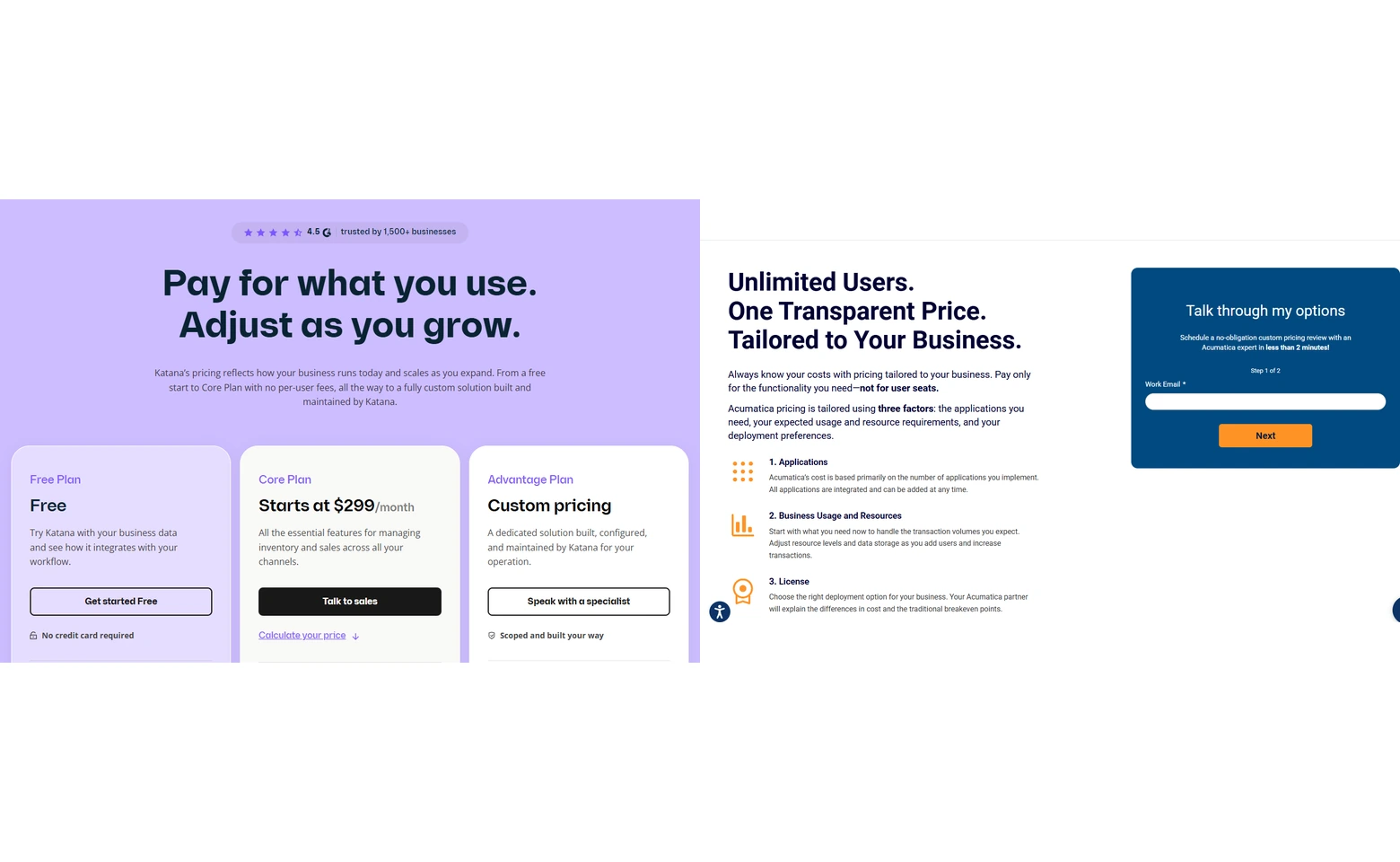
PRO TIP
Get every quote-based vendor to itemize software, implementation, and annual support separately, in writing. A low monthly license with a heavy implementation fee can cost more over three years than a higher subscription that deploys in weeks.
Frequently Asked Questions
It depends on your production model. Small make-to-order shops fit MRPeasy, inventory-led makers fit Katana or Fishbowl, and mixed-mode shops that are scaling fit Dynamics 365 Business Central or Acumatica. For most small manufacturers, cloud MRP like MRPeasy, from $49 per user per month, is the lowest-risk starting point.
Published prices start around $49 per user per month for cloud MRP and run to $110 per user per month for Dynamics 365 Business Central Premium, while Acumatica’s APEX bundle starts under $2,185 per month. Mid-market systems like NetSuite, Epicor, and SAP are quote-only, often five to six figures a year once implementation is included.
The big three ERP vendors are SAP, Oracle, and Microsoft. For large manufacturers they dominate, but small shops often get a better fit and faster payback from SMB-focused systems like MRPeasy, Katana, Acumatica, or Microsoft’s own Dynamics 365 Business Central, which is sized for smaller operations.
SAP S/4HANA usually is, but SAP Business One is its small-business product and can fit smaller manufacturers. That said, many small shops choose lighter cloud options, MRPeasy or Katana for simple operations, Business Central or Acumatica for mixed-mode, because they deploy faster and cost less to run.
MRP (material requirements planning) plans materials, production schedules, and work orders. ERP wraps that production core in finance, sales, purchasing, inventory, and sometimes CRM, so the whole business runs on one system. Many small shops start with focused MRP like MRPeasy and move to full ERP as they scale.
Choosing ERP is one half of turning capability into orders; the other half is a website that converts the buyers your new system helps you serve. If you want a clear read on where your site is losing quote requests, request a free manufacturer website investigation and we will show you what to fix first.
