
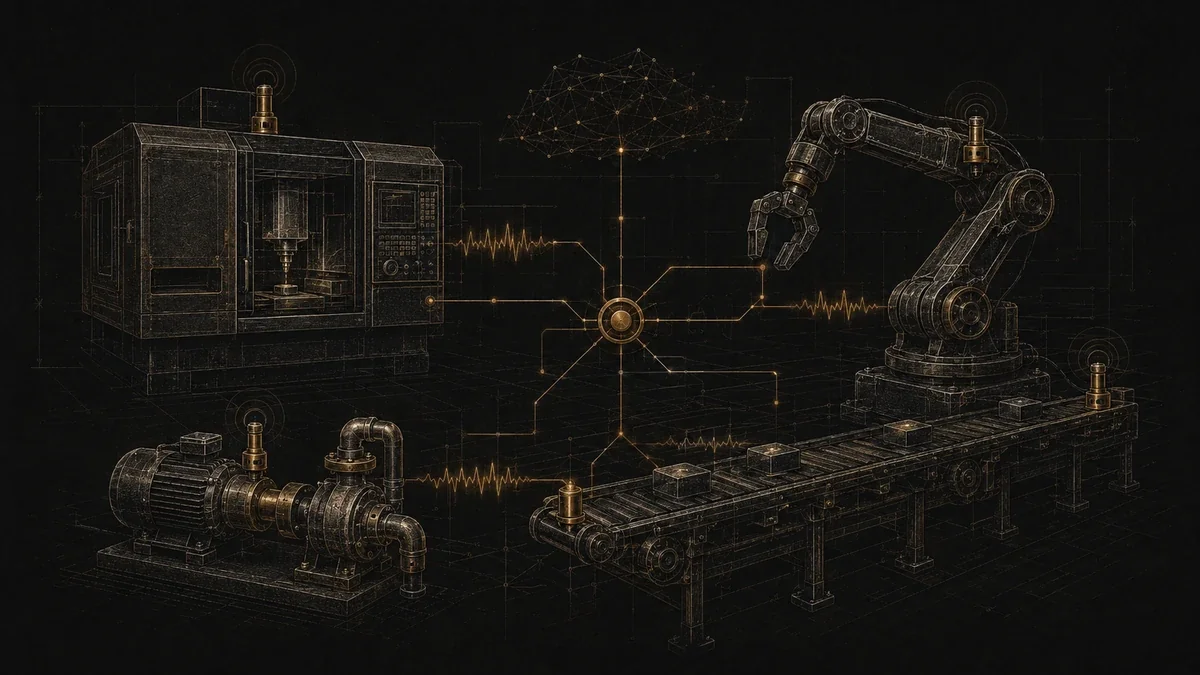
The phrase Industry 4.0 shows up on every trade-show banner and vendor slide, usually bolted to a product someone wants to sell you. On the plant floor it means something narrower and far more useful: machines that carry sensors, a network that carries their data off the machine, and software that turns that data into a decision faster than a supervisor walking the floor with a clipboard could. That is the whole idea. Most of the rest is packaging.
This guide strips Industry 4.0 and the Industrial Internet of Things (IIoT) back to what they actually change about running a plant: what gets instrumented, where the data goes, which core technologies matter, and where a small or mid-sized manufacturer should start without signing a seven-figure “digital transformation” contract. No buzzwords, no maturity theater, just the parts that earn their keep.
Direct answer — What is Industry 4.0?
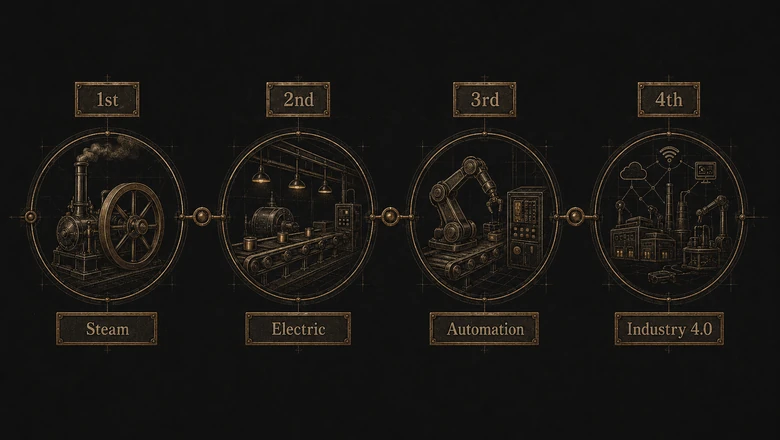
Industry 4.0 is the fourth industrial revolution: the use of connected sensors, data, and software to let machines, systems, and people share information and act on it in near real time. It builds on steam (1.0), electricity and mass production (2.0), and computers and automation (3.0). It is not a single product you buy. It is a set of technologies, led by the Industrial Internet of Things, that make a factory’s data visible and usable. “Smart manufacturing” means roughly the same thing.
Key Takeaways
- Industry 4.0 is not a purchase. It is connected sensors plus data plus software applied to production. IIoT is the layer that gets machine data off the machine.
- The four revolutions in one line: steam (1.0), electricity and mass production (2.0), computers and PLCs (3.0), connected data and cyber-physical systems (4.0).
- The core technologies are a short list: IIoT sensors, edge and cloud, analytics, AI and machine learning, digital twins, robots and cobots, additive manufacturing, AR, and OT cybersecurity.
- IIoT is not consumer IoT. Industrial sensors are built for uptime, harsh conditions, and decades-long machine life, and a failed reading stops production, not a playlist.
- Most manufacturers are early. 95% are investing in AI, yet far more are still piloting smart manufacturing than running it at scale (Rockwell, 2025). Being deliberate beats being first.
- Start with one bottleneck asset. Instrument it, make its data visible, prove ROI on a single use case, then fund the next step with the win.
What Industry 4.0 actually means (skip the buzzwords)
Industry 4.0 is the fourth industrial revolution, defined by connected machines and shared data rather than by one new machine or power source. The label comes from “Industrie 4.0,” a German government initiative announced at Hannover Messe in 2011, and it caught on because it named a shift people were already feeling on the floor.
The number makes more sense once you see the three revolutions behind it:
- Industry 1.0 (late 1700s): water and steam power mechanized work that had been done by hand.
- Industry 2.0 (early 1900s): electricity and the moving assembly line brought mass production.
- Industry 3.0 (1970s): computers, PLCs, and early automation let individual machines run themselves.
- Industry 4.0 (2011 onward): networks and data connect those machines so information flows across lines, plants, and business systems, and decisions get made on that data automatically or by a person reading a live number.
The jump from 3.0 to 4.0 is the part worth internalizing. Automation 3.0 made a single machine repeat a task without a human. Industry 4.0 connects the machines to each other and to software, so the value comes from the data moving between them, not from any one machine working harder. The term of art for that bridge between a physical machine and its digital record is a cyber-physical system. If you want the hands-on version of turning that idea into working cells and lines, that is the job of a full industrial automation build-out, which sits one layer below the strategy.
What is IIoT, and how it differs from the IoT on your phone
The Industrial Internet of Things (IIoT) is the network of sensors, machines, and controllers in a factory that collect and exchange data over a network. It is the plumbing underneath Industry 4.0: without it, there is no data to be smart with.
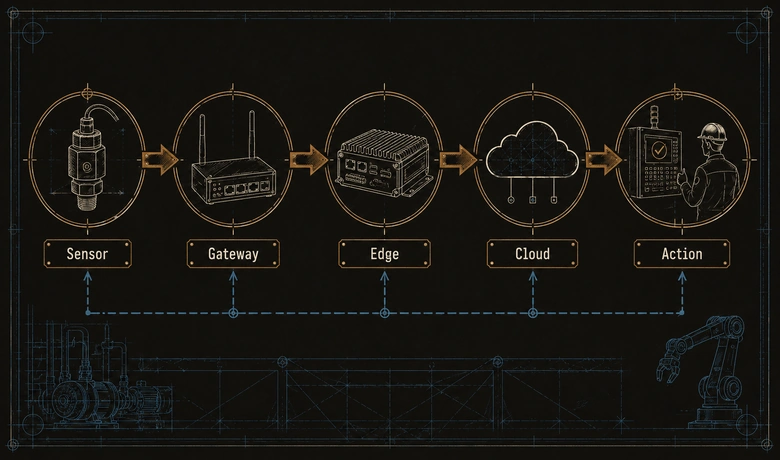
In practice, IIoT is a chain. A sensor on a motor reads vibration, temperature, or current draw. A gateway or edge device gathers those readings. The data then moves to a platform where software can watch it, chart it, and raise an alert. Add up thousands of those chains across a plant and you have the raw material for every Industry 4.0 promise, from predictive maintenance to a live OEE number.
People conflate IIoT with the smart speaker in their kitchen, and that mix-up leads to bad buying decisions. The differences are real:
| Dimension | Consumer IoT | Industrial IoT (IIoT) |
|---|---|---|
| Typical device | Smart speaker, thermostat, watch | Vibration or temperature sensor, PLC, machine controller |
| Cost of a failed reading | Minor annoyance | Scrap batch, downtime, safety event |
| Operating environment | Home or office | Heat, dust, vibration, coolant, EMI |
| Expected lifespan | 2 to 5 years | 10 to 25 years, matched to the machine |
| Common protocols | Wi-Fi, Bluetooth | OPC UA, Modbus, MQTT, EtherNet/IP |
| Design priority | Convenience | Uptime, safety, data integrity |
The takeaway is that IIoT sensors are chosen the way you choose any plant equipment: for the environment, the machine life, and the consequence of failure. A consumer-grade sensor that drops a reading now and then is fine on a doorbell and dangerous on a stamping press.
The core Industry 4.0 technologies (the actual short list)
Industry 4.0 technologies are a defined set of tools that connect, analyze, and act on factory data, not an open-ended list of trend words. Nine of them do the real work, and every “smart factory” pitch you hear is some combination of these:
| Technology | What it is | What it does on the plant floor |
|---|---|---|
| Industrial IoT (IIoT) | Sensors and connectivity on machines | Gets real-time condition and output data off equipment |
| Edge and cloud computing | Local plus remote compute | Processes data near the machine for speed, stores and analyzes at scale in the cloud |
| Big data and analytics | Tools that find patterns in high-volume data | Turns thousands of readings into trends, alerts, and root cause |
| AI and machine learning | Models that predict and classify | Predicts failures, flags defects, and tunes settings without a hand-written rule for every case |
| Digital twin | A live virtual model of an asset, line, or product | Lets you simulate and test a change before touching the real machine |
| Robots and cobots | Automated and collaborative arms | Handle repetitive, precise, or unsafe tasks; cobots work beside operators |
| Additive manufacturing | Layer-by-layer 3D printing | Produces prototypes, tooling, jigs, and low-volume or complex parts on demand |
| Augmented reality (AR) | Digital overlays on the real view | Guides assembly and maintenance and enables remote expert support, hands-free |
| OT cybersecurity | Security for operational technology | Protects connected machines from the risk that connectivity introduces |
Read that list top to bottom and a shape appears. Connectivity is the spine, because nothing else works until the data leaves the machine. Analytics and AI are where value compounds, since a prediction is worth more than a chart. In Rockwell’s 2025 survey of more than 1,500 manufacturers, 95% said they had invested or planned to invest in AI within five years, which tells you where the money is heading even if the floor has not caught up yet. If you want the concrete version of that, our rundown of where factory AI actually earns its keep covers the applications worth funding first.
One row on that table gets skipped in most vendor decks, so name it plainly: OT cybersecurity is the tax you pay for connecting anything. The moment a machine joins a network, it becomes reachable, and a stopped line is a worse outcome than a leaked spreadsheet. Budget for it from day one, not after the first incident.
A note on Industry 4.0 standards and connecting old machines
The question every plant hits second is how to connect equipment that predates the internet. The floor already speaks in PLCs and SCADA systems, so the job is getting their data into a common language. OPC UA has become that language, a vendor-neutral protocol for moving machine data between controllers, MES, and the cloud. Above it, ISA-95 (the IEC 62264 standard) defines how the plant floor talks to ERP, and Germany’s RAMI 4.0 reference model maps the whole stack from a single sensor up to the connected supply chain. You do not need to memorize these. You need to know they exist, because “horizontal” integration across your suppliers and “vertical” integration from the floor up to ERP are where retrofit projects live or die, and 5G is starting to make the wireless side of it practical for older machines.
Digital twins: the one worth understanding first
A digital twin is a live virtual model of a physical asset, fed by real sensor data, used to simulate and predict how the real thing behaves. The word gets misused, so start with what it is not: a CAD drawing is static, and a dashboard is a rear-view mirror. A twin is different because it stays in sync with its physical counterpart through a constant feed of IIoT data, so it can answer “what happens if” questions before you touch the floor.
Twins come at three scales. An asset twin models one machine or component. A process twin models a line or cell. A system twin models a whole plant or supply chain. The higher you go, the more data and integration it takes, which is why full plant twins tend to be big-company projects.
The payoff is testing changes in software instead of in production. McKinsey reports that digital twins can cut product development time by up to 50%, and the same logic applies to a new maintenance interval, a reordered line, or a schedule change you would rather not learn about the hard way. For a small manufacturer, the honest move is to start with a single-asset twin on the machine that matters most, or to skip twins entirely until the sensor data underneath them is trustworthy. Building a full digital twin in manufacturing is a deep subject that deserves its own treatment; the point here is to know what the word means and where it fits.
What Industry 4.0 looks like on the plant floor (real examples)
Industry 4.0 on the plant floor usually shows up as five practical wins, not one dramatic overhaul. None of them require rebuilding the factory. Each one turns a stream of machine data into a decision that used to depend on someone noticing.
Predictive maintenance. Sensors watch a motor’s vibration and temperature, and software flags a bearing failure days before it happens. The U.S. Department of Energy found that a predictive program can deliver 25% to 30% lower maintenance costs and 70% to 75% fewer breakdowns than running to failure. This is the single most common on-ramp, and it is why software that reads a machine’s condition signature is where many plants spend their first Industry 4.0 dollar.
Downtime and OEE visibility. Machines report their own run, idle, and fault states, so you get a real Overall Equipment Effectiveness number instead of a shift lead’s estimate. Once the number is trustworthy, the arguments about where time is lost stop being opinions. If OEE is new to you, the math behind a number that finally means something is worth ten minutes.
Connected quality and machine vision. Cameras inspect every part instead of a sample, and defects get caught in-line rather than at final audit. Pairing cameras that check every part with analytics moves quality from reactive sorting to catching the drift before it makes scrap.
Digital work instructions and AR. Operators follow on-screen, version-controlled steps, sometimes overlaid on the part through AR glasses. Tribal knowledge stops walking out the door at retirement, and a new hire gets to competent faster.
Connected inventory and traceability. Scans and RFID track material from raw stock through work-in-process to finished goods, with lot and serial genealogy that turns a recall from a panic into a query.
Where the data lands, and what it’s worth
All of this data has to land somewhere, and that somewhere is usually a manufacturing execution system sitting between the machines and the ERP. The payoff shows up once that data is used to act, not merely collected.
Across the World Economic Forum’s Global Lighthouse Network, the most advanced plants have averaged 50%-plus productivity gains and 80%-plus defect reductions, with reported payback of two to three times the investment over three years.
Those Lighthouse numbers, drawn from the 201 sites recognized as of September 2025, are the ceiling, not the floor. They come from years of disciplined work, not a single software purchase. The reason to cite them is to show the wins are real and measurable, which is exactly what makes the hype forgivable.
The smart factory maturity ladder: figure out where you actually are
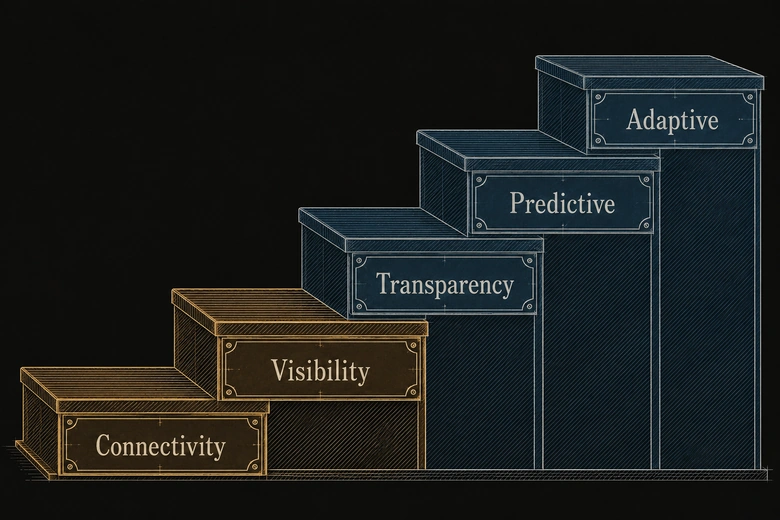
A smart factory maturity model sorts a plant’s Industry 4.0 progress into stages, from basic connectivity to autonomous operation. The version most engineers borrow from is the Acatech Industrie 4.0 Maturity Index, and it climbs in five rungs:
- Connectivity: machines and systems are networked and can exchange data.
- Visibility: you can see what is happening right now, on a live dashboard rather than a whiteboard.
- Transparency: you understand why it is happening, because analytics surface the cause.
- Predictive capacity: you know what will happen next, from failure forecasts to demand swings.
- Adaptability: the system responds on its own, adjusting settings in a closed loop.
Here is the honest read for most shops. You are at rung one if you can network a machine but still read production off a whiteboard. You are at rung two if you have live dashboards but still guess at causes. Very few small and mid-market plants are past rung three, and that is completely normal. The Rockwell survey’s split, with far more manufacturers piloting than running at scale, is this ladder showing up in the data.
PRO TIP
Do not skip rungs. Buying predictive analytics for data you cannot yet see or trust is a vendor fantasy that ends in a dashboard nobody opens. Earn visibility before you pay for prediction.
The cheapest way to climb from rung one to rung two is often connected maintenance, because the data is simple and the payback is quick. Standing up a connected maintenance system gets work orders, asset history, and downtime causes into one place, which is visibility you can act on without a data-science team.
Where to start (without boiling the ocean)
To start with Industry 4.0, instrument one bottleneck asset, make its data visible, and prove ROI on a single use case before you scale anything. The manufacturers who stall are the ones who buy a platform first and go looking for a problem to solve with it. Reverse that order:
- Pick one asset that hurts. Your bottleneck machine, or the one that fails most and takes the shift down with it.
- Instrument it. A few sensors and a gateway. You rarely need to rip out and replace the existing controls to get useful data.
- Make the data visible. One dashboard someone actually checks daily beats ten reports nobody reads.
- Attach one use case. Downtime tracking or predictive maintenance. One thing, done well, not ten things half-wired.
- Prove the number, then repeat. Take the measured ROI to the next asset and let the win fund the next step.
IMPORTANT
The biggest Industry 4.0 failures are not technical. They are commercial: buying a platform before knowing the use case, then paying a subscription for capability nobody uses. The use case comes first, always.
Budget with your eyes open. Sensors and a gateway are cheap; the real spend is integration and the software subscription that sits on top, which is exactly where quotes get vague. Before you sign anything, our breakdown of what a manufacturing software stack actually costs shows where the recurring charges hide. Industry 4.0 is not a destination you arrive at. It is the habit of connecting one more thing, seeing it clearly, and acting on what you see, funded one proven win at a time.
Frequently Asked Questions
Industry 4.0 is the use of connected sensors, data, and software to make a factory’s machines and systems share information and act on it in near real time. It is the fourth industrial revolution, following steam, electricity, and computers. In plain terms: machines that talk, data that flows, and decisions made on live numbers instead of guesswork.
IoT is the broad idea of connected devices, including consumer gadgets like smart speakers. IIoT, the Industrial Internet of Things, is the factory-grade version: sensors and controllers built for harsh conditions, decades-long machine life, and industrial protocols. The core difference is stakes and durability, since a failed IIoT reading can stop production or create a safety risk.
They are used interchangeably in most conversations. Industry 4.0 is the broader concept of the fourth industrial revolution, while “smart manufacturing” usually names the same connected, data-driven approach applied specifically to production. If someone draws a line between them, smart manufacturing is the plant-floor practice and Industry 4.0 is the umbrella idea it lives under.
Not all of it, and not at once. A small manufacturer rarely needs a full smart factory, but almost every shop benefits from a single connected use case, usually downtime tracking or predictive maintenance on a bottleneck machine. Start with one asset, prove the return, and expand only when the numbers justify it. Deliberate beats early.
Industry 5.0 is an emerging framing that adds human-centered work, resilience, and sustainability on top of Industry 4.0’s connectivity. It does not replace 4.0; it reframes the goal around people and the planet rather than pure efficiency. For most manufacturers it is a direction of travel, not a checklist to act on yet, so getting the 4.0 fundamentals right comes first.