
Manufacturing website design is the work of getting an engineer to qualify your shop before a single email is sent. In its 2025 B2B Buyer Experience Report, published in November 2025 from nearly 4,000 buyers across North America, EMEA and Asia-Pacific, 6sense found that buyers now make first contact 61% of the way through the buying journey, down from 69% a year earlier, while the average buying cycle compressed from 11.3 months to 10.1. Buyers are deciding sooner, and they are deciding from your pages.
That shorter window is why manufacturing web design is a different discipline from generic web design, and why website design for manufacturers keeps failing when it is handed to a studio that treats a factory like a restaurant. A homepage that wins a design award does nothing if a procurement manager cannot confirm your tolerances, your certifications, and your lead times in under a minute. The features that matter are the ones that answer a buyer’s qualifying questions and turn a visit into a request for quote.
This is the buyer’s checklist, not the agency’s. Below are the 25 features industrial buyers expect from a manufacturing website, grouped by the five questions a buyer is really asking, with how to verify each one on your own site.
Direct answer — What is manufacturing website design?
Manufacturing website design is the practice of building a supplier’s site so an engineer or procurement buyer can verify fit and request a quote without calling. It covers 25 features across the five things every industrial buyer checks: that they can find you, that you can prove you make the part, that your quality system is credible, that requesting a quote is easy, and that the site works on a phone. The non-negotiables are capability pages with real specs, visible certifications and lead times, and a qualifying RFQ form. The goal is a qualified quote request, not raw traffic.
Key Takeaways
- Manufacturing website design is judged by buyers before you ever meet them, so design for the question behind the visit, not for visual polish.
- The 25 features sort into five buyer questions: can I find you, can you make my part, can I trust you, how do I get a quote, and is the site usable.
- The three non-negotiables are capability pages with real specs, visible certifications and lead times, and a qualifying RFQ form.
- Self-service is now expected: 95% of B2B buyers who already use a self-service portal say it improves purchasing efficiency (Spryker and Statista, fieldwork March 2025), so gating specs costs you the RFQ.
- Measure the site by qualified quote requests per landing page, not by sessions or bounce rate.
What manufacturing website design has to do that ordinary web design does not
A manufacturing website is a supplier’s primary sales tool: a set of pages that lets an engineer or procurement buyer confirm you can make their part, trust your quality system, and request a quote without picking up the phone. It is closer to a technical document than a brochure, and buyers treat it that way.
Self-service is the expectation now, not a perk. In a study fielded 17 to 21 March 2025 among 100 US B2B buyers in automotive, medtech, agriculture and industrial manufacturing, Spryker and Statista found that 95% of buyers who already use a self-service portal say it improves purchasing efficiency, and 86% of those users rate their buying experience positively against just 32% of non-users. A site that hides specs behind a “contact us” wall fails the first test a buyer runs.
Most manufacturer sites fail it quietly. The Content Marketing Institute’s Manufacturing Content Marketing Benchmarks, Budgets and Trends: Outlook for 2025, fielded June to August 2024 among 104 manufacturing marketers and published in November 2024, found only 20% rate their content strategy as very effective, and 47% admit their content is not tied to the customer journey. It is still the most recent manufacturing-specific edition. The gap between a site that looks fine and a site that earns quotes is the gap this checklist closes.
The 25-feature manufacturing website checklist
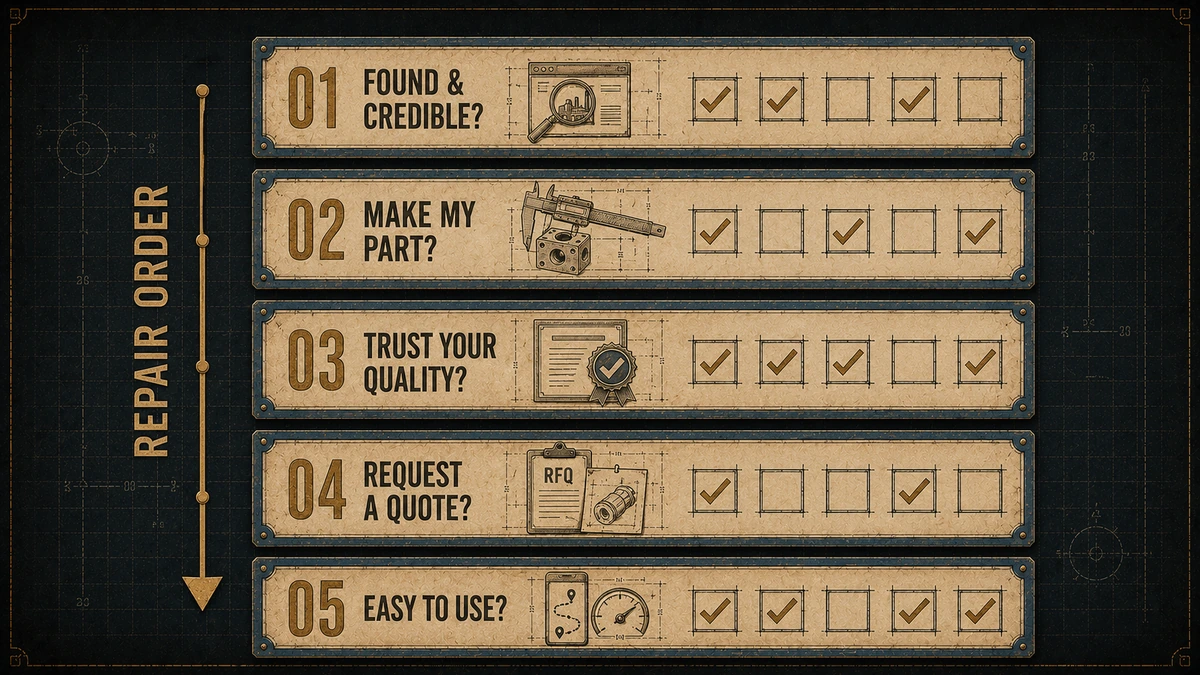
The RFQ-Ready Website Checklist groups 25 features into the five questions an industrial buyer asks on the way to a quote. We built it as the buyer’s scorecard: print it, walk your own site row by row, and mark every feature you cannot find. The features you are missing are the RFQs you are losing.
| # | Feature | Why industrial buyers expect it | How to verify it on your site |
|---|---|---|---|
| Layer 1: Can I find you and do you look credible? | |||
| 1 | Clear positioning statement in the hero | Buyers decide in seconds whether you make what they need | Homepage states what you make and for whom, above the fold |
| 2 | Fast load and Core Web Vitals pass | A slow site reads as operational immaturity | LCP under 2.5s on mobile in PageSpeed Insights |
| 3 | Mobile-responsive, tap-friendly layout | Buyers open your pages between meetings and on the shop floor | Check the mobile share of sessions on your capability pages, then open each one on a phone with gloves on |
| 4 | Search-optimized process and material pages | Buyers search the exact process, not your brand | You rank for a real capability query, not just your company name |
| 5 | Structured data for products and specs | Search and AI engines need labeled facts to quote you | Product or Organization schema validates with no errors |
| Layer 2: Can you make my part? | |||
| 6 | Dedicated capability pages | One combined “capabilities” paragraph cannot rank or qualify | Each core process has its own page with equipment listed |
| 7 | Stated size and tolerance limits | Buyers must confirm fit against a real spec | Largest part, tightest tolerance, and typical volumes are written down |
| 8 | Materials and finishes supported | The wrong material ends the conversation early | A materials page lists grades, properties, and finishes |
| 9 | Industries served pages | Buyers want proof you understand their standards | Pages exist for the industries you actually want more of |
| 10 | Downloadable spec sheets, CAD, and PDFs | Engineers pull files into their own evaluation | Spec sheets and drawings download without a form wall |
| Layer 3: Can I trust your quality system? | |||
| 11 | Certifications shown with scope | ISO 9001, AS9100, and IATF 16949 are gating filters | Certification logos link to scope, body, and current dates |
| 12 | Case studies with real parts | Buyers trust evidence over adjectives | At least three projects show the part, problem, and result |
| 13 | Client logos and named industries | Familiar names lower a buyer’s perceived risk | Logos are real and permitted, not generic stock |
| 14 | Facility photos and equipment list | Buyers want to see the floor that makes their part | Real facility images and a machine list, not stock photography |
| 15 | Lead times stated up front | A buyer who cannot see a timeline has to email a competitor to compare | Typical lead times appear without an email request |
| Layer 4: How do I get a quote? | |||
| 16 | A “Request a Quote” CTA on every page | The buyer should never hunt for the next step | A visible RFQ button sits in the header on all pages |
| 17 | A qualifying RFQ form | Vague forms produce vague, low-quality enquiries | Form asks material, quantity, tolerance, and timeline |
| 18 | Drawing and file upload | Engineers quote from a print, not a description | The form accepts a drawing or 3D file upload |
| 19 | Multiple contact options | Buyers pick the channel that fits the moment | Click-to-call, email, and a scheduling option are present |
| 20 | A stated response time | Silence after a quote request loses the job | The form sets an expectation, such as a reply in one business day |
| Layer 5: Is the site actually usable? | |||
| 21 | Faceted catalog and part-number search | Complex product lines are unusable without filtering | Search handles part-number variants and filters by spec |
| 22 | Logical menus and breadcrumbs | Buyers must orient inside a deep product tree | A mega-menu plus breadcrumbs reach any page in two clicks |
| 23 | Self-service technical resources | Buyers want answers without a sales call | Specs, FAQs, and downloads are open, not gated |
| 24 | Analytics and conversion tracking | You cannot improve a number you do not measure | Qualified RFQs are tracked by landing page |
| 25 | AI-search and answer-engine readiness | Buyers increasingly start in AI answers, not blue links | Pages give clean definitions, tables, and FAQs engines can cite |
No site needs all 25 perfect on day one. The order of the layers is the order of repair: a buyer who cannot find you never reaches your RFQ form, and a buyer who does not trust you never fills it in. Fix top to bottom.
What good manufacturing website design actually looks like
The clearest way to grade a design is to check it against the rows above rather than against how it looks. Four public sites, checked in August 2026, show what individual rows look like when a supplier commits to them.
Protolabs publishes the numbers most shops hide. Its CNC machining pages state a standard milling tolerance of ±0.005 in. (±0.127 mm), a maximum milled envelope of 22 by 14 by 3.75 in., a turning capacity of 3.95 in. diameter by 9 in. long, and a full material list of seven metals and sixteen plastics, with a design guide offered as a download. That is rows 6, 7, 8 and 10 done properly: a capability page written as a spec sheet, not a paragraph of adjectives.
Xometry answers the qualification questions in public. Its CNC service page names its certifications with their editions, ISO 9001:2015, ISO 13485, IATF 16949:2016 and AS9100D, plus ITAR registration, and states a standard lead time of three to seven business days. Rows 11 and 15 are the two most commonly buried facts on a manufacturer site, and putting them on the page removes two emails from the buyer’s process.
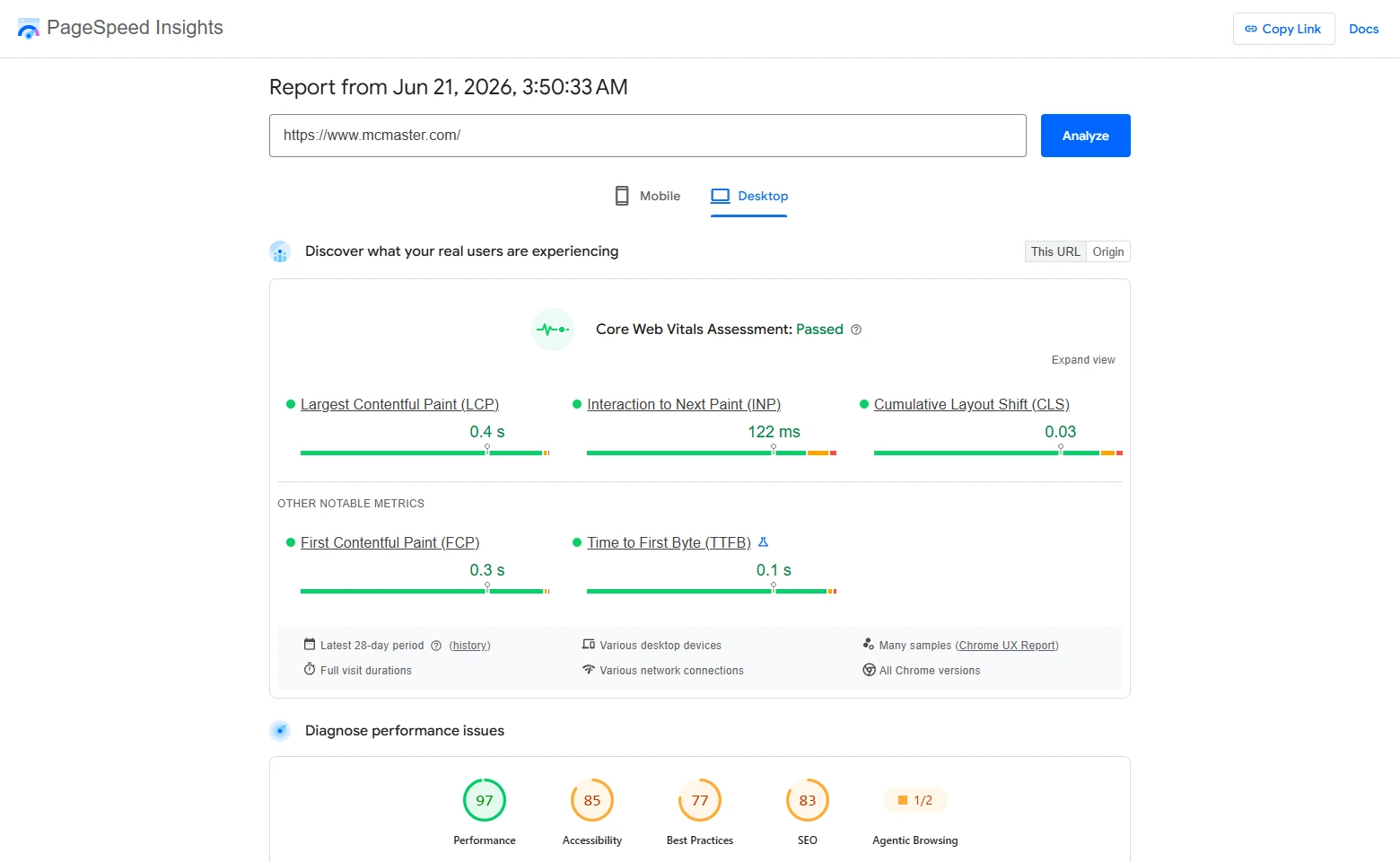
McMaster-Carr is the speed benchmark. When we ran it through PageSpeed Insights on 21 June 2026, the desktop result passed Core Web Vitals with a Largest Contentful Paint of 0.4 seconds, an Interaction to Next Paint of 122 milliseconds and a Cumulative Layout Shift of 0.03. Its mobile and origin runs did not pass, which is worth stating plainly: even the reference case has a phone problem. That is row 2, and it is the row most often traded away for a homepage slider.
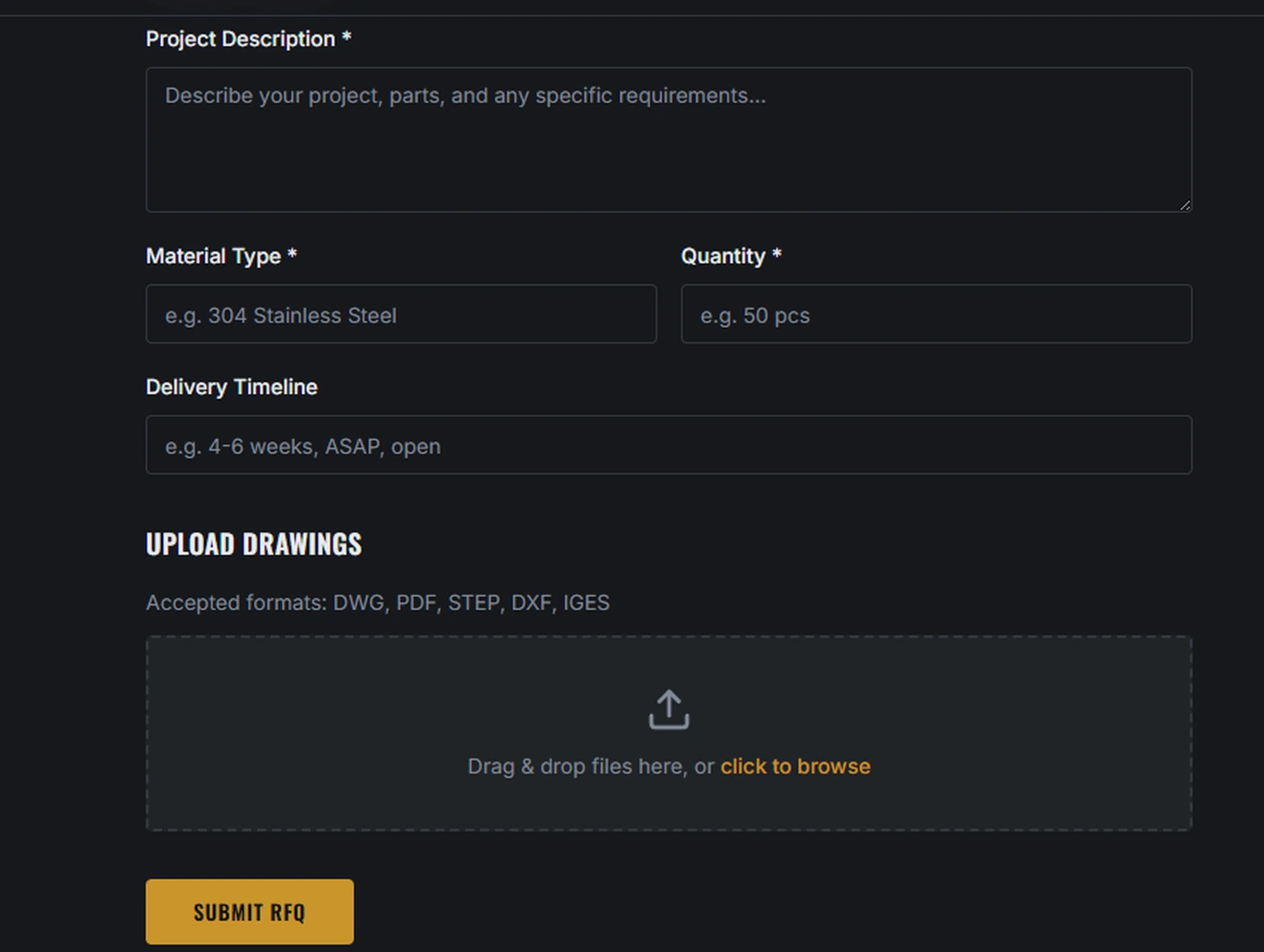
Pinnacle Metal Works shows what a qualifying form looks like at shop scale. Its public RFQ form, captured on 21 June 2026 and shown further down this page, asks for a project description, material type, quantity, delivery timeline and a drawing upload. That is rows 17 and 18, from a shop with no marketplace behind it.
Two of those four are digital-manufacturing marketplaces with engineering teams behind their websites, and a thirty-person job shop is not going to reproduce their quoting software. It does not need to. The transferable part is free: the tolerance table, the certification scope, the lead time, and a form that asks for a drawing. Almost everything on the checklist that changes a buyer’s mind is text you already know.
Capability pages: prove you can make the part
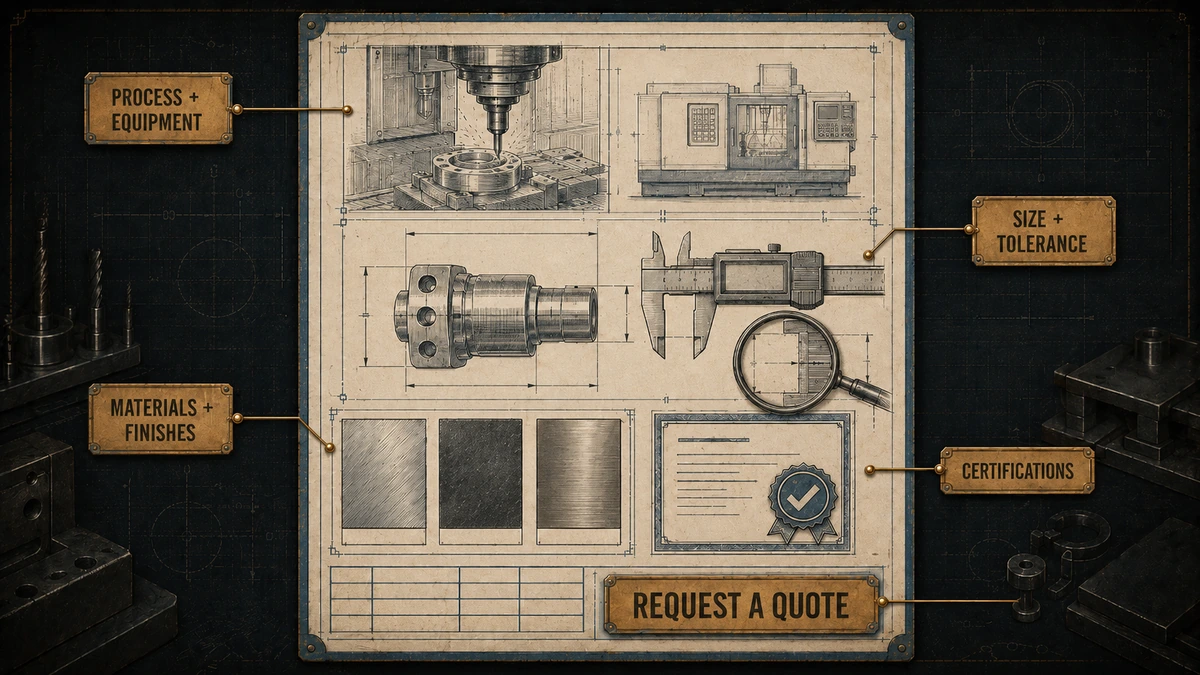
Capability pages are the spine of a manufacturing website, because they answer the only question that starts a quote: can you make my part? A single page that lists every process in one paragraph cannot rank for a specific search and cannot qualify a specific buyer. Each process deserves its own page.
Write each page like a spec sheet, not a brochure. State the largest part you can hold, the tightest tolerance you can certify, the volumes you run well, and the materials and finishes you support. Those specifics do two jobs at once: they help the page rank for the exact query an engineer types, and they pre-qualify the enquiry so your estimators stop quoting work you cannot win. The page architecture and the evidence that make a capability page convert are a discipline of their own, and our done-for-you manufacturing website design service exists to build exactly these pages when you would rather not build them in-house. If you are weighing outside help more broadly, the same buyer-first standard is what should decide which manufacturing marketing agency to trust.
PRO TIP
Build one capability page for each process-and-industry pair you genuinely want more of. A shop chasing aerospace machining work needs a page for exactly that, not a line buried in a combined list. Specific pages win specific quotes.
Design for more than one buyer
A manufacturing website serves several people at once, and the strongest ones make room for each. The engineer wants tolerances, materials, and CAD files. The procurement manager wants certifications, lead times, capacity, and terms. The operations leader or owner wants proof you are reliable at volume. One generic “products” section forces all three to dig, and buyers who have to dig leave.
Give each audience a clear path from the homepage. Strong industrial sites split distinct verticals right up front, so a medical-device engineer and a heavy-equipment buyer each land on relevant pages without wading through the other’s content. The capability and industry pages in the checklist above are how you build those paths, which is why a flat brochure site loses to a structured one even when the brochure looks nicer.
Trust signals buyers look for before they ever enquire
Trust signals are the features that tell a buyer your quality system is real before they risk a quote request. For industrial buyers, the first signal is compliance: certifications such as ISO 9001, AS9100, and IATF 16949 are filters that decide whether you are even eligible to quote. Show them with scope and current dates, not as a faded logo in the footer. Those same records become pass/fail evidence in strategic supplier qualification before a bidder reaches price scoring.
Evidence beats adjectives everywhere else. Case studies that name the part, the problem, and the measured result do more than any “quality is our passion” line. Real facility photos and a machine list let a buyer picture the floor that will make their part. And lead times belong on the page, not behind a form, because timeline is one of the first things procurement screens for. A documented lean manufacturing result should name the baseline, the change, the metric, and the sustained outcome.
Vary the proof, because different buyers trust different things. An engineer is convinced by a tolerance held and a finish certified; a procurement manager is convinced by a recognizable client logo and an on-time-delivery number; an owner is convinced by years in business and capacity at volume. A site that offers only one kind of proof persuades only one kind of buyer, so spread certifications, named projects, logos, facility imagery, and concrete numbers across the pages where each audience lands. Suppliers offering vendor-managed inventory should publish the replenishment data and ownership rule behind VMI, along with the service level and exception path, instead of treating it as a slogan.
IMPORTANT
Do not gate specs, lead times, or drawings behind a “request access” wall. A buyer who cannot qualify you in 60 seconds moves to the supplier who let them. Gating the exact facts a buyer needs costs you the exact RFQ you wanted.
The RFQ form is the most important page on your site
The RFQ form is where website design for manufacturers either pays off or leaks, so treat it as the most important page you own. A buyer who searched a precise query and read a precise capability page, then hits a blank “Contact us” box, will often leave. The ones who do submit hand your sales team almost nothing to act on. Closing that gap is a design job in itself: the fields a converting RFQ form keeps and cuts decide whether a submission arrives quotable or blank. That leak gets more expensive the more you spend upstream, because every marketing channel you fund pours its traffic into this one form, which is why fixing the site comes first in the order to spend a marketing budget in.
Design the form to qualify. Ask for material, quantity or volume, tolerance or spec, target timeline, and a drawing or file upload. Those fields raise the quality of every enquiry and quietly filter the tire-kickers who will not spend two minutes describing a real job. Tightening the form so it screens weak enquiries without scaring off good buyers is its own craft, and turning more visitors into qualified quote requests is where most of the recoverable revenue on a manufacturer site actually sits. Those same fields are early demand signals; routing them into a sales and operations planning process that reconciles demand with capacity is what stops the website from promising work the plant cannot schedule.
The best manufacturing website is not the one that wins a design award. It is the one an engineer can use to qualify you, and quote you, in under a minute.
Speed, mobile, and the technical foundation
Technical performance is a credibility signal, not just a ranking factor. A buyer evaluating whether to trust your shop reads a slow, clunky site as a sign of operational immaturity. The “3-second rule” people ask about is real in spirit: if your pages crawl, buyers leave before they read a word.
Hold your site to current standards. Google’s Core Web Vitals thresholds ask for a Largest Contentful Paint under 2.5 seconds, an Interaction to Next Paint of 200 milliseconds or less, and a Cumulative Layout Shift of 0.1 or less, measured at the 75th percentile of page loads across mobile and desktop. Mobile is where the margin is thinnest, because buyers open capability pages between meetings and on the shop floor rather than at a desk. Check your own analytics for the mobile share of sessions on those pages before you decide how much the phone experience is worth to you. Before you rebuild anything, run a diagnostic so you fix the right things in order: the foundation first, then the pages, then the proof.
Make your site easy for search and AI engines to cite
Findability is the feature that decides whether the other 24 ever get seen. Buyers search the process, the material, and the tolerance, not your company name, so your pages have to be built to surface for those queries and to be cited when an AI answer summarizes them.
The same structure that helps engines rank you also helps them quote you: a clean definition near the top, a comparison or checklist table, specs written as specs, and a clear question-and-answer format. AI Overviews and tools like ChatGPT and Perplexity build answers from pages that made the facts easy to lift, and they cite the source. Earning that citation for “ISO 9001 certified aluminum die casting” is worth more than a thousand stray visits, and it is the same discipline behind our manufacturing SEO and AI-visibility work. Clean, first-party facts are what get a manufacturer page both ranked and cited.
What manufacturing web design services actually include
Manufacturing web design services normally cover four things: the structure of the site, the pages that carry your capabilities, the RFQ path, and the technical build that keeps those fast and maintainable. Where quotes differ is how much of the fourth item is included, and how much of the first is quietly left to you.
Design and development are separate jobs, and the split matters when you compare proposals. Manufacturing web design decides what a buyer sees and in what order: how many capability pages exist, what each one states, where the spec table sits, what the RFQ form asks. Manufacturing web development is what makes it run: the platform, the templates, part-number search and filtering, file-upload handling on the form, the integration into your CRM or ERP, and the performance work behind the Core Web Vitals numbers. A studio strong on the first and weak on the second ships a site that looks right and cannot hold a catalogue.
A scope worth paying for names its deliverables in checklist terms: how many capability pages, who writes the tolerances and materials, whether certifications are collected with their scope and dates, whether the RFQ form is instrumented so you can see qualified requests by landing page, and who owns the migration and the redirects. A scope that says “modern responsive design” and “SEO optimisation” and stops there has not been costed against anything you can verify.
Ask what happens after launch, too. Capability pages age when equipment changes, and certifications lapse on a fixed date, so someone has to own the update or the site quietly stops being true.
Hiring a manufacturing web design agency: what to demand
A manufacturing web design agency should be judged on the evidence it can show against the 25 rows, not on the portfolio it leads with. Most industrial portfolios are screenshots of homepages, and the homepage is the one page in this checklist that carries almost no qualifying information.
Ask for four things instead. First, a capability page they wrote, with the tolerances and materials still on it, so you can see whether they can write to a spec or only to a brand. Second, a live RFQ form they designed, and the fields it asks for. Third, the instrumentation behind that form: can they tell you how many qualified requests a page produced, or only how many sessions? Fourth, the certifications your buyers filter on, named without prompting. An agency that cannot say what AS9100 or IATF 16949 is for will write your trust section from whatever it finds online.
Be sceptical of anyone who can show a manufacturer’s site they launched but not one they improved. A launch proves they can build. An improvement proves they know what moved. And a proposal written around traffic rather than quote requests is being measured against the wrong number.
We should be straight about our own position. Factory Investigator’s parent company sells this work, and the website design service linked earlier on this page is ours. That is precisely why the test above is written as things you can demand from anybody, including us.
What manufacturing website design costs
Manufacturing website design is priced by scope, and the scope that matters is how many pages have to carry real specifications. The ranges below are what we see quoted in the US market as of Q3 2026, for the work itself rather than for any platform licence.
A focused rebuild for a job shop runs to the low five figures (as of Q3 2026): a homepage, five to ten capability pages written as spec sheets, a certifications and quality page, and a qualifying RFQ form with file upload. Most of that cost is not visual. It is the interviewing needed to get your tolerances, volumes and materials out of the estimator’s head and onto a page.
A catalogue site is a different order of work. Faceted search across part numbers, spec tables generated from a product database, CAD and datasheet downloads, and an ERP or CRM integration push a project into the mid five figures, with six figures normal once customer-specific pricing or a configurator is in scope (as of Q3 2026).
The cheapest useful project is neither of those. Fixing the RFQ form and rewriting the top three capability pages on the site you already own is often a four-figure engagement (as of Q3 2026), and it moves the number the other two are measured by. Spend against quotes won: a site that doubles its traffic and still produces the same five vague enquiries has not paid for itself.
Where to start if you can only fix five things
Prioritize by what blocks an RFQ first. If your budget covers only a handful of fixes this quarter, repair in this order and you will recover the most lost quotes for the least spend. Within the quote path itself, our audit of 25 manufacturer sites found where the friction points concentrated: mobile usability, a stated response time and a nearby trust signal accounted for 274 of 490 points, or 56%.
- Fix the RFQ form first. Add material, quantity, tolerance, timeline, and file upload. This is the cheapest change with the largest effect on lead quality.
- Publish or sharpen your top three capability pages. Lead with the processes you most want more of, written as spec sheets.
- Surface certifications and lead times. Move them out of the footer and onto every relevant page.
- Pass Core Web Vitals on mobile. A fast, tap-friendly site protects every other fix from leaking.
- Open your specs and downloads. Remove the form walls in front of the facts buyers use to qualify you.
Frequently Asked Questions
A manufacturing website is a supplier’s primary sales tool, built so engineers and procurement buyers can confirm you make their part, trust your quality system, and request a quote without calling. It centers on capability, process, material, and certification pages plus a qualifying RFQ form, and it reads more like a technical document than a brochure.
The essentials are capability pages with real tolerances and volumes, materials and finishes supported, visible certifications with scope, case studies, lead times stated up front, a qualifying RFQ form with file upload, fast mobile performance, logical navigation, and open self-service specs. Together these answer the buyer’s five questions: can I find you, can you make my part, can I trust you, how do I quote, and is the site usable.
It depends on scope. A focused redesign for a small shop, with strong capability pages and a real RFQ form, typically runs in the low five figures, while a large catalog with configurators, customer pricing, and ERP integration reaches six figures (as of Q3 2026). Judge the spend against quotes won, not page count, and start with the RFQ form and top capability pages for the fastest return.
The 3-second rule is the idea that a visitor should understand what you do, and the page should load, within about three seconds, or they leave. For manufacturers it has two parts: speed, measured by Core Web Vitals such as a Largest Contentful Paint under 2.5 seconds, and clarity, meaning your hero states what you make and for whom right away.
Manufacturing web design decides what a buyer sees and in what order: how many capability pages exist, what specifications each one states, where the spec table sits, and what the RFQ form asks for. Manufacturing web development is what makes that run: the platform and templates, part-number search and filtering, file-upload handling, the CRM or ERP integration, and the performance work behind Core Web Vitals. Most manufacturer sites fail on the design decisions rather than the development, because the missing tolerances and certifications are a content problem, not a code problem.
The 7 C’s are content, context, community, customization, communication, connection, and commerce. They are a general framework, but for a manufacturer the ones that earn quotes are content and communication: precise capability and spec content, and a clear path to request a quote. A buyer cares less about community than about whether your page answers their qualification question.
If you want a clear read on which features your current site is missing and which ones are costing you quotes, request a free manufacturer website investigation and we will show you exactly where buyers are dropping off and what to fix first.
