
Lean manufacturing has become unusually easy to imitate and unusually hard to practice. A plant can buy red-tag tape, fill a wall with charts, name a continuous-improvement manager, and still ship late with too much work-in-process. The props are visible. The management system that makes problems safe to expose is not.
This guide treats lean as a manufacturer has to adopt it: one customer problem, one value stream, one measured experiment at a time. It maps the principles and tools, separates Lean from Six Sigma, and shows where the effort turns into theater.
Direct answer — What is lean manufacturing?
Lean manufacturing is a management system that defines value from the customer’s view, maps the value stream, makes work flow, lets demand pull production, and repeatedly pursues perfection. It produces shorter lead times, less work-in-process, fewer defects, and better use of people and equipment by removing non-value-adding work. It is not a cost-cutting event or a toolbox; it is a daily way of exposing and solving problems.
Key Takeaways
- Lean is a management system built around value, value stream, flow, pull, and perfection, not a tool bundle.
- Start with one product family and one customer problem. A plant-wide launch makes activity visible before it makes a result visible.
- Use Lean for waste and flow, Six Sigma for persistent variation, and Lean Six Sigma when the problem genuinely contains both.
- A 30-day pilot can prove a countermeasure; lean has no finish date because the next problem always appears.
- Lead time, WIP, first-pass yield, OEE, and problem-closure time matter more than event counts, audit scores, or the number of boards installed.
- If improvement ideas become a surprise headcount case, people learn to hide the next problem. That is the fastest way to kill lean.
What lean manufacturing actually means
Lean manufacturing is a system for creating the value a customer needs with less waste, time, material, effort, and capital. Waste reduction matters, but it is the consequence of designing a better flow and teaching people to solve the problems that interrupt it. A plant is not lean because it carries little inventory or looks tidy. It is lean when abnormalities surface quickly, the people closest to the work can act on them, and management removes the conditions that keep producing them.
From TPS to the five principles
The operating logic grew from the Toyota Production System. Toyota describes TPS as the pursuit of waste elimination and shorter lead times through two pillars: jidoka, which stops an abnormal process before defects continue, and Just-in-Time, which makes only what is needed when it is needed. Toyota also states that the premise is making work easier for workers. That last point is the part copied tool programs tend to erase.
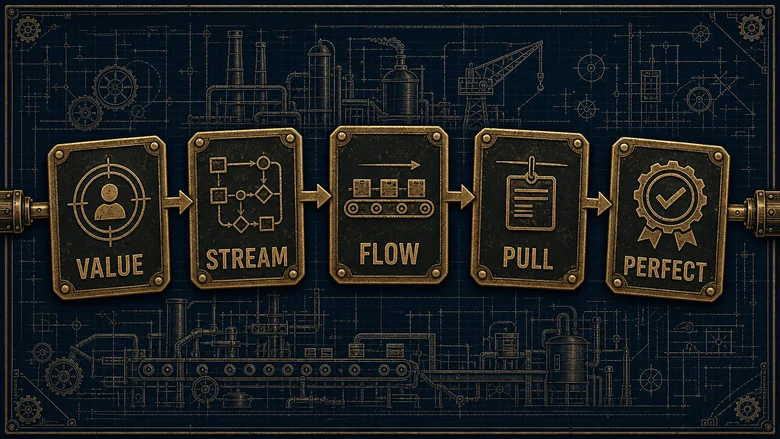
James Womack and Daniel Jones later expressed lean thinking as five principles. The Lean Enterprise Institute’s formulation moves from customer value to a value stream, then flow, pull, and an endless pursuit of perfection. Read them as a sequence of factory questions, not five independent projects.
| Lean principle | Factory question | Evidence it is taking hold |
|---|---|---|
| Value | What outcome, quality, price, and delivery does this customer actually need? | Product-family targets are tied to customer need, not a department’s utilization target. |
| Value stream | Which steps and information moves create that value from order to delivery? | The whole flow has an owner, a baseline, and a visible constraint. |
| Flow | What stops the work from moving steadily through the value-creating steps? | Queues, handoffs, rework loops, and interruptions shrink without hiding risk. |
| Pull | Can downstream use trigger upstream work instead of a forecast pushing more WIP? | Replenishment follows real consumption and overproduction becomes harder. |
| Perfection | What problem should the people running this process solve next? | Teams repeat measured experiments and update standard work when a better method holds. |
Lean manufacturing tools: a map, not a checklist
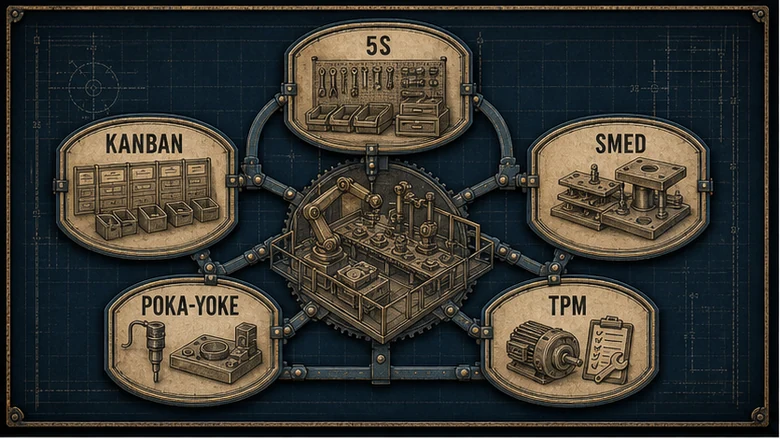
Lean manufacturing tools diagnose different failure modes. A value stream map cannot stabilize a bearing, an OEE number cannot explain a recurring dimensional shift, and a kaizen event cannot substitute for daily management. Start with the problem, then choose the smallest method that can test a useful countermeasure.
A problem-to-tool map
| Tool | What it does | When to reach for it | Read more |
|---|---|---|---|
| Eight wastes | Gives a team a shared language for non-value-adding work, including unused talent. | Use it during observation when people can see delay, excess motion, inventory, rework, or overproduction but have not named the pattern. | |
| Value stream mapping | Places material and information flow, work time, and waiting on one current-state view. | Use it when departments blame one another or local metrics cannot explain end-to-end lead time. | |
| Kaizen event | Concentrates a cross-functional team on one bounded problem for a short implementation sprint. | Use it when the problem is visible, the people and authority are available, and a change can be tested on the floor. | |
| Six Sigma and DMAIC | Structures a data-led project around defining, measuring, analyzing, improving, and controlling a stubborn problem. | Use it when output varies despite a reasonably stable flow and the cause is not visible from direct observation. | |
| SPC charts | Separates routine process variation from signals that deserve investigation. | Use it on a measurable characteristic when reacting to every data point is creating tampering or missed signals. | |
| OEE | Combines availability, performance, and quality into a loss view for a constrained asset or line. | Use it when downtime, speed loss, and rejects compete for attention and the team needs one loss tree. | |
| TPM and autonomous maintenance | Builds basic equipment care into daily work while maintenance owns deeper reliability tasks and failure elimination. | Use it when dirty, loose, worn, or poorly inspected equipment keeps breaking flow and feeding reactive work. | Build the maintenance checklist and decide when software should schedule it |
Why a tool rollout is not Lean
The table is a route map, not a rollout plan. Launching every method at once creates seven training streams and no owned problem. A stronger plant teaches one tool at the moment a team needs it, records whether the countermeasure changed the target condition, and keeps only the practice that helped people see or solve the work better.
Lean manufacturing vs Six Sigma vs Lean Six Sigma
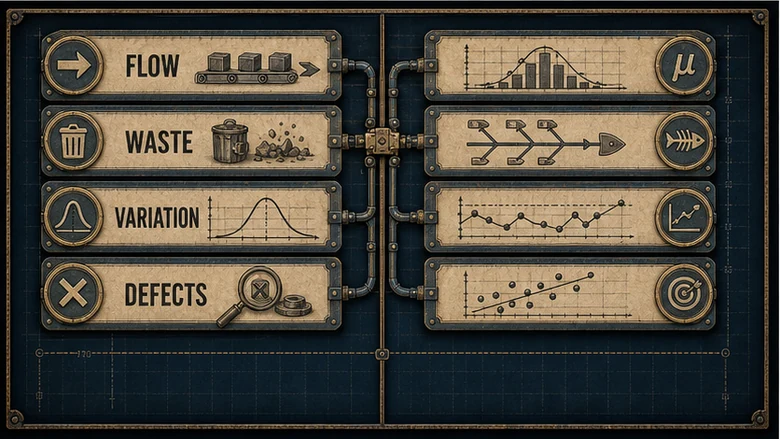
Lean manufacturing and Six Sigma solve overlapping but different problem shapes. Lean looks across the flow for delay and non-value-adding work. Six Sigma studies variation and defects when the cause needs stronger measurement and analysis. Lean Six Sigma uses both, but combining names does not excuse a team from defining which problem it is actually solving.
The distinction is more precise than the slogan “Lean is speed and Six Sigma is quality.” Toyota’s jidoka makes quality central to lean, while Six Sigma projects can remove costly waste. The useful difference is method and emphasis: ASQ describes Lean as focused on waste, work standardization, and flow, while Six Sigma emphasizes variation reduction and statistical control.
A problem-based comparison
| Approach | Best first fit | Core question | Typical evidence | Common failure |
|---|---|---|---|---|
| Lean | Queues, long lead time, excess WIP, awkward flow, repeated handoffs | Which work creates customer value, and what prevents it from flowing? | Floor observation, current-state flow, lead time, WIP, standard work | Installing tools by department while the end-to-end flow stays broken |
| Six Sigma | Defects or output variation persist in a measurable process | Which inputs explain the variation, and can the change be controlled? | Capability data, defect definitions, cause analysis, controlled trials | Starting a heavy analysis project before the measurement system or scope is sound |
| Lean Six Sigma | A flow problem and a variation problem are materially connected | Which delay should be removed, and which variation must be controlled so the new flow holds? | Value-stream evidence plus a bounded DMAIC analysis | Using the combined label for every project and adding ceremony without sharper thinking |
WHEN TO USE WHICH
Start with Lean when the waste is visible across the flow. Start with Six Sigma when the process is stable enough to measure but the output remains unpredictable. Use Lean Six Sigma when removing the queue will not hold unless a variation source is also controlled. If the team cannot state the problem in one sentence, it is not ready to choose a method.
Should a manufacturer do Lean or Six Sigma first?
Most manufacturers should begin by seeing the flow because it exposes whether the expensive problem is waiting, rework, instability, or a mix. That does not mean every company must “do Lean first” as policy. A calibrated grinding process that suddenly produces a wide dimensional spread is already a variation problem. A job shop where orders spend twelve days waiting between two hours of work has a flow problem. The work decides.
The short animation below from the Lean Enterprise Institute is useful because it moves the decision above individual tools. Its five questions connect purpose, work, capability, management behavior, and the assumptions behind the system.
How to start a lean manufacturing process
Start a lean manufacturing process with one value stream and a target condition, not a corporate launch. Choose a product family important enough for leadership to notice but contained enough that a team can observe the whole path from demand to shipment. The first result should be evidence that the team can solve a real problem together, not a declaration that the plant is now lean.
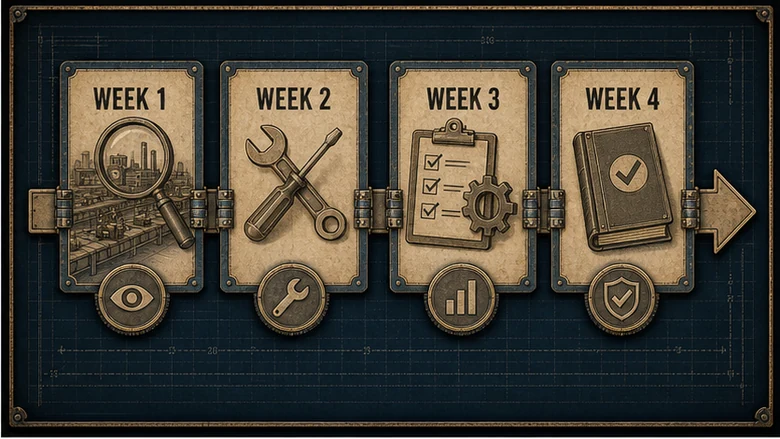
A 30-day first pilot
Workflow · 30-day pilot
How to run your first lean improvement
Use this six-step pilot to move one product family from a customer problem to a measured, standardized countermeasure in 30 calendar days.
Define the customer problem and target
Write the gap in customer terms: late orders, escaped defects, unstable mix, or excessive lead time. Record one outcome metric, its current baseline, and a 30-day target before discussing tools.
Choose one product family and owner
Select products that share most processing steps, mark the start and end of the flow, and name one person accountable for the whole value stream. Give the owner access to operators, quality, maintenance, planning, and engineering.
Observe the work and record a baseline
Walk an actual order from demand to shipment. Record work time, waiting, WIP, defects, stops, handoffs, and information delays from the floor rather than reconstructing an ideal process in a meeting room.
Select the biggest solvable obstacle
Choose the obstacle that most limits the target and can be tested inside the pilot. State the suspected cause and the evidence that would prove the countermeasure helped or failed.
Run one controlled countermeasure
Change one condition, define the test window, assign an owner, and protect safety and quality. Compare the same metric before and after; do not bury a weak result inside a bundle of simultaneous changes.
Standardize, review, and choose the next gap
If the result holds, update the work method, train every affected shift, and set a review cadence. If it does not, keep the learning, reverse the change safely, and test the next cause instead of declaring victory.
What the 30-day clock proves
A 30-day pilot is long enough to include more than a workshop and short enough to keep one business problem in view. It is not a promise that the target will be met in a month. The proof is whether the team can describe the changed condition, show the measure, sustain the new method across shifts, and name the next gap without waiting for a consultant.
Lean manufacturing examples: what good adoption looks like
Useful lean manufacturing examples show a problem, a countermeasure, and evidence. They do not present a copied solution as universal. The three patterns below are illustrative factory scenarios, not reported case-study results, and each would need a real baseline before a manufacturer acted.
A job shop attacks setup delay, not operator speed
Suppose a machining cell misses due dates because small batches spend too long waiting for changeovers. The team follows one product family, separates setup work that can happen while the machine runs from work that requires a stop, stages tools in sequence, and tests a new standard on every shift. The first evidence is the distribution of changeover time and the queue in front of the cell, not whether operators look busier.
A packaging line pulls from real consumption
Suppose upstream production fills floor space with one package size while the line starves for another. The team first confirms demand, container quantities, replenishment time, and process stability. It then tests a small pull loop on one family with clear minimum and maximum signals. The evidence is less WIP and fewer shortages without lower service, not the visual appeal of new cards.
A fabricator stops defects where they begin
Suppose final inspection keeps finding a weld defect after the part has already consumed downstream labor. The team defines the abnormal condition at the welding step, gives the operator a clear response, and tests the suspected cause with quality and engineering. If the result still varies, the problem moves into a bounded statistical investigation. The lean move is not to remove inspection blindly; it is to make the defect visible earlier and prevent recurrence.
The evidence base is bigger than the usual trophy case. On its current Lean and Process Improvement page, the NIST MEP National Network reports more than 80,000 lean projects and over $18.8 billion in manufacturer savings (page accessed July 30, 2026; NIST does not state the measurement period for those cumulative figures). That cumulative total does not predict what one plant will save. It does show why measured improvement has outlasted each new label attached to it.
What Lean costs and how long it takes
Lean has no honest universal price or completion date. A local experiment may need only protected team time and simple measurement. A multi-site transformation can require years of leader development, coaching, data repair, layout changes, fixtures, maintenance recovery, and repeated experiments. The right budget begins with the problem and the capability gap, not a per-employee training package.
| Cost category | What it looks like in a first pilot | Budget trap |
|---|---|---|
| People and backfill | Operators, a value-stream owner, and support functions get protected time to observe and test. | Calling improvement “extra work” and expecting the same output during the test. |
| Training and coaching | Method training arrives when the team needs it, with coaching on real work. | Buying broad certification before anyone owns a business problem. |
| Measurement | Definitions, baseline collection, and simple visual review of the target metric. | Buying a data platform before agreeing what a good unit or a stop means. |
| Physical changes | Tool staging, small fixtures, point-of-use storage, marked locations, or a limited layout trial. | Committing capital before a temporary test proves the flow. |
| Sustainment | Training every shift, auditing the new condition, and giving leaders time to remove obstacles. | Funding the event but not the daily management that keeps the gain. |
A first pilot can produce evidence in 30 days, but lean itself does not finish. One solved queue exposes the next unstable process; one stable process makes the next quality signal easier to see. Treat the pilot clock as a learning cadence, not a transformation deadline.
When a lean manufacturing consultant is worth it
A lean manufacturing consultant is worth considering when a plant lacks an experienced facilitator, the value stream crosses functions that cannot resolve their own conflicts, or leaders need an outside mirror for management behavior. The consultant should build internal capability while a real value stream improves. The Lean Enterprise Institute describes its own enterprise approach as people-centered coaching designed to leave the organization able to improve independently. That is a sound test for any proposal.
Compare consultant proposals by scope and exit condition, not day rate alone. Ask what problem will be framed, which model line will be coached, how operator knowledge enters the work, which leader routines will change, who becomes the internal coach, and what evidence ends the engagement. Reject a provider who guarantees savings before seeing the floor, arrives with a fixed plant template, measures success in workshop counts, or stays indispensable by owning the method.
Why Lean Manufacturing fails
Lean manufacturing fails when it is installed as a staff program while the management system that creates the waste stays untouched. The Lean Enterprise Institute’s transformation work explicitly connects purpose, process, capability, leadership behavior, and basic assumptions. Leaving any one of those outside the change is how a tidy pilot becomes an isolated island.
| Failure mode | What it looks like | Correction |
|---|---|---|
| Lean as a layoff program | Operator ideas create capacity, then the capacity becomes a surprise headcount case. | State before the work how gains will be redeployed, and never ask people to design an undisclosed cut. |
| Kaizen theater | Leaders count events, boards, and certificates while lead time and defects do not move. | Tie every activity to one business problem, one owner, one baseline, and one follow-up date. |
| Tools without a problem | Every area runs 5S, maps, and audits whether or not those methods fit its constraint. | Choose the tool only after observation defines the gap and the evidence needed. |
| Local efficiency | Each machine stays busy, batches grow, and the customer waits longer. | Manage the order-to-delivery value stream and the constraint, not maximum utilization at every step. |
| Inventory cut before stability | Buffers disappear while breakdowns, quality loss, and supplier variation remain. | Reduce inventory through controlled experiments as process stability and replenishment improve. |
| Management exemption | Operators update boards, but priorities, approvals, and cross-functional decisions still create the queue. | Make leader response time and obstacle removal part of the standard management work. |
THE TRUST TEST
Before asking for improvement ideas, tell the team what will happen to recovered hours. If leadership cannot answer, pause. People do not resist improvement because they dislike better work; they resist a process that asks them to expose waste while hiding the employment decision attached to it.
How to know Lean is working
Lean is working when the value stream improves and the organization gets better at solving the next problem. Measure customer outcomes and process conditions together. A single cost number arrives too late and can reward the wrong behavior, while a wall of activity metrics can make a stalled system look energetic.
Metrics that reveal flow, quality, and learning
| Measure | Healthy signal | Watch-out |
|---|---|---|
| Order-to-delivery lead time | Falls for the selected product family while service holds. | Counting only machine cycle time and ignoring queues. |
| Work-in-process | Falls as flow and replenishment improve. | Removing buffers before instability is controlled. |
| First-pass yield | Rises without looser specifications or hidden rework. | Moving inspection or changing the defect definition. |
| OEE loss by cause | The constrained asset loses fewer minutes to the targeted availability, speed, or quality cause. | Raising the percentage by excluding planned loss or changing the ideal cycle. |
| Schedule attainment | More jobs finish when promised with less expediting. | Freezing an unrealistic schedule so the metric looks stable. |
| Problem-closure time | Abnormalities get an owner, a containment response, and a tested countermeasure faster. | Closing records administratively while recurrence continues. |
| Frontline participation | More people can state the target condition, surface a problem, and run a small test safely. | Counting raw idea submissions without checking implementation or learning. |
Read the system, not one score
Review a small set weekly at the value-stream level. Pair lagging outcomes such as delivery and defects with leading conditions such as WIP, stops, and closure time. When a metric improves, ask what physical or management condition changed. When nobody can answer, the gain is not yet understood and should not be copied.
A lean plant is not the one with the most improvement activity. It is the one where the next important problem becomes visible sooner, is solved closer to the work, and stays solved long enough to expose the next one.
The verdict is simple: lean is worth doing when leadership wants a better production system and is willing to change its own behavior with the floor. It is not worth branding as “Lean” when the real objective is a quick labor cut, a certificate program, or a set of photos for the next board meeting. Start with one value stream. Let the evidence earn the right to spread.
Frequently Asked Questions
Lean manufacturing is a management system for creating customer value with less waste, time, effort, material, and capital. It defines value, identifies the value stream, improves flow, establishes pull, and pursues perfection through repeated problem-solving. Lean is broader than a set of factory tools and should change how leaders and frontline teams expose and solve problems.
The five principles are value, value stream, flow, pull, and perfection. First define value from the customer’s view. Then identify every step required to deliver it, make the value-creating work flow, let real downstream demand pull upstream work, and repeat the improvement cycle rather than treating the first future state as final.
Lean manufacturing primarily attacks waste, delay, and broken flow across a value stream. Six Sigma primarily attacks defects and process variation through structured measurement and analysis. Lean Six Sigma combines them when a problem includes both flow loss and unstable output. Neither is automatically better; the observed problem determines the method.
The eight wastes are transportation, inventory, motion, waiting, overproduction, overprocessing, defects, and unused talent, often remembered as TIMWOODS. They are observation prompts, not eight separate programs. A team should identify which waste materially blocks customer value in its selected flow, then investigate the condition producing it.
No. Lean manufacturing aims to remove non-value-adding work, not define a headcount target. It can create available capacity, and leadership still decides how that capacity is used. If people discover that their improvement ideas become surprise layoffs, they will rationally hide the next problem. Leaders should state the redeployment plan before asking teams to remove waste.
