
Most factory improvement dies in the follow-up. A team spots a bottleneck, promises to fix it, and six weeks later the line runs exactly as it did before. Kaizen events exist to break that pattern. Instead of spreading a fix across months of part-time meetings, a kaizen event puts the right people in one room for a few focused days and does not let them leave until the process has actually changed.
This guide covers what a kaizen event is, when to run one (and when not to), how to build the charter and the team, and a day-by-day agenda you can adapt to your own floor. It also covers the part most teams skip: how to make the improvement hold after everyone goes back to their day jobs.
Direct answer — What is a kaizen event?
A kaizen event is a short, focused improvement project where a cross-functional team spends three to five consecutive days fixing one specific process. The team maps the current state at the gemba, finds the waste, tests changes on the floor, and standardizes what works before the event ends. It differs from daily continuous improvement, which is a steady habit rather than a time-boxed burst, and from a full lean transformation, which spans the whole value stream.
Key Takeaways
- A kaizen event is a three-to-five-day sprint by a cross-functional team on one bounded process, not an open-ended project.
- Run one when a problem is contained, visible on the floor, and needs a fast cross-functional decision; skip it when the fix needs long data collection or capital approval.
- The prep decides the result: a one-page charter, a clear target metric, and a team that is at least half operators.
- A standard week runs map, analyze, trial, implement, and standardize, ending with a report-out to management.
- The event is worthless without a sustainment plan: standard work, visual controls, and a 30-day follow-up audit.
- “Kaizen” means continuous improvement; the event is the burst and daily kaizen is the habit, and a healthy plant needs both.
What is a kaizen event?
A kaizen event is a time-boxed workshop, usually three to five days, where a cross-functional team redesigns one process and puts the change in place on the spot. The name is telling. Kaizen is a Japanese word for continuous improvement, brought to Western industry by Masaaki Imai and his 1986 book Kaizen: The Key to Japan’s Competitive Success, and the Kaizen Institute Imai founded still defines it as continuing improvement involving everyone, managers and operators alike.
The event, sometimes called a kaizen blitz or a kaizen workshop, is one expression of that idea: a rapid burst aimed at a single target. Rather than study a problem for a quarter, a small team goes to where the work happens, changes the process during the week, and measures the difference before it disbands. That compression is the point. A short clock forces decisions that a standing committee would defer for months.
Kaizen event vs. continuous improvement
Kaizen events and continuous improvement are related but not interchangeable. Continuous improvement is the everyday habit: small changes made by the people who run a process, every shift, forever. A kaizen event is the occasional step-change you schedule when a specific problem needs more hands and more authority than daily improvement can muster. The Lean Enterprise Institute warns leaders not to lean on events alone, because it is the daily practice that builds frontline problem-solving skill. Use the table below to place the right tool against the right problem.
| Approach | What it is | Use when | Avoid when |
|---|---|---|---|
| Kaizen event (blitz) | A three-to-five-day cross-functional sprint that redesigns one process and implements it during the event | A bounded problem needs a fast cross-functional decision and hands-on change | The fix needs weeks of data, capital approval, or spans many value streams |
| Daily kaizen | Small, everyday improvements made by the people who run the process | You are building an everyday improvement habit and frontline problem-solving | You need a step-change on a specific bottleneck this month |
| Point kaizen | A few-hours-to-one-day fix on a single station or problem | The issue is small, local, and obvious to everyone involved | The problem crosses departments or needs a full redesign |
When to run a kaizen event (and when not to)
Run a kaizen event when a problem is specific, visible on the floor, and solvable with knowledge already in the building. The classic triggers are a bottleneck that throttles throughput, a changeover that eats hours, a cluttered layout that forces operators to walk, or a defect that keeps coming back. These share a shape: the answer is knowable in days, and the people who know it work in your plant.
The harder skill is knowing when not to run one. A kaizen event is the wrong tool when the real work is data collection over many weeks, when the fix depends on capital equipment that takes months to approve and install, or when the “process problem” is actually a strategy or product decision in disguise. Force an event onto one of those and the team spends five days building a plan they cannot execute, which teaches everyone that kaizen events do not work.
A concrete example makes the fit obvious. Say a machining cell takes 45 minutes to change over between parts, and that changeover happens six times a shift. The waste is visible, the people who do it are on site, and no new equipment is required, only a better sequence and some staged tooling. That is an ideal candidate: over one week a team can rework the changeover with SMED-style methods, prove a faster time on the floor, and write it into standard work. Contrast that with “reduce warranty returns,” which usually needs months of field data before anyone can even name the cause. The first is an event; the second is a project that an event cannot rush.
Before the event: charter, scope, and team
The week is won or lost before it starts. Preparation fixes the scope, the target metric, and the team, so the event itself is spent solving instead of arguing about boundaries. Give preparation a week or two of lead time, not an afternoon.
Write a one-page event charter
A charter is a single page that answers four questions: which process, what boundaries, which metric, and what baseline. Name the exact start and end points of the process so the team cannot wander. Pick one primary metric to move, such as changeover minutes, units per hour, walking distance, or defect rate, and record today’s number so you can prove the change. If you want a starting point, the downloadable charter and agenda template below maps directly to the week described here.
Pick a cross-functional team
A good kaizen team is five to eight people, and at least half of them should be operators who run the process every day. Round the team out with a facilitator who keeps time and method, a process owner who will live with the result, and someone with the authority to approve changes on the spot so decisions do not stall waiting for a manager. Add support functions as the problem demands: maintenance to move equipment, engineering to redraw a layout, quality to confirm a standard. The whole team works at the gemba, the actual place the work happens, not in a conference room down the hall.
Preparation also means clearing the runway. Free the operators on the team from their normal production targets for the week, stage any materials or tooling the trials will need, and get leadership to sign the charter so the scope is protected once the event starts. An event that competes with a shift’s output quota loses every time, so protect the team’s time as deliberately as you protect the scope.
How to run a kaizen event, day by day
A standard kaizen event follows the same arc every time: learn, map, analyze, trial, implement, and standardize, compressed into one working week. The five-day agenda below is the common shape for a manufacturing event, though the U.S. EPA notes that a kaizen event can run anywhere from one to seven days depending on the size of the problem.
The five-day agenda
| Day | Focus | Output |
|---|---|---|
| Day 1 | Train the team and map the current state at the gemba | Baseline metrics, a current-state map, and a ranked list of waste |
| Day 2 | Analyze root causes | Verified causes from 5 Whys and fishbone analysis, plus candidate solutions |
| Day 3 | Design and trial the new process | A redesigned layout or standard, tested in a first live run |
| Day 4 | Implement and refine | The new process running under normal conditions, measured against baseline |
| Day 5 | Standardize and report out | Standard work documents, a control plan, and a report to management |
Every event measures a before and an after. When the target is downtime or throughput on a bottleneck machine, an overall equipment effectiveness baseline gives the team a single number to move and defend on Day 5. Capture that number on Day 1, before anyone touches the process.
The six-step method
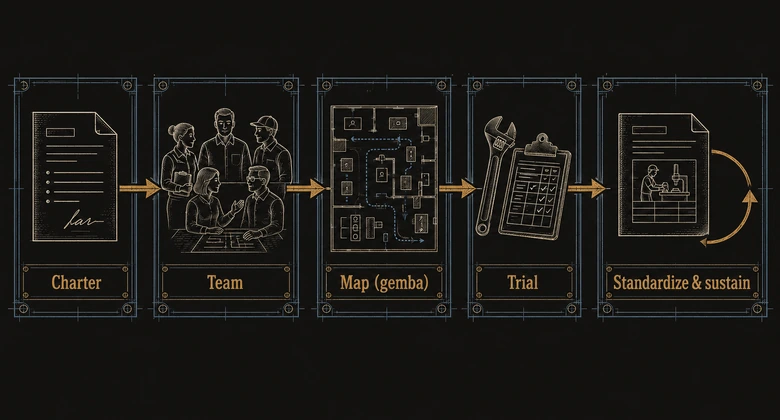
Workflow · one week (5 days)
How to run a kaizen event
Take one bounded process from problem to standardized fix in a single focused week, using a cross-functional team that works at the gemba.
-
Charter and scope the event
Write a one-page charter naming the process, its boundaries, the target metric, and today’s baseline. A tight scope is the single biggest predictor of a successful event.
-
Assemble a cross-functional team
Pull five to eight people, at least half of them operators who run the process daily, plus a facilitator and someone who can authorize changes on the spot.
-
Map the current state at the gemba
Walk the real process, time each step, and mark every delay, motion, and rework loop on a current-state map. Measure the baseline before you change anything.
-
Find root causes and trial improvements
Use 5 Whys and fishbone analysis to reach true causes, then test redesigns on the floor the same day rather than debating them in a room.
-
Implement and standardize
Run the new process under normal conditions, fix what breaks, then write standard work and visual controls so the method is identical on every shift.
-
Report out and set the follow-up
Present before-and-after numbers to management, assign owners to open items, and book a 30-day audit to confirm the gains held.
Map, brainstorm, and trial improvements
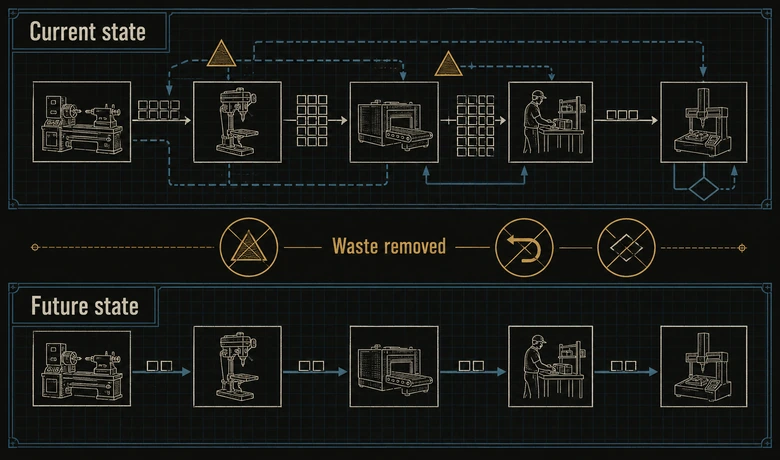
The middle of the week is where a kaizen event earns its name: the team turns a current-state map into a tested, better process. It starts by making the work visible. A value stream map of the current state exposes where material and information actually flow, where they stop, and how long each handoff really takes. Against that map, the team hunts the eight wastes of lean, from overproduction and waiting to the excess motion that walks an operator ten extra steps per cycle.
Seeing waste is not the same as knowing why it happens. Structured root-cause tools such as the 5 Whys and fishbone diagrams keep the team from stopping at the first convenient explanation and push them toward the cause they can actually remove. A defect blamed on “operator error” often traces back to an unclear work instruction or a fixture that lets the part seat two ways.
Kaizen events favor action over analysis. Rather than schedule a change for next quarter, the team moves the machine, reworks the cell, or rewrites the sequence that same afternoon and watches what happens. A trial that fails on Wednesday is useful, because there are still two days to try the next idea. The floor, not the whiteboard, is where the answer gets confirmed.
Standardize and sustain the gains
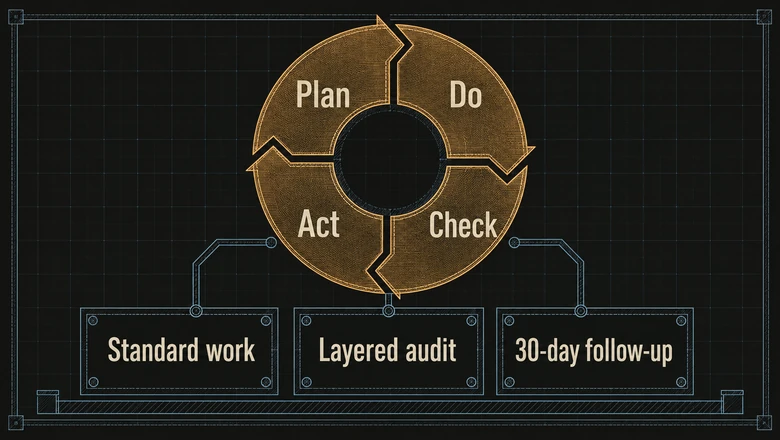
The improvement is only real if it survives the week. Standardizing and sustaining the change is the step that separates a kaizen event from a motivational exercise. Standard work is the anchor: the team documents the new method step by step, sets the pace, and posts visual controls so the right way is also the obvious way. Those standard-work and control documents belong in a system every shift can reach and revise, which is a core job of quality management software built for manufacturing rather than a binder that yellows on a shelf.
Sustaining also means the line keeps doing it once the facilitator is gone. On connected equipment, a manufacturing execution system can hold the new sequence, prompt the operator through it, and flag when a step is skipped, turning standard work into something the system checks instead of something people remember. The tighter the loop between the standard and the floor, the less the gain drifts.
Then you follow up. The U.S. EPA’s kaizen model schedules follow-up checks at 30 and 90 days, and that cadence matters: a layered audit at 30 days catches the quiet return of the old habit while it is still easy to correct. Put a name and a date on every open item from the report-out, and treat the audit as a scheduled event, not a good intention.
IMPORTANT
The most common way a kaizen event fails is having no sustainment plan. If you leave Day 5 without standard work, an owner for each open item, and a booked 30-day audit, the line will drift back to its old state within weeks and the whole week is wasted.
Common reasons kaizen events fail
Most failed kaizen events fail for the same handful of reasons, and every one of them is avoidable in planning. Watch for these before the week starts:
- Scope too broad. “Fix the whole assembly line” is not a kaizen event. Narrow it to one process with clear boundaries or the team never reaches a result.
- No baseline data. Without a before number captured on Day 1, you cannot prove the after, and the improvement becomes an opinion.
- A manager-heavy team. When operators are outnumbered, the people who actually run the process stop talking and the real waste stays hidden.
- No authority in the room. If every change has to wait for a sign-off from someone who is not there, momentum dies by Wednesday.
- No sustainment plan. An event with no standard work and no follow-up audit is a temporary rearrangement, not an improvement.
- Treating it as a one-off. A kaizen event should feed the daily habit, not replace it. Plants that only improve during events plateau fast.
Frequently Asked Questions
A kaizen event is a focused, three-to-five-day project where a cross-functional team improves one specific process. The team maps the current state, finds the root causes of waste, trials changes on the floor, and standardizes what works, all within the event so the improvement is in place before it ends.
Most kaizen events run three to five consecutive days. The U.S. EPA notes the range can stretch from one to seven days depending on the size of the problem. Preparation adds a week or two of lead time beforehand, and a follow-up audit lands about 30 days after the event closes.
Kaizen is the Japanese term for continuous improvement, so they name the same idea. In practice, “continuous improvement” usually means the daily habit of small changes by frontline teams, while a “kaizen event” means a scheduled, time-boxed burst on one problem. A strong plant runs both: the habit and the occasional step-change.
A kaizen blitz is another name for a kaizen event: the same intensive, few-day workshop where a team rapidly redesigns and implements an improvement. “Blitz” emphasizes the speed and the compressed timeline. You may also hear it called a kaizen workshop or a rapid improvement event; the method is the same.
After the event, the team sustains the change. That means standard work is followed on every shift, visual controls stay in place, and open items from the report-out get owners and dates. A layered audit at 30 days confirms the gains held, and the lessons feed the plant’s daily continuous improvement so the process keeps getting better.
