
Ask ten people what PLC programming is and you’ll get ten ladder-logic tutorials. Ask a plant owner what they actually need to know, and it’s a different question: who should write the logic that runs your machines, what happens when that person leaves, and how you avoid paying to rebuild a line because nobody documented it. This guide answers the manufacturer’s version of the question, not the hobbyist’s.
A programmable logic controller (PLC) is the small industrial computer that runs a machine or a line, and PLC programming is how you tell it what to do. Most articles on the topic are written for someone who wants to become a controls engineer. If you own or run the plant, your job isn’t to learn ladder logic overnight. It’s to understand enough to make good calls: build the skill in-house or hire an integrator, and how to keep control of the code either way.
So we’ll cover the basics quickly, the languages you’ll hear named, where PLCs sit in your wider systems, and then the decision most guides skip: how to actually get PLC work done without getting locked in.
Direct answer — What is PLC programming?
PLC programming is the process of writing the control logic that tells a programmable logic controller (PLC) how to run a machine or production line. The PLC repeats a fast scan cycle: read inputs, run your logic, update outputs, usually in milliseconds. Most programs use one of the five IEC 61131-3 languages, ladder logic being the common one. It’s operational-technology control code tied to specific hardware, not general IT software, so vendor choice and documentation matter as much as the code itself.
Key Takeaways
- A PLC is a ruggedized industrial computer that runs machines by reading inputs, executing logic, and setting outputs on a repeating scan cycle. PLC programming is writing that logic.
- The IEC 61131-3 standard defines five languages. Ladder logic (the ladder diagram) dominates on the plant floor; Structured Text and Function Block show up on more complex jobs.
- PLC code is hardware-specific. Allen-Bradley, Siemens, and the rest each use their own software, so your brand choice is a decade-long commitment, not a detail.
- The real manufacturer decision isn’t which language to learn. It’s whether to build PLC skill in-house or hire a system integrator, and how to keep the code, documentation, and passwords in your name.
- Whichever route you pick, own the source code and the documentation. That’s the one thing that protects you when a machine goes down at 2 a.m. and the original programmer is long gone.
What a PLC is (and what PLC programming actually controls)
A PLC, or programmable logic controller, is a ruggedized industrial computer built to control machines and processes in real time. It reads signals from sensors and switches, runs the logic you programmed, and switches outputs like motors, valves, and indicator lights on or off. Unlike an office PC, it’s built to run for years in heat, vibration, and electrical noise without crashing.
Inside, a PLC has a CPU, a power supply, memory, and input/output (I/O) modules that connect it to the physical world. Inputs can be discrete (a limit switch that’s simply on or off) or analog (a temperature or pressure reading). Outputs drive the equipment. A communications port ties the controller into the rest of the plant.
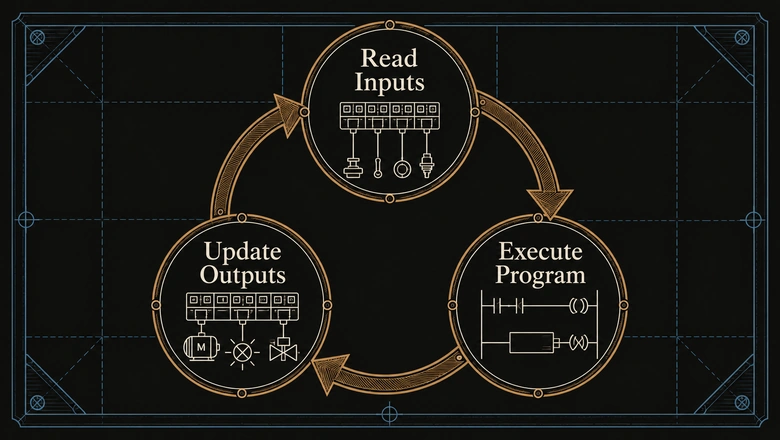
What PLC programming actually controls is the scan cycle. The controller loops through the same three steps over and over, usually in a few to a few tens of milliseconds: read every input, run your program top to bottom, then update every output. Because that loop is fast and deterministic, a PLC can react to a jammed part or an open guard door in time to matter, which a general-purpose computer running a normal operating system can’t reliably promise.
The idea goes back to 1968, when Dick Morley and his team built the Modicon 084 to replace banks of hardwired relays on a General Motors line. The core job hasn’t changed since: replace physical rewiring with logic you can edit in software.
The PLC programming languages (IEC 61131-3), at a glance
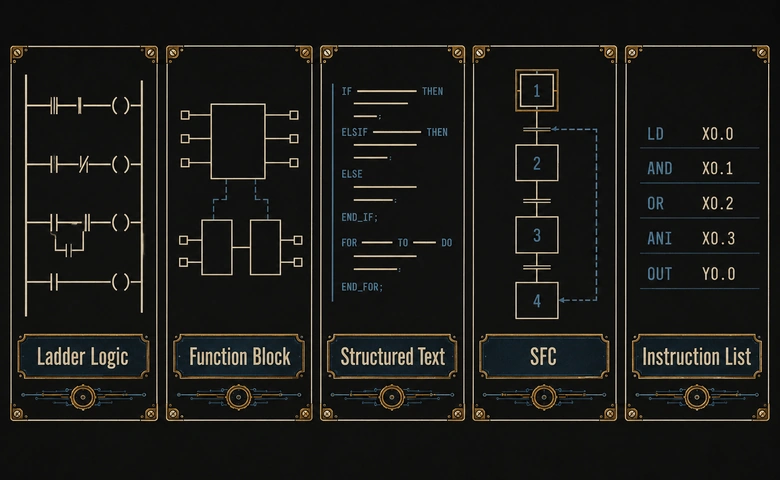
PLC programming languages are standardized under IEC 61131-3, an international standard that defines five of them. You don’t need to know all five to run a plant, but you should recognize the names, because the one your equipment uses affects who can maintain it.
| Language | What it is | Best for |
|---|---|---|
| Ladder Diagram (LD) | Graphical rungs that look like relay wiring diagrams | Discrete on/off logic; the language technicians read fastest |
| Function Block Diagram (FBD) | Wired blocks that pass signals, like a signal-flow drawing | Process control, analog loops, and PID |
| Structured Text (ST) | A high-level text language similar to Pascal | Math, data handling, and logic too complex for ladder |
| Sequential Function Chart (SFC) | A flowchart of steps and transitions | Step-by-step batch and sequence control |
| Instruction List (IL) | A low-level, assembly-like text language | Legacy code only; deprecated in the 2013 edition of the standard |
In practice, most factory-floor programs are written in ladder logic, often called a ladder diagram, because it maps cleanly onto the relay logic maintenance teams already understand. Structured Text and Function Block turn up on more involved jobs, and it’s common to see a single program mix two or three languages. Instruction List, the old text option, was deprecated in the third edition of the standard and is best avoided in new work.
Ladder logic, the one you’ll see most
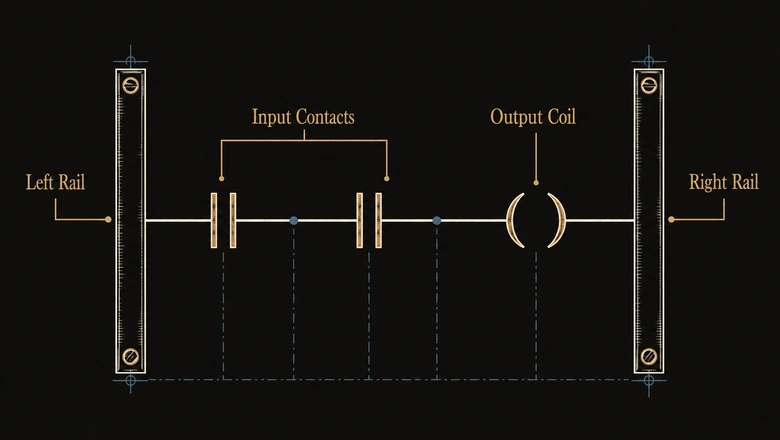
Ladder logic is a graphical PLC language that represents control logic as rungs between two vertical power rails, read left to right and top to bottom. Each rung is a small rule: input conditions on the left (drawn as contacts) and an action on the right (drawn as a coil). If the contacts on a rung make a complete path, the coil energizes, and the motor starts or the valve opens.
The reason ladder logic won’t die is that it reads like the electrical drawings a plant already lives by. An electrician who has never touched code can usually follow a ladder diagram and troubleshoot it on the floor. That accessibility is a real operational asset: the more people who can read your logic, the less a single specialist’s absence can shut you down.
Where PLCs sit in the automation stack
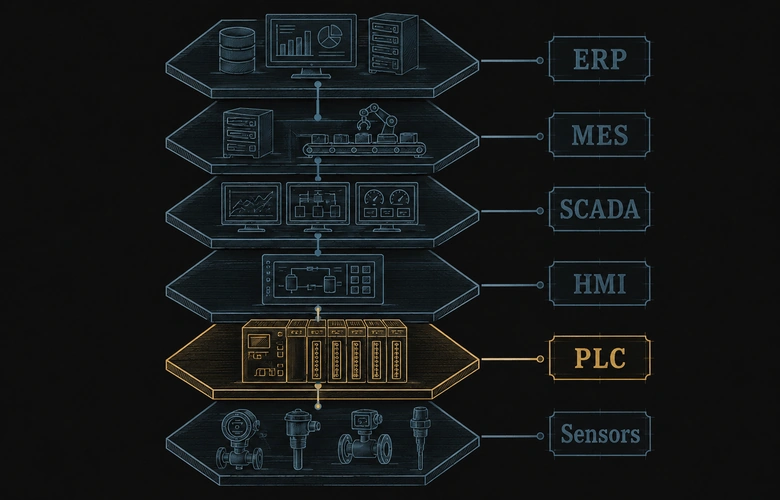
A PLC sits at the control layer of the factory, between the sensors and actuators on the machine and the software systems that plan and track production. Below it are field devices: switches, drives, valves, safety relays. Above it are the systems people watch from a desk. This control layer is one piece of a larger picture, and our guide to how the sensing, control, and decision layers fit together maps the whole thing.
A typical chain runs sensor to PLC to HMI/SCADA to MES to ERP. The PLC controls the machine in real time. An HMI (the touchscreen on the line) and SCADA give operators a view and manual control. The machine data a PLC produces only becomes a production record once an MES turns it into work-order and quality history, and the ERP above that handles orders and costs.
Get this picture straight and a lot of software confusion clears up: the PLC decides what the machine does this millisecond; the higher layers decide what to build and prove what got built. Increasingly the same machine data also streams to cloud dashboards and analytics, which is the heart of the shift people call Industry 4.0.
Industrial PLC programming: what the work really involves
Industrial PLC programming is more than writing logic. It’s specifying the I/O, choosing the hardware, writing and testing the code, wiring it to the machine, and commissioning the whole system so it runs safely for years. The coding is often the smaller part. One industrial rate guide suggests budgeting 30 to 50 percent of programming time for debugging and startup alone, because the hard part is the machine, not the syntax.
Then there’s safety. A PLC that controls a press, a robot cell, or anything that can hurt someone often needs safety-rated logic and hardware held to functional-safety standards, which is exactly where casual DIY tends to fall down. And once a line is running, the controller becomes an asset you maintain like any other; plants that track that work in a dedicated CMMS tend to catch controller and I/O faults before they turn into downtime.
The tools are also tied to the hardware brand. Allen-Bradley controllers (from Rockwell Automation) are programmed in Studio 5000 Logix Designer; Siemens controllers use TIA Portal; Mitsubishi, Omron, and Schneider Electric (which owns the original Modicon line) each have their own environments. Vendor-neutral options like Codesys and the open-source OpenPLC exist, but most plants standardize on one brand so their people and spare parts stay consistent. That standardization is a genuine decision: the brand you program today is one you’ll live with for a decade.
In-house vs. hiring a PLC integrator (how to choose help)
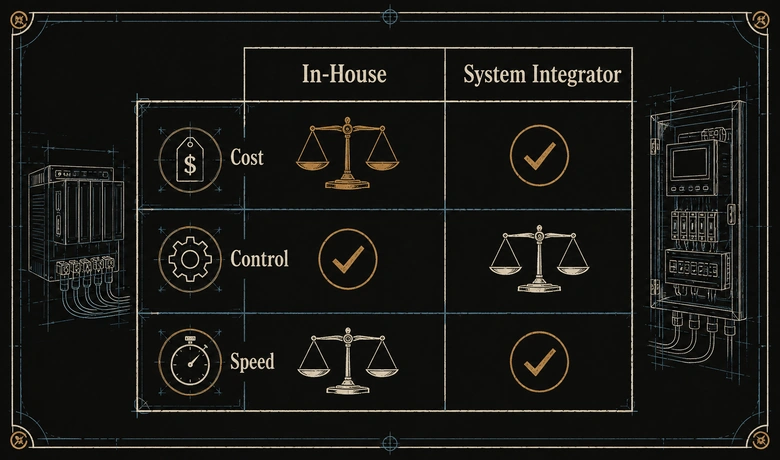
The biggest PLC programming decision most manufacturers face isn’t technical. It’s whether to build the skill in-house or hire a system integrator. And hiring a full-time controls engineer is hard, and getting harder: Deloitte and The Manufacturing Institute project that manufacturers could need up to 3.8 million new workers by 2033, with as many as 1.9 million jobs going unfilled if the talent gap holds. Demand for the work isn’t the constraint: the global PLC market runs about $13.3 billion in 2026 and keeps growing, per Mordor Intelligence. The bottleneck is people who can program all that hardware. For a lot of plants, that math settles it: you can’t hire a PLC programmer you can’t find, so you buy the capability as a service.
| Approach | Up-front cost | Control | Speed to start | Best for |
|---|---|---|---|---|
| In-house engineer / team | High fixed (US controls salaries roughly $90k–140k) | Highest, if the work is documented | Slow (you have to hire first) | Plants with constant changeovers, many lines, or proprietary processes |
| System integrator (project) | Pay per project (US rates ~$75–150+/hr) | Depends on your contract | Fast (they start now) | New lines, retrofits, one-offs, brands you don’t run in-house |
| Hybrid (they build, you maintain) | Medium | Shared | Fast | Most mid-market plants: buy the build, keep day-to-day tuning |
So which route fits? Use the constraint, not the org chart, to decide:
- Build in-house when PLC changes are constant (frequent changeovers, recipe tweaks, many lines), the process is proprietary, and you can realistically recruit and keep a controls engineer.
- Hire an integrator when the work is a discrete project (a new line, a retrofit, a machine on a brand your team doesn’t know), or when you simply can’t fill the role.
- Go hybrid when you want an integrator to build and commission the system, then hand it to your maintenance team to run and make small edits. This is where most mid-market plants land.
- Avoid pure DIY when the system involves safety-rated functions, high-speed motion, or a line whose downtime is expensive, unless you already have proven controls talent on staff.
PRO TIP
Whoever writes the code, put source-code ownership, full documentation, and controller passwords in the contract before work starts. The most expensive PLC problems usually aren’t bugs. They’re locked controllers no one can edit after the integrator moves on.
How much does PLC programming cost?
PLC programming costs are usually billed by the hour or quoted per project, not sold as a license. In the US, independent programmers commonly charge in the range of $75 to $125 an hour, while established integrators run roughly $125 to $150 and up, with specialized or safety work higher still (rates as of 2026). A small standalone machine might be a few thousand dollars of programming; a full line with HMIs, drives, and integration runs well into five or six figures once you count design, wiring, and startup.
Two things blow up these numbers, and neither is the code. The first is change: I/O added late, a moved sensor, a customer revision. The second is integration into the rest of your systems, which is why PLC work rarely shows up as a clean line item and why it pays to understand what the surrounding software actually costs before you sign anything.
How to choose a PLC integrator (or programmer)
To choose a PLC integrator, weigh documentation and handover discipline as heavily as raw technical skill. A brilliant program you can’t maintain is a liability, not an asset. Work through this checklist before you sign:
- Brand fit: do they program your controller brand (Allen-Bradley, Siemens, whatever you run) every day, not just “in general”?
- Code ownership: you own the source code, and it’s delivered to you, stated in writing.
- Documentation: commented code, an I/O list, electrical drawings, and a plain functional description you can hand to the next person.
- Passwords and access: every controller password and login is documented and yours, with no vendor lockout.
- Safety credentials: demonstrated experience with functional-safety standards if your application needs them.
- References: a plant like yours you can actually call, ideally running the same equipment.
IMPORTANT
Get controller passwords and the source project files in writing before the final payment. A surprising share of downtime emergencies trace back to a controller nobody in the building can open, because the only copy of the program left with a contractor who has moved on.
Frequently Asked Questions
A PLC (programmable logic controller) is a ruggedized industrial computer that controls machines and processes by reading inputs from sensors, running control logic, and switching outputs to devices like motors and valves. It repeats this scan cycle in milliseconds and is built to run reliably for years in harsh factory conditions.
The IEC 61131-3 standard defines five: Ladder Diagram (ladder logic), Function Block Diagram, Structured Text, Sequential Function Chart, and Instruction List. Ladder logic is the most common on the factory floor. Instruction List was deprecated in the standard’s 2013 edition. Many programs mix two or three of these languages in a single project.
In the US, PLC programming is typically billed at about $75 to $125 an hour for independent programmers and $125 to $150 or more for established integrators, as of 2026. A small machine may cost a few thousand dollars to program; a full production line often runs into five or six figures once design, wiring, and commissioning are included.
Yes. Free simulators and vendor software make it possible to learn ladder logic on your own, and many controls engineers are self-taught. But for a running plant, the question isn’t whether one person can learn it. It’s whether you have enough trained people that a single absence can’t stop production, which is why many manufacturers hire an integrator or build a small team.
Yes, ladder logic is still the most widely used PLC language on the factory floor. It stays popular because it mirrors the relay wiring diagrams electricians already read, so maintenance teams can troubleshoot it without being software developers. Newer languages like Structured Text handle complex math and data, but ladder logic remains the default for discrete machine control.
PLC programming is where your machines get their instructions, but it’s only one system in a plant full of them, and the technical choices quietly become business risks. If you’d like a second set of eyes on how your plant’s controls, software, and shop-floor data fit together, request a manufacturer investigation and we’ll take a look.
