
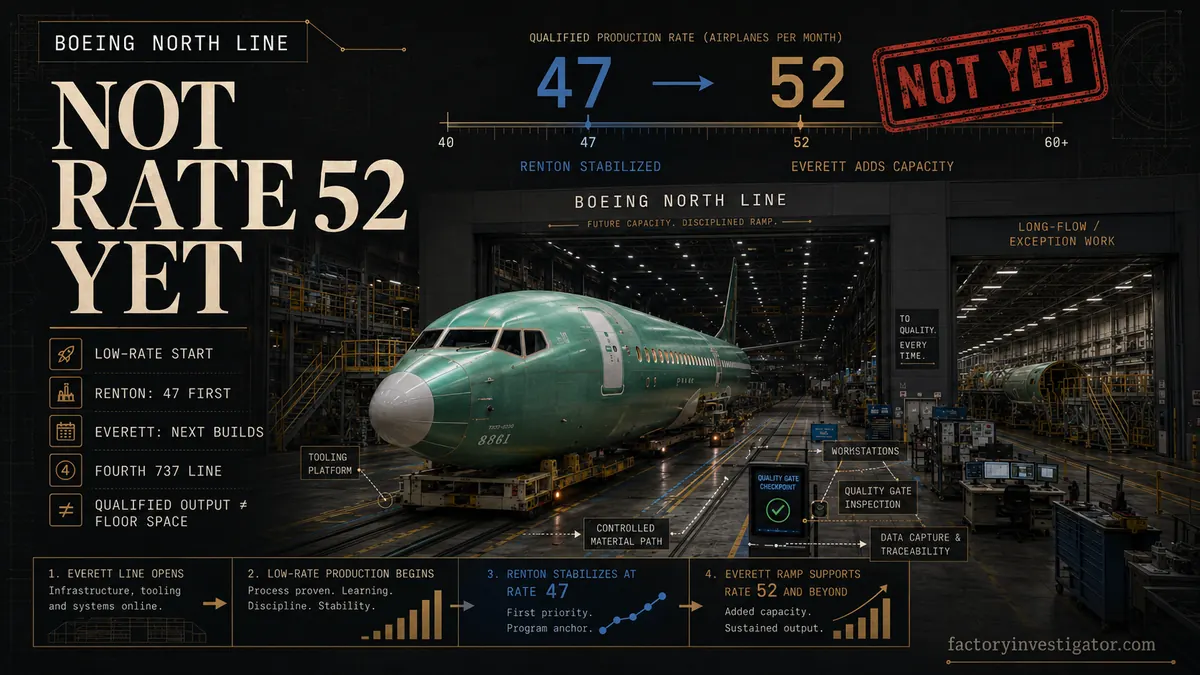
Direct answer – Is Boeing’s new Everett 737 line producing 52 airplanes per month?
No. Boeing opened the Everett 737 North Line in July 2026, but it begins with low-rate initial production. Boeing says Renton’s three lines must stabilize at Rate 47 before Everett supplies the additional builds needed for Rate 52 and beyond. The new line is future capacity and production resilience, not current output of 52 airplanes.
Boeing said on July 10, 2026 that it officially opened the 737 North Line in Everett, Washington, after workers began production on the first Everett-built 737 MAX earlier that week.
The opening puts 737 production outside Renton for the first time in more than 50 years. Boeing says its backlog exceeds 4,000 airplanes and carries current orders into the 2030s.
The search-result trap is treating installed line capacity as current monthly output. Boeing’s own sequence is conditional: complete compliance work, run low-rate production, stabilize Renton at 47 airplanes per month, then use Everett for the builds needed to reach 52 and beyond.
Key Takeaways
- Boeing opened its fourth 737 production line in Everett in July 2026.
- The line starts with low-rate initial production and regulatory compliance work.
- Renton’s three lines are expected to stabilize at Rate 47 before Everett supports Rate 52.
- The North Line adds space for airplanes that need work beyond the standard 10-day flow.
- Manufacturers should judge the ramp by stable output and quality, not installed floor space.
What Boeing opened in Everett
The North Line is the fourth final assembly line in the 737 program. Boeing built it inside existing Everett factory space and designed the process to replicate the production method used at Renton, allowing teams to share work standards and improvements across both sites.
Replicating a line across sites is not a tooling copy alone. A shared value stream map for material, work and exceptions gives both factories the same definition of flow before local workarounds create two different production systems.
Boeing first announced the line in 2023. Its April 2026 readiness update said the new line would be capable of building the 737-8, 737-9 and 737-10, with low-rate initial production intentionally slowing the build so teams can perform extra checks and adjust the production system.
The company also built a cross-site workforce. Boeing says the Everett team includes new hires and employees from Renton, Everett and Moses Lake, while operations in Wichita, Auburn and Frederickson contribute to 737 production.
Why the North Line is not Rate 52 yet
Rate 52 is a program target, not the Everett line’s opening output. Boeing says Renton is moving toward Rate 47 in the coming months. After that system stabilizes, Everett will add the builds needed for 52 airplanes per month and later increases.
That distinction matters because an assembly line can be open while its validated output remains low. Staffing, tooling, supplier deliveries, work instructions, quality gates and rework loops all have to settle before nominal capacity becomes repeatable production.
The same mistake appears in everyday production scheduling: a calendar can load work against theoretical hours that the process has not demonstrated. The correction is to plan from proven cycle time, constraints and quality yield, then increase the rate after the data holds.
Rate without quality is not useful throughput. Plants that track availability, performance and quality through OEE already know why a new line needs more than a monthly target. The numerator is good output, not units that enter the process. The Bosch Roseville SiC production ramp shows why sample output still needs yield and qualification evidence before it becomes usable commercial supply.
Why long-flow capacity matters more than floor space
Boeing says the North Line will protect production stability because work is spread across more lines. It also provides space for long-flow airplanes that need work beyond the standard 10-day production flow, including more complex interiors.
That may be the most useful manufacturing detail in the announcement. A line designed only around average flow can clog when a unit needs extra work. Separate long-flow capacity gives the main sequence room to continue while the exception receives controlled attention.
It is the large-aircraft version of a rule in industrial automation planning: stabilize the process and measure the constraint before chasing maximum speed. Extra equipment or floor space cannot compensate for a repeatability problem.
The gap between installed capacity and qualified output also appears in Micron’s U.S. fab expansion. Concrete, tools and buildings matter, but customer supply changes only after the process can run at acceptable yield. Boeing’s equivalent proof is stable, conforming airplanes leaving the new line at the planned rate.
What manufacturers and suppliers should watch
The first checkpoint is the first completed Everett airplane, followed by evidence that the line can repeat its planned flow without shifting unfinished work downstream. Boeing has not disclosed a date for the first delivery from the North Line in its July opening announcement.
The second is Renton’s Rate 47 stabilization. If Renton does not hold that rate with quality, Everett’s contribution to Rate 52 becomes harder to interpret. The target should be read as a sequence, not a combined capacity number available on opening day.
The third is supplier readiness. Wichita, Auburn, Frederickson and the wider 737 supply base have to support another final assembly path without moving shortages or defects between sites. The validation problem resembles factory-built nuclear supplier readiness: the lead plant scales only when upstream processes and records scale with it.
For other manufacturers, the lesson is simple. Announce installed capacity if the market needs the signal, but manage the operation by qualified rate. A new line earns its capacity claim when good units move through it repeatedly, exceptions stay controlled and suppliers keep the schedule without borrowing quality from the future.
Frequently Asked Questions
The North Line is inside Boeing’s Everett, Washington factory, about 40 miles north of the long-standing 737 operation in Renton. It is the first 737 production line in Everett and the first time the airplane has been built outside Renton in more than 50 years.
Rate 52 means a 737 program production rate of 52 airplanes per month. Boeing says Renton’s lines must first stabilize at Rate 47, after which the Everett North Line will add the builds required to reach Rate 52 and support later increases.
Boeing’s April 2026 readiness update said the North Line would be capable of building all 737 MAX models and would initially focus on the 737-8, 737-9 and 737-10. The July opening release described the first airplane only as a 737 MAX.
Low-rate initial production gives Boeing time to complete compliance work, perform additional checks and adjust the new production system before standard flow. It is intended to establish repeatability and quality before the line contributes more airplanes to the monthly program rate.