
Walk into most small manufacturers’ marketing and you’ll find money spread evenly across a website refresh, a directory listing, a LinkedIn page, and a trade-show booth, with almost no idea which of them produced last quarter’s quote requests. Digital marketing for manufacturers isn’t hard because the channels are complicated. It’s hard because the budget gets split before anyone decides what a marketing dollar is actually supposed to do in a shop that sells engineered parts and long-cycle projects.
The answer is narrow, and it’s the frame for this entire guide: a marketing dollar’s job is to bring in qualified requests for quote (RFQs) from buyers who can specify your work. Not traffic. Not impressions. Not “brand awareness” you can’t tie to a PO. This piece ranks every channel by that single test, tells you honestly what each costs and how long it takes, and gives you the order to spend in when the budget is $2,000 a month or $20,000.
Direct answer — What is the best digital marketing strategy for manufacturers?
Digital marketing for manufacturers is the mix of online channels (website, SEO, content, email, paid, and social) that turns buyer research into quote requests. Spend in priority order: first make your website and RFQ path convert, then earn buyer-intent SEO and capability content, then add email follow-up. Treat paid ads, LinkedIn, and trade shows as accelerators, not the foundation. The metric that decides where money goes is qualified RFQs, not traffic.
Key Takeaways
- Buyers run most of the purchase before they call you. Gartner finds only 17% of the B2B buying journey is spent with suppliers, so your digital presence does the early qualifying whether you invest in it or not.
- The metric that ranks channels is qualified RFQs, not traffic, followers, or impressions.
- Spend in order: fix the website and RFQ path first, then buyer-intent SEO and capability content, then email follow-up. Paid, LinkedIn, and trade shows accelerate that engine; they don’t replace it.
- Organic costs less per lead over time (manufacturing organic leads average roughly $415 versus $691 for paid, per First Page Sage) but takes months to compound. Paid buys speed, not durability.
- Hire a manufacturing marketing company after you know which channel earns your RFQs, not before, or you’re paying someone to guess with your money.
What digital marketing for manufacturers actually is
Digital marketing for manufacturers is the set of online channels a shop uses to get found by industrial buyers, prove it can make the part, and convert that interest into a quote request. The channels are the same ones every business uses (search, content, email, paid ads, social). What changes is the buyer, the sales cycle, and the goal. You’re marketing to an engineer or a procurement lead who needs tolerances, certifications, and lead times before they’ll spend ten minutes talking to you.
That’s why the RFQ, not the click, is the unit of success. A manufacturing buyer does the shortlisting quietly. Gartner’s research on the B2B buying journey puts only 17% of a buyer’s time in front of any supplier, and when they’re weighing several vendors, a single sales rep sees just 5% to 6% of that time. By 2026 that self-directed behavior has hardened further: Gartner’s March 2026 sales survey found 67% of B2B buyers now prefer a rep-free buying experience. The shop that shows the specs, the process capability, and the proof online gets the RFQ. The shop that hides it behind “contact us” gets skipped.
This also sets the boundary for the rest of this guide. Getting found is SEO. Turning demand into a filled-out form is your website. Choosing which lead sources to run is its own discipline, and the deeper playbook for which lead channels to run first, and in what order, lives in our lead-generation guide. Here, the job is the money question that sits above all of them: given a fixed budget, where does the next dollar go?
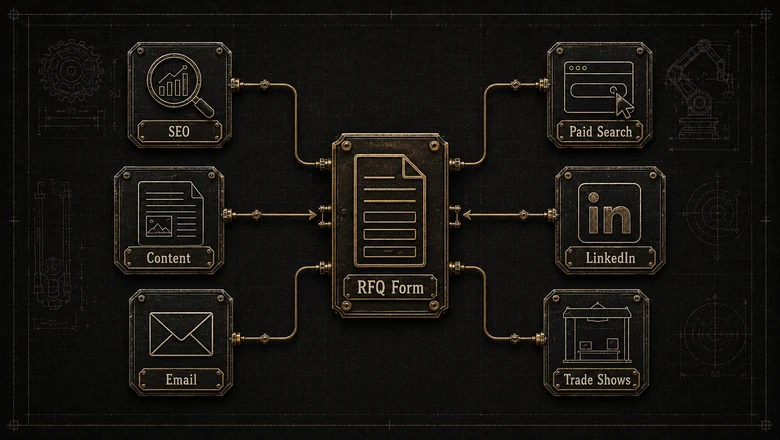
The channels, compared: where each one earns RFQs
Every channel below can produce a quote request, but not at the same cost, effort, or reliability. Read this table as a triage tool: it ranks the channels by how directly they turn into RFQs, so you can see at a glance which ones deserve the first dollar and which are accelerators you add later. Cost figures are directional, drawn from published B2B cost-per-lead benchmarks and our own read of what manufacturers actually pay.
| Channel | Best for | Effort to start | Typical cost | RFQ potential |
|---|---|---|---|---|
| Website + RFQ conversion | Turning existing demand into quotes | Medium, mostly one-time | Owned (build cost) | Highest — every channel converts here |
| SEO (buyer-intent) | Being found during research | High, compounding | Low per lead (~$415 organic) | High, once you rank (3–6+ months) |
| Content marketing | Proving capability, earning trust | Medium-high, ongoing | Low-medium | Medium-high (feeds SEO and sales) |
| Email / follow-up | Staying in long sales cycles | Low-medium | Low | Medium (needs a list first) |
| Paid search (PPC) | Buying high-intent visibility now | Low to launch | Higher per lead (~$691 paid) | Medium-high, but stops when you stop paying |
| LinkedIn / social | Credibility, reaching named accounts | Medium, ongoing | Medium | Low-medium (slow to convert to RFQ) |
| Trade shows / directories | Relationships, vertical reach | High | Highest cost per lead | Medium (expensive per RFQ) |
Two numbers anchor the whole table. In First Page Sage’s 2025 cost-per-lead data, a manufacturing lead from organic channels averages about $415, while the same lead from paid averages about $691. Organic is cheaper and the gap widens over time, but organic also takes months to arrive. That trade-off (cheap and slow versus fast and rented) is the reason spend has an order rather than a menu.
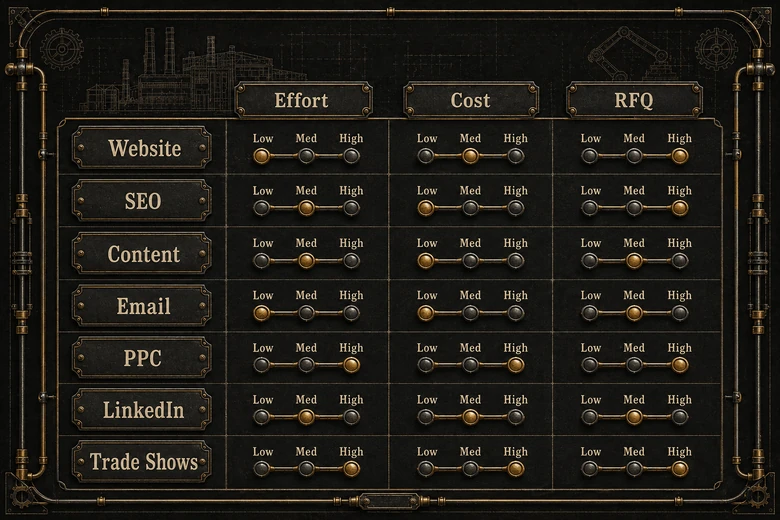
Where to spend first: the priority order
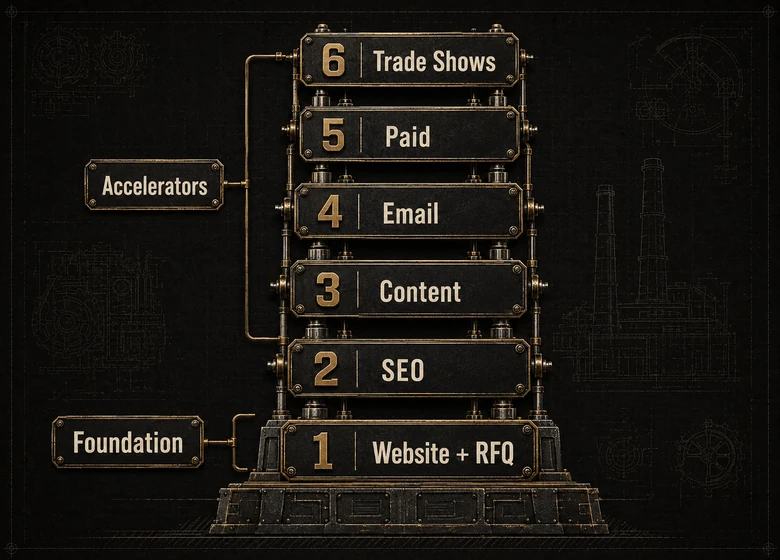
Spend in the order a buyer actually moves, from the place demand converts back out to the places that create it. The sequence below is deliberate: each step makes the next one worth more. Rank higher on SEO before your website converts and you pour visitors into a leaky form. Run paid ads before your capability content exists and you pay for clicks that bounce.
- Make the website and RFQ path convert. This is the foundation every other channel feeds. If the quote form is buried, generic, or asks for a phone call instead of specs, fix that before you spend a dollar on traffic.
- Claim buyer-intent SEO. Rank for the specific searches that happen right before a quote (process + material + spec), not vanity terms. This compounds.
- Publish capability and educational content. Prove you can make the part with spec sheets, tolerances, and process pages. This content is what SEO ranks and what sales sends.
- Turn on email follow-up. Manufacturing cycles run months. A simple sequence keeps you in the deal between the first download and the eventual RFQ.
- Add targeted paid to accelerate. Once the site converts and the content exists, PPC and LinkedIn buy speed on the highest-intent searches and accounts.
- Use trade shows and directories as supplements. They earn relationships and vertical reach, but at the highest cost per lead, so they support the engine rather than being it.
PRO TIP
If you can only do two things this quarter, do steps 1 and 2. A converting site plus buyer-intent SEO is the entire compounding engine; everything else amplifies it. A shop with a great booth and a broken quote form is lighting money on fire.
The website is the channel every other channel feeds
Your website is the only channel you own, and it’s where every other channel cashes out. An ad, a search result, a directory listing, and a trade-show badge scan all lead to the same place: a page where a buyer decides whether to request a quote or close the tab. Spend here first because a 20% lift in conversion makes every upstream dollar worth 20% more, for free.
For a manufacturer, “converting” is specific. It means the buyer can find the process, the materials, the size envelope, the tolerances, the certifications, and a way to submit a drawing without a sales call. That’s a different bar than a pretty homepage, and it maps to a concrete checklist of the features industrial buyers expect before they’ll fill out a form. Miss those and it doesn’t matter how much traffic you buy; the RFQ won’t come.
Content marketing for manufacturers that earns quotes
Content marketing for manufacturers means publishing the technical proof a buyer needs to shortlist you, not blog posts written for a search robot. The mistake is treating content as “articles.” For a shop, the content that earns RFQs is closer to documentation: capability pages, material and process guides, tolerance charts, finishing options, industries served, and honest lead-time expectations. This is the material an engineer reads at 11 p.m. while building a shortlist.
The highest-converting page a manufacturer can publish is a capability page written like a spec sheet, because it answers the qualify-or-skip questions in one place. Standard blog content still has a role: it captures earlier-stage searches (“how to choose a CNC finish,” “aluminum vs steel for X”) and routes those readers toward the capability pages. But the order matters. Build the proof pages first; write the awareness content second.
IMPORTANT
Don’t publish content a competitor could publish word-for-word. “5 benefits of CNC machining” ranks for no one and proves nothing. Your unique tolerances, materials, industries, and process photos are the moat. Generic content is why most manufacturer blogs sit unread at position 40. A plant’s measured lean manufacturing improvements are stronger evidence than another generic benefits post.
SEO and getting found in search and AI answers
SEO is how you get found during the research phase you never see, and for a manufacturer it now spans two surfaces: classic Google results and AI answers. The buyer searching “titanium 5-axis machining aerospace tolerances” is doing bottom-of-funnel work. Ranking there is worth more than ranking for a thousand generic industry terms. The mechanics of that (keyword targeting, technical setup, and getting cited) are their own deep topic, and the full playbook is our guide to the keyword and technical work that gets a shop ranked for buyer-intent searches.
The newer half is AI search visibility. Buyers increasingly ask an assistant before they open ten tabs: roughly half of B2B buyers now start their research with AI chatbots, per G2’s buyer-behavior data. The same structured, specific content that ranks in Google (clear specs, real numbers, direct answers) is what these engines lift and cite. You don’t optimize twice; you write clearly enough to be quoted once.
Email, paid, and social: the accelerators
Email, paid ads, and social are accelerators: they speed up or amplify an engine that the website, SEO, and content have already built. Reach for them once the foundation converts, not before, and they earn their keep. Reach for them first and they expose every crack in the funnel at a price per click.
Email is the strongest accelerator for manufacturers because the sales cycle is long. A buyer who downloads a spec sheet in March may not issue an RFQ until August; a short, useful follow-up sequence keeps you in the room. Paid search is the fastest way to appear on a high-intent term while your SEO is still climbing, but treat it as rented demand that stops the day you stop paying. LinkedIn builds credibility and lets you reach named accounts, but it converts slowly, so budget it as a brand and relationship play rather than an RFQ machine. To know which of these is actually working, you need attribution: a CRM that tags where each quote request came from turns “we feel like ads help” into a number you can act on. Attribution still stops short of an operating plan: reconciling qualified pipeline with material and capacity constraints is the next monthly decision.
How to sequence spend by budget and situation
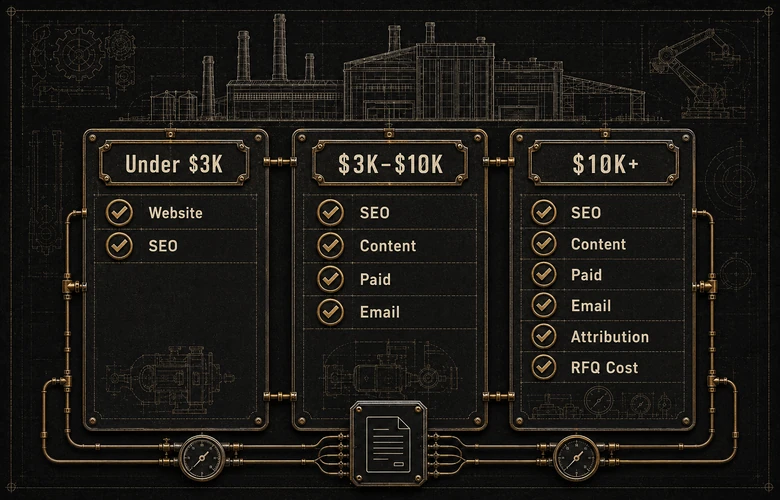
Match the spend order to the constraint you actually have, because a shop with $2,000 a month and a shop with $20,000 shouldn’t start in the same place. The priority list doesn’t change; where you enter it does. The three situations below cover most manufacturers. When an outside agency, ad platform, or specialist executes that budget, the approved service-spend trail should connect scope, PO or controlled exception, acceptance, invoice, and payment.
Tight budget (under $3,000/month)
Put almost everything into the foundation. Fix the site’s conversion path, build three to five real capability pages, and do the on-page SEO yourself. Skip paid entirely until organic proves the pages convert. At this level, one well-optimized capability page that ranks is worth more than a whole ad account.
Growing budget ($3,000–$10,000/month)
Keep the foundation funded, then add a small paid-search budget on your two or three highest-intent terms and a light email follow-up. This is the range where a specialist starts to pay off, and where how to vet a manufacturing marketing company becomes a decision worth making carefully rather than fast.
Established budget ($10,000+/month)
Run all channels, but govern them with attribution. Measure cost per qualified RFQ by channel and move money toward whatever is cheapest per real quote request. This is also where trade shows and directories earn a place, funded from a channel you’ve proven, not from the money that should be fixing your website.
When to hire a manufacturing marketing company
Hire out when you’ve proven a channel works and can’t scale it with your own hours, not when you’re hoping an agency will discover what works for you. That distinction protects your budget. An agency handed a converting website and a channel that already produces RFQs can pour fuel on a fire. An agency handed a broken funnel and a blank check will bill you for months of “strategy” while the quote form still doesn’t work.
Before you sign anything, know your own numbers: which pages convert, what a qualified RFQ costs you today, and which channel produced last quarter’s real quotes. That knowledge is also what lets you tell a genuine manufacturing specialist from a generalist who’ll run the same LinkedIn playbook they use for a dentist. The full checklist for vetting fit, pricing, and manufacturing experience is its own guide, and it’s the right next read if outsourcing is where you’re headed.
Frequently Asked Questions
Manufacturers do digital marketing by making their website convert first, then earning buyer-intent SEO and publishing capability content that proves they can make the part. Email keeps you in long sales cycles, and paid ads plus LinkedIn accelerate once the foundation works. The goal throughout is qualified RFQs, measured by cost per quote request, not traffic.
There’s no universal percentage, but the constraint should set the plan, not a benchmark. Under $3,000 a month, put nearly all of it into the website and SEO foundation. From $3,000 to $10,000, add light paid and email. Above $10,000, run every channel but govern spend by cost per qualified RFQ so money follows results.
Digital marketing is the full mix of online channels and where to invest across them; lead generation is the narrower discipline of choosing and running the specific channels that produce inquiries. This guide handles the budget-priority question. For the deeper channel-by-channel selection and RFQ-quality tactics, see our manufacturing lead generation guide.
SEO is cheaper per lead and compounds, but takes three to six months; paid is faster but stops the day you stop paying. Manufacturing leads from organic average around $415 versus $691 for paid. Start with SEO for durability, then add paid on your highest-intent terms to buy speed while rankings build.
Trade shows still matter for relationships and vertical reach, but they carry the highest cost per lead of any channel, so they belong on top of a working digital engine, not in place of one. Fund them from a channel you’ve already proven, and use digital to book meetings before the show and follow up with the leads after it.
