
Most “best manufacturing CRM” lists rank the same general sales tools every other industry sees, then paste the word “manufacturing” on top. That is why so many shops buy a polished CRM and still cannot generate a quote from an RFQ, give a distributor its own portal, or let a repeat customer reorder without a phone call.
A manufacturing CRM has to do three jobs a generic sales CRM was never built for: turn a request for quote into a priced order, manage the dealers and distributors who sell on your behalf, and make repeat and reorder business effortless. Score the market on those three jobs and the rankings look nothing like the usual roundup.
We scored nine CRMs against that manufacturer-fit standard, with live pricing checked in June 2026 and every figure linked to its source. Where a price is gated, we say so rather than guess. This guide gives you the scorecard, the per-vendor verdicts, and a decision framework for picking by your own order pattern.
Direct answer — What is the best manufacturing CRM software?
The best manufacturing CRM is the one that fits how you actually sell: by RFQ-to-quote handling, distributor and dealer management, and repeat-order workflows, not by generic sales features. For contracted, repeat-volume manufacturers, Salesforce Manufacturing Cloud scored highest in our review; Prospect CRM leads for stock-and-reorder distributors; Epicor and Microsoft Dynamics 365 suit ERP-centered shops; Zoho and Pipedrive fit small shops with simple quoting. There is no single winner, only the best fit for your order pattern.
Key Takeaways
- Score CRMs on RFQ-to-quote handling, distributor and dealer management, and repeat-order workflows, not on generic pipeline features.
- Salesforce Manufacturing Cloud (4.5/5) leads on contracted, repeat-volume fit; Prospect CRM (4/5) leads for stock-aware distributors who live on reorders.
- The cheap horizontal CRMs (Pipedrive, HubSpot Sales Hub) score lowest on manufacturer fit because quoting, dealer portals, and reorders are absent or unbundled.
- “Quote-only” is the norm at the top: Salesforce add-ons, Infor, and Epicor publish no clean per-seat price, so budget for add-ons and ERP, not just the seat.
- Pick by order pattern: make-to-order shops need CPQ, distributors need reorder and channel portals, and most need real ERP and inventory sync.
Methodology
How this comparison was scored
- Scope
- 9 manufacturing-relevant CRM platforms scored against a three-axis manufacturer-fit rubric: HubSpot Sales Hub, Salesforce Manufacturing Cloud, Microsoft Dynamics 365 Sales, Zoho CRM, Pipedrive, SugarCRM (SugarAI), Prospect CRM, Infor CRM, and Epicor CRM.
- Sources reviewed
- Each vendor’s own pricing and product documentation pages, plus four ranking competitor guides for coverage, cross-checked by a second reviewer for every price.
- Date range
- Pricing and capabilities checked June 2026. Every price in this guide is dated “as of June 2026” because software pricing moves and much of it is quote-only.
- Tools used
- A fixed 0–5 rubric scoring three axes: RFQ and quote-to-order handling, distributor and dealer management, and repeat-order and reorder workflows. Overall fit is the rounded average of the three, held at or below that average where a CRM delivers its manufacturer value only inside one vendor’s ERP. Documentation-based scoring, not hands-on testing.
- Limitations
- Scores rest on published vendor documentation, not hands-on implementation testing. List prices change and exclude add-ons, onboarding fees, and ERP licenses; Infor, Epicor, and several partner-portal and CPQ add-on layers are quote-only, so real total cost runs higher and is deal-specific.
- Editorial independence
- No vendor named here paid for placement, ranking, or coverage, and none reviewed this guide before publication. See our editorial policy.
- Conflicts of interest
- Factory Investigator’s sister service business sets up CRM and analytics for manufacturers; none of the scored vendors were clients at the time of evaluation.
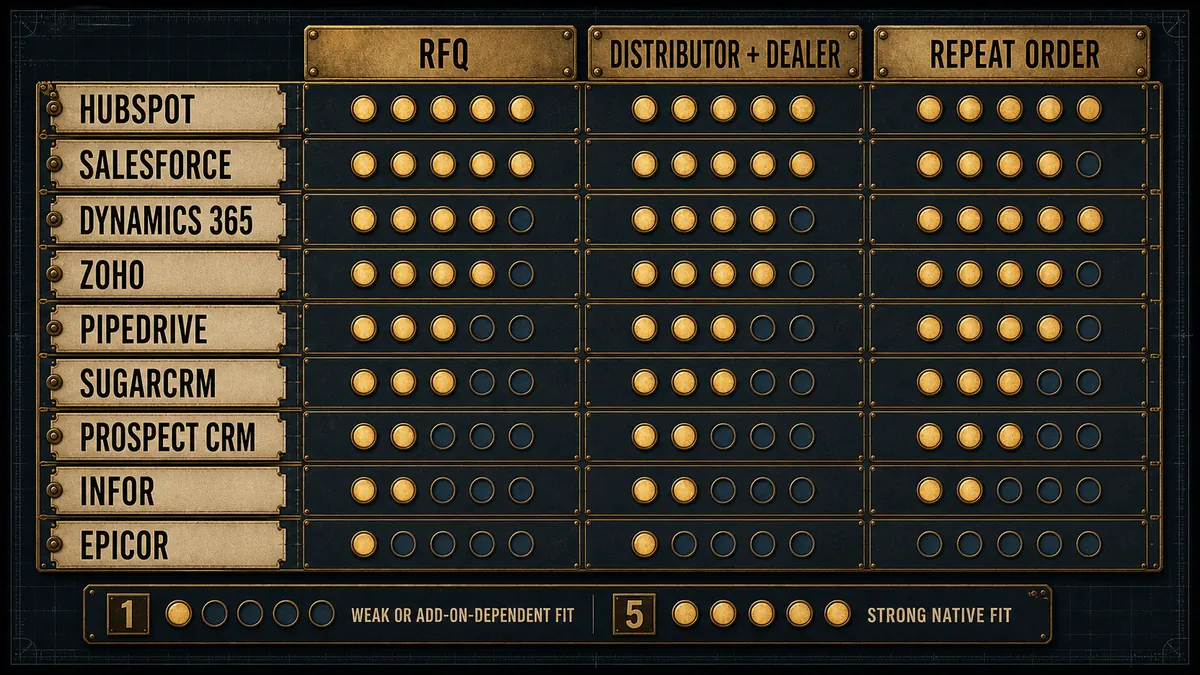
The table below is the short version, by manufacturer type. The full scorecard and the per-vendor verdicts follow underneath.
| If you are a… | Top pick | Why |
|---|---|---|
| Mid-market maker with contracts and repeat volume | Salesforce Manufacturing Cloud | Native sales agreements and account forecasting |
| Distributor or stock-from-shelf manufacturer | Prospect CRM | Stock-aware reorder tooling and ERP sync |
| Shop already on Epicor or Microsoft ERP | Epicor CRM / Dynamics 365 Sales | CRM shares the ERP database |
| Small shop with simple, low-volume quoting | Zoho CRM | Native quotes and orders at a low price |
What a manufacturing CRM is
A manufacturing CRM is sales software that manages the full industrial selling cycle: capturing an RFQ, turning it into a priced quote and order, supporting the distributors and dealers who resell your product, and keeping repeat and reorder business flowing, usually in sync with an ERP or inventory system. It is a sales system shaped around how factories actually win and keep orders. The live stock and pricing a rep relies on, though, are only as accurate as the inventory system your CRM syncs to, which is its own decision before you wire the two together.
That is a wider job than a generic CRM does. A standard sales CRM tracks contacts, deals, and a pipeline. It rarely knows what a price book is, has no concept of a dealer network, and treats every order as a one-time deal rather than a standing relationship. For a manufacturer, those three gaps are exactly where revenue leaks.
What to look for in a manufacturing CRM
The features that decide manufacturer fit fall into six areas. Use this as a checklist when you shortlist, and score each candidate against it before the demo:
- RFQ and CPQ: native request-for-quote intake, configure-price-quote for made-to-order parts, and quote-to-order conversion tied to BOM and cost data.
- Price books and contract pricing: multiple price lists, customer-specific and volume pricing, and discount rules, not one flat rate per product.
- Distributor and dealer portals: self-service ordering, deal registration, and channel-agreement tracking for the partners who sell on your behalf.
- Repeat-order and reorder tooling: standing orders, template reorders, lapsed-account alerts, and account-based demand forecasting.
- ERP and inventory sync: two-way links to your ERP or inventory system so reps see live stock and pricing and orders flow to fulfillment, often over EDI.
- Traceability and field access: lot or serial tracking where you need it, plus mobile access for reps quoting from a plant floor or a trade show.
How we scored manufacturer fit
We graded each CRM on three axes, because those are the workflows a manufacturer buys a CRM to run. Each axis is scored 0 to 5 from published vendor documentation, and the overall score is the rounded average, held down where the value only appears inside that vendor’s ERP. Nothing here is a hands-on lab test; it is a documentation-based read of what each platform natively does.
RFQ and quote-to-order handling. Can the CRM take a request for quote, apply price books and discounts, configure a made-to-order product, and convert an accepted quote into an order? This is where a thin CRM shows itself fastest. If your enquiries arrive as RFQs, the way you handle them on the page is its own discipline, and a CRM that cannot price and convert them is a contact list with a logo. The deeper conversion mechanics live in how you structure the RFQ intake itself; the CRM is what happens after the form is sent. When the configuration runs deep, that job belongs to a dedicated manufacturing CPQ rather than the CRM, which is why the strongest CRMs here integrate one instead of trying to be one.
Distributor and dealer management. Many manufacturers sell through channels. A fit CRM gives dealers and distributors a portal to register deals, check stock and pricing, and place orders, plus a way to track negotiated channel agreements. Deere’s dealer-parity repair rules show that the channel may also need to support customers who buy software resources instead of dealer labor. Most horizontal CRMs have nothing native here and lean on third-party partner-portal add-ons.
Repeat-order and reorder workflows. Industrial revenue is mostly repeat business. The best tools surface lapsed or declining accounts, support standing orders and template reorders, forecast demand against contracted volumes, and sync inventory both ways with the ERP. We scored a one-time-deal CRM low here no matter how slick its pipeline looks. That repeat revenue still begins with a first qualified order, and the first order begins with a quote request a buyer could actually finish, so the design of the quote-request form feeds even a reorder-driven pipeline. We kept the rubric and the independence rules public for the same reason the rest of our editorial standards are: a score you cannot see the working behind is just an opinion with a number on it.
Manufacturing CRM software compared
Here is the full scorecard, sorted by overall manufacturer fit. Prices are starting list prices as of June 2026; “quote-only” means the vendor publishes no per-seat figure on its own site.
| CRM | Type | RFQ / quoting | Distributor & dealer | Repeat order & reorder | Starting price (as of June 2026) | Manufacturer fit |
|---|---|---|---|---|---|---|
| Salesforce Manufacturing Cloud | Industry CRM | 4 / 5 | 4.5 / 5 | 5 / 5 | $275 / user / mo (Enterprise) | 4.5 / 5 |
| Prospect CRM | Stock-aware B2B CRM | 3.5 / 5 | 3 / 5 | 5 / 5 | From £177 / mo (4 users) | 4 / 5 |
| Epicor CRM | ERP-embedded CRM | 4 / 5 | 2.5 / 5 | 4 / 5 | Quote-only | 3.5 / 5 |
| Microsoft Dynamics 365 Sales | Horizontal CRM + ERP | 3.5 / 5 | 2 / 5 | 3.5 / 5 | $65 / user / mo (Professional) | 3 / 5 |
| Zoho CRM | Horizontal CRM | 3 / 5 | 2 / 5 | 2.5 / 5 | $14 / user / mo (Standard) | 3 / 5 |
| SugarCRM (SugarAI) | Horizontal CRM | 2.5 / 5 | 2.5 / 5 | 3.5 / 5 | $59 / user / mo (15-seat min) | 3 / 5 |
| Infor CRM | ERP-aligned CRM | 3.5 / 5 | 2 / 5 | 3 / 5 | Quote-only | 2.5 / 5 |
| HubSpot Sales Hub | Horizontal CRM | 2.5 / 5 | 1.5 / 5 | 1.5 / 5 | Free; paid from $7 / seat / mo | 2 / 5 |
| Pipedrive | Horizontal CRM | 2 / 5 | 1 / 5 | 1 / 5 | $14 / seat / mo (Lite) | 1.5 / 5 |
IMPORTANT
A CRM is not an ERP. The strongest manufacturer scores above come from CRMs that sync tightly with an ERP for inventory, pricing, and orders, not from CRMs trying to be the system of record for production. If a vendor pitches its CRM as a full shop-floor system, read that as a warning, not a feature.
The 9 manufacturing CRMs, scored
Each verdict below gives what the tool is, the manufacturer it fits, its standout, and a starting price linked to the vendor’s own page. Add-on layers are flagged because they decide your real cost.
1. Salesforce Manufacturing Cloud (4.5 / 5)
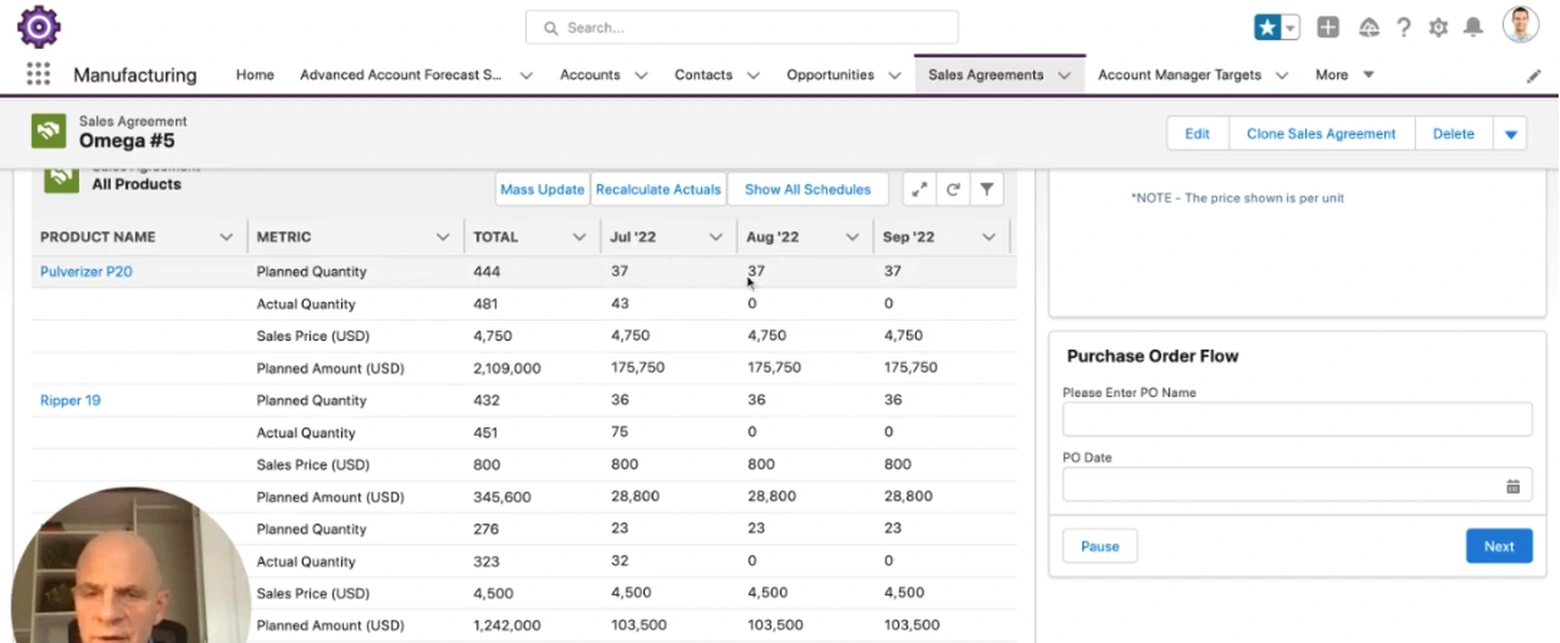
What it is: a dedicated industry CRM built around manufacturer accounts. Best for: mid-market and enterprise makers with negotiated contracts and repeat volume. Standout: native Sales Agreements track planned versus actual volume against contract terms, and Advanced Account Forecasting builds demand forecasts from agreements and order history, the strongest repeat-business fit of any mainstream CRM. Starting price: $275/user/month for Enterprise, $425 for Unlimited (billed annually, as of June 2026). RFQ/CPQ (Revenue Cloud) and dealer portals (Experience Cloud) are separately priced, quote-only add-ons, so plan for a higher real total.
RFQ 4/5 · Distributor 4.5/5 · Repeat-order 5/5.
2. Prospect CRM (4 / 5)
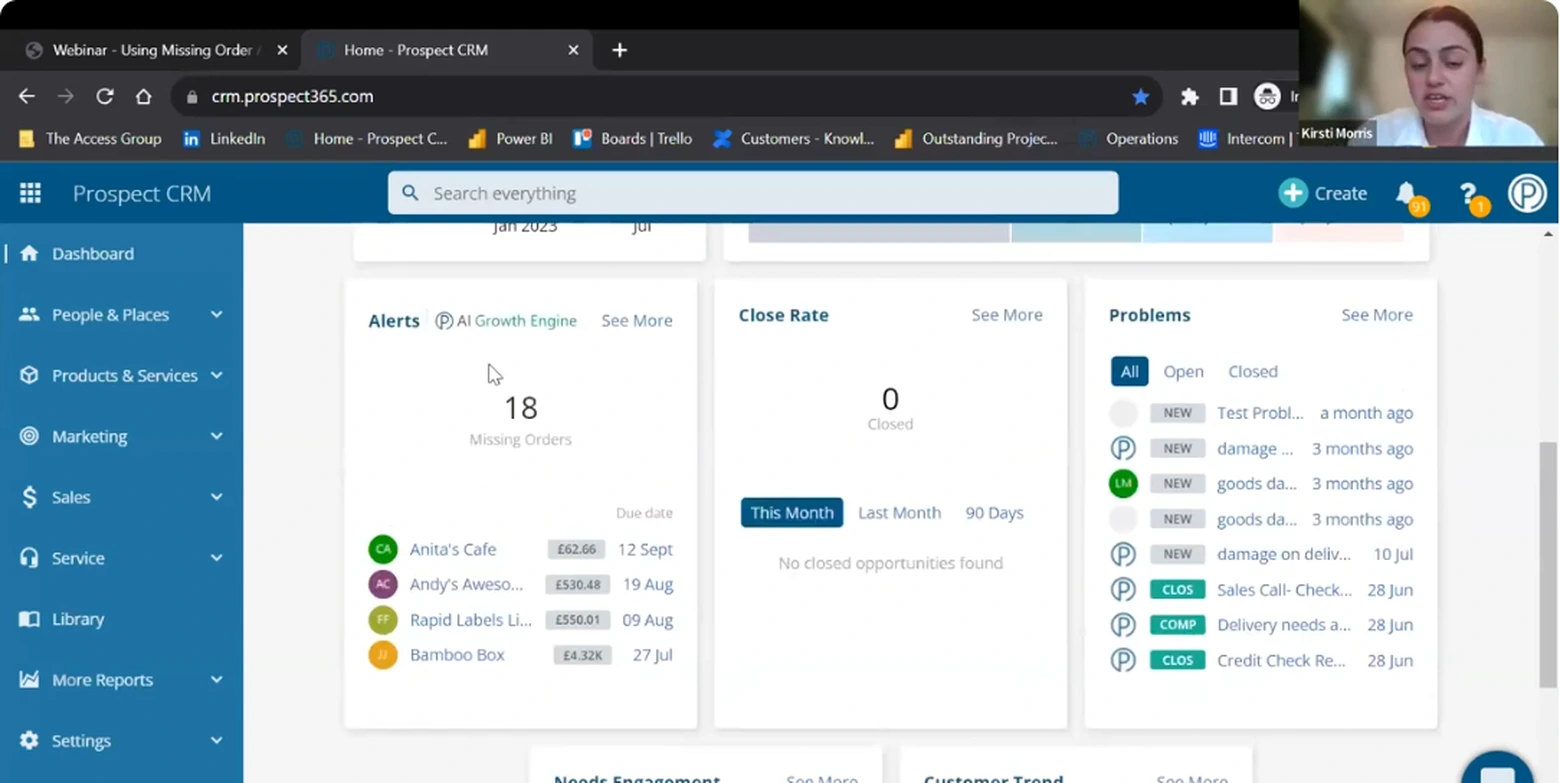
What it is: a “stock-aware” B2B CRM (part of The Access Group, alongside Unleashed) built for product sellers. Best for: wholesalers, distributors, and stock-from-shelf manufacturers who live on reorders. Standout: Missing Order Alerts flag lapsed and declining accounts, RFM segmentation and template orders speed repeat ordering, and two-way sync with Unleashed, Cin7, Katana, and Sage keeps stock and pricing in one place. Starting price: from £177/month for Start-Up (4 users), Professional from £351, Advanced from £1,933 (annual contract, as of June 2026). It lacks rules-based CPQ for engineered products.
RFQ 3.5/5 · Distributor 3/5 · Repeat-order 5/5.
3. Epicor CRM (3.5 / 5)
What it is: a CRM module embedded inside Epicor Kinetic (manufacturing ERP) and Prophet 21 (distribution ERP), not a standalone product. Best for: shops already standardized on Epicor ERP. Standout: because CRM shares the ERP database, estimating and RFQ management, CPQ, blanket orders, EDI demand, and inventory all run natively with no integration gap. Starting price: quote-only; Epicor publishes no per-seat figure and prices Kinetic by platform, package, and users (as of June 2026). There is no dedicated OEM dealer-network portal.
RFQ 4/5 · Distributor 2.5/5 · Repeat-order 4/5.
4. Microsoft Dynamics 365 Sales (3 / 5)
What it is: Microsoft’s horizontal sales CRM, strongest when paired with Business Central ERP. Best for: manufacturers already in the Microsoft and Business Central ecosystem. Standout: native quote-to-order with multiple price lists, plus deep two-way ERP sync that lets a rep check live inventory and BC price lists and auto-transfer orders for fulfillment and reorder. Starting price: $65/user/month Professional, $105 Enterprise, $150 Premium (paid yearly, as of June 2026). There is no native CPQ configurator or dealer portal; both need add-ons.
RFQ 3.5/5 · Distributor 2/5 · Repeat-order 3.5/5.
5. Zoho CRM (3 / 5)
What it is: an affordable, highly customizable horizontal CRM with native order modules. Best for: small manufacturers wanting real quotes and orders without enterprise cost. Standout: built-in Products, Price Books, Quotes, Sales Orders, Purchase Orders, and Invoices, with a CPQ module in early access, all inside a low-priced tool. Starting price: $14/user/month Standard up to $52 Ultimate, plus a free three-user tier (billed annually, as of June 2026). Reorder and demand forecasting need Zoho Inventory or Books bolted on.
RFQ 3/5 · Distributor 2/5 · Repeat-order 2.5/5.
6. SugarCRM, now SugarAI (3 / 5)
What it is: a mid-market CRM, now rebranding to SugarAI, with embedded sales-i revenue intelligence. Best for: distributors and reorder-driven sellers who want ERP-fed buying signals. Standout: sales-i analyzes ERP transaction history to surface reorder, cross-sell, and declining-spend alerts on each account, backed by 180-plus ERP integrations. Starting price: $59/user/month Sugar Sell Standard, $85 Advanced, $135 Premier, with a 15-seat minimum (billed annually, as of June 2026). CPQ and dealer management come from third-party partners, not native modules.
RFQ 2.5/5 · Distributor 2.5/5 · Repeat-order 3.5/5.
7. Infor CRM (2.5 / 5)
What it is: Infor CloudSuite CRM (the former Saleslogix), aligned to Infor’s manufacturing ERP. Best for: shops already running Infor ERP, and few others. Standout: tight coupling to Infor ERP pricing plus a companion Infor CPQ gives reps real-time pricing, configuration, and quote-to-order. Starting price: quote-only; Infor publishes no figure and bundles CRM into wider CloudSuite deals (as of June 2026). As a standalone sales tool on an aging codebase, it adds little unless you are an Infor ERP shop.
RFQ 3.5/5 · Distributor 2/5 · Repeat-order 3/5.
8. HubSpot Sales Hub (2 / 5)
What it is: a polished, marketing-led horizontal CRM with a genuinely free tier. Best for: inbound-driven manufacturers who value ease of use and will add modules for the rest. Standout: transparent per-seat pricing and a clean quote-to-cash flow, once you pay for it. Starting price: free to start; paid from $7/seat/month Starter, $90 Professional, $150 Enterprise (billed annually, as of June 2026). The catch for manufacturers: quoting and CPQ now live in a separate, separately-priced Revenue Hub seat, and there is no native dealer portal, reorder workflow, or ERP sync. A marketing-led CRM only earns its price once inbound is actually producing quotes, which is why it pays to settle which marketing channel is actually earning your RFQs before you buy the platform built to track them. If lead generation is the real gap, our guide to hiring a manufacturing marketing agency covers when to outsource demand generation instead.
RFQ 2.5/5 · Distributor 1.5/5 · Repeat-order 1.5/5.
9. Pipedrive (1.5 / 5)
What it is: a lightweight, easy-to-adopt sales pipeline CRM. Best for: very small shops with simple, low-volume quoting and no channel or reorder needs. Standout: low price, fast setup, and a Products catalog plus Smart Docs that cover basic quoting. Starting price: $14/seat/month Lite up to $69 Ultimate (billed annually, as of June 2026). It has no CPQ, no partner or dealer portal, and no repeat-order or ERP sync, so manufacturers outgrow it quickly.
RFQ 2/5 · Distributor 1/5 · Repeat-order 1/5.
How to choose a manufacturing CRM
Choose by your order pattern, not by brand recognition. The right CRM for a make-to-order job shop is the wrong one for a stock-and-reorder distributor, and the gap between them is exactly the three axes above. Work through the cases below before you sit through a single demo.
Use a make-to-order or engineered-product fit (Salesforce, Epicor, Infor) when most enquiries arrive as RFQs for configured parts. You need CPQ and price books that tie to BOM and cost data, which the ERP-embedded options do natively and the horizontal tools do only through add-ons.
Use a stock-and-reorder fit (Prospect CRM, SugarCRM) when your revenue is repeat orders from a known account base. Prioritize reorder alerts, template orders, and two-way inventory sync over pipeline polish, because your growth comes from retention, not net-new logos.
Use an ERP-ecosystem fit (Dynamics 365, Epicor, Infor) when you already run a major ERP. The CRM that shares or natively syncs to that ERP will beat a “better” standalone CRM you have to integrate by hand.
Use a budget or starter fit (Zoho, Pipedrive, HubSpot free) when you are small, your quoting is simple, and you sell direct. Start cheap and native, and move up when channel or reorder complexity actually arrives.
PRO TIP
Price the whole stack, not the seat. For the top manufacturer-fit tools, the published seat price excludes the parts you most need: CPQ, partner portals, onboarding fees, and ERP licenses are extra and often quote-only. Get one written quote for your full configuration before you compare. If you would rather not run that evaluation in-house, our CRM and analytics setup service scopes the real stack and the tracking around it.
Frequently Asked Questions
A CRM in manufacturing is sales software that runs the industrial selling cycle: capturing RFQs, turning them into priced quotes and orders, managing distributors and dealers, and keeping repeat and reorder business flowing, usually in sync with an ERP or inventory system. It is built around how factories win and keep orders, not just contacts and deals.
It depends on your order pattern. In our June 2026 scoring, Salesforce Manufacturing Cloud led for contracted, repeat-volume makers, Prospect CRM for stock-and-reorder distributors, and Epicor or Dynamics 365 for ERP-centered shops. Zoho is the best low-cost pick for small shops. There is no single best CRM, only the best fit for how you sell.
As of June 2026, entry pricing ranges from free (HubSpot) or about $14/user/month (Zoho, Pipedrive) to $275/user/month for Salesforce Manufacturing Cloud Enterprise. Several manufacturer-grade options (Infor, Epicor, and CPQ or dealer-portal add-ons) are quote-only, so the real total includes add-ons, onboarding, and often an ERP license.
Most need both, doing different jobs. A CRM owns selling: quotes, RFQs, dealers, and reorders. An ERP owns production and inventory: BOMs, work orders, and stock. The best manufacturing CRMs do not replace the ERP, they sync to it so reps see live pricing and inventory and orders flow through to fulfillment.
Some can natively; many cannot. ERP-embedded CRMs (Epicor, Infor) and Salesforce with Revenue Cloud handle RFQ-to-quote-to-order with CPQ and price books. Horizontal tools like Pipedrive and HubSpot Sales Hub cover only basic quoting and push CPQ to a paid add-on, so confirm native RFQ handling before you buy if quoting is core to your sales.
The fastest way to know which fit you need is to look at how your own quotes, channel, and reorders actually flow today, then match that to the axis a CRM is strongest on. If you want that mapped against your live site and sales process before you commit budget, request a free Manufacturer Website Investigation and we will show you where enquiries are leaking before they ever reach a CRM.
