
Vendor management inventory is a grammatically awkward search term for a very practical operating model. The industry name is vendor-managed inventory, or VMI: the supplier watches selected stock and decides when to replenish it. The important argument begins one line deeper. Managing the bin does not automatically mean owning what is in it.
That distinction is where otherwise sensible VMI programs break. Operations thinks the supplier owns the stock, finance books it on receipt, purchasing expects a purchase order, and the supplier ships against a min/max signal. The bins stay full while the records disagree. A workable VMI agreement states four responsibilities separately: who owns the goods, who owns the data, who triggers replenishment, and exactly when title transfers.
Direct answer — What is vendor-managed inventory?
Vendor-managed inventory (VMI) is a replenishment arrangement in which the supplier monitors a customer’s on-hand stock, consumption, and forecast, then decides when and how much to replenish within agreed rules. VMI defines who manages replenishment, not who owns the goods: title may pass on shipment, receipt, or consumption. Consignment defines ownership, not management. The contract must state both the replenishment authority and the title-transfer point.
Key Takeaways
- VMI is a management model. It transfers the replenishment decision to the supplier; it does not, by itself, determine inventory ownership.
- Consignment is an ownership model. The supplier retains title until an agreed event, usually consumption or withdrawal.
- Clean on-hand, usage, forecast, receipt, and exception data matter more than an elaborate portal. VMI on inaccurate records only outsources the confusion.
- The best manufacturing fit is usually a stable family of high-use, low-value C-parts with standard pack sizes and a dependable supplier.
- The commercial downside is real: convenience can hide price drift, deepen supplier dependency, and make switching harder.
What “Vendor Management Inventory” Means in Practice
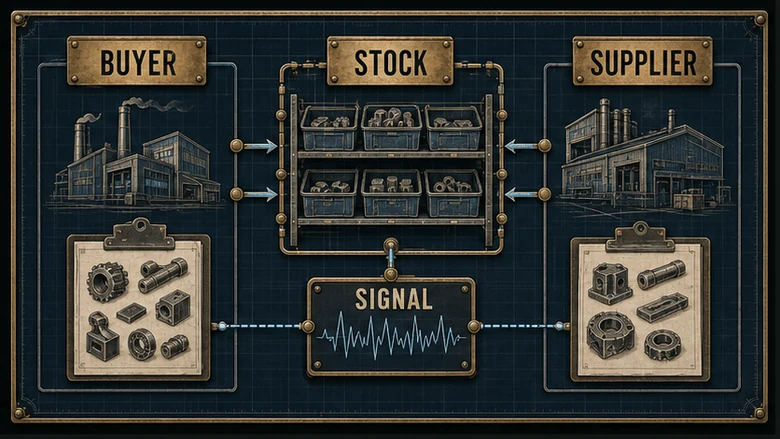
Vendor-managed inventory is a closed-loop replenishment model in which the supplier receives demand and stock signals, applies agreed rules, and creates the next replenishment. The buyer still sets the commercial boundaries. The supplier does not get an unlimited right to push material into the plant.
| Model | Who manages stock? | Who owns stock? | Who triggers replenishment? | Typical title transfer | Buyer cash impact |
|---|---|---|---|---|---|
| VMI, non-consigned | Supplier | Buyer after the contractual transfer point | Supplier, within agreed rules | Shipment or receipt | Buyer funds inventory before use |
| VMI with consignment | Supplier | Supplier until use or withdrawal | Supplier, within agreed rules | Consumption or issue from stock | Buyer pays later, after the trigger event |
| Consignment only | Buyer or jointly agreed party | Supplier until use or withdrawal | Buyer may still place the order | Consumption or issue from stock | Buyer avoids funding unused stock |
| Traditional purchase order | Buyer | Buyer after the contractual transfer point | Buyer | Shipment, receipt, or other agreed term | Buyer carries ordered inventory |
The compact rule is simple: management answers who decides; consignment answers who owns. A VMI program can be consigned or non-consigned, and consigned material can exist without supplier-managed replenishment. Treating those words as synonyms is the first contractual error to remove.
VMI also does not replace a demand plan. It shortens the path from demand signal to replenishment decision. The supplier still needs the approved demand and capacity assumptions that come out of a disciplined sales and operations planning cycle; otherwise it is merely reacting faster to a noisy forecast.
How Vendor-Managed Inventory Works
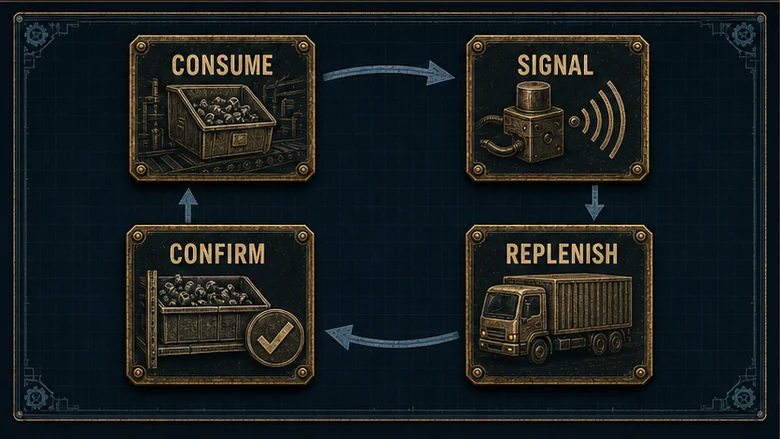
Vendor-managed inventory works as a repeated seven-step loop, not as a one-time bulk delivery. Current SAP Business Network documentation describes the same operating pattern: the buyer designates managed materials and shares demand, stock, and min/max information; the supplier plans replenishment and communicates shipment data.
- Define the scope. The parties name the SKUs, locations, storage points, pack sizes, lead times, and people covered by the VMI agreement.
- Set the control rules. Buyer and supplier agree min/max levels, order multiples, review frequency, forecast horizon, frozen windows, and exception thresholds.
- Share the operating signal. The buyer sends usable on-hand, consumption, demand, open receipts, rejects, and forecast data by EDI, portal, CSV, or API.
- Calculate the need. The supplier applies the agreed rule to projected stock, confirmed inbound, lead time, and pack constraints.
- Create the replenishment record. Depending on the design, the supplier proposes an order, creates an order acknowledgement, releases against a blanket order, or submits a replenishment request for buyer approval.
- Ship, receive, and transfer title. The physical delivery, accounting receipt, and ownership transfer occur at the contractually defined events. They are not necessarily the same event.
- Reconcile exceptions. Both parties review count variances, rejected material, expedites, missed service levels, obsolete stock, price changes, and forecast breaks.
The fifth step is where VMI meets purchasing. A normal buyer-created PO may be replaced by a supplier-generated suggestion, release, or acknowledgement, but the wider procure-to-pay control trail still needs an approved price, receipt, invoice match, and auditable liability. Removing repetitive PO entry is useful; removing financial control is not.
The ERP or MRP remains the buyer’s system of record for demand, inventory, and commitments. The boundary between material planning and the wider ERP record matters because VMI changes who acts on the signal, not which system must keep purchase, stock, and accounting records synchronized.
Who Owns the Inventory in VMI?
Inventory ownership in VMI is whatever the contract says it is; supplier management does not settle title. Oracle’s JD Edwards documentation explicitly supports both customer-owned VMI and supplier-owned VMI with consignment. That is the cleanest correction to the common claim that every VMI bin remains supplier property.
In non-consigned VMI, the buyer may take title when goods ship or arrive, while the supplier continues to monitor and replenish them. The inventory is buyer-owned but supplier-managed. Finance books the receipt and liability under the agreed terms; operations does not place each replenishment order manually.
In consigned VMI, the supplier both manages the replenishment and retains title until the buyer consumes, withdraws, or otherwise accepts the material. The buyer holds the physical stock without yet owning it. Consumption must therefore create a reliable ownership and billing event, not just reduce a quantity on a screen.
IMPORTANT
Never let “supplier-owned” live only in a slide deck. Put the transfer event, valuation method, loss and damage responsibility, cycle-count rule, and tax treatment in the signed agreement, then make the ERP transaction match it.
Physical custody creates another split. Stock can sit in the buyer’s crib, line-side rack, vending machine, or two-bin station while the supplier owns it. The agreement must say who can access it, who counts it, who absorbs shrinkage, how rejected material is quarantined, and which record wins when the physical count differs from the portal.
What Data a VMI Supplier Needs
A VMI supplier needs enough data to reconstruct the buyer’s projected inventory position by item and location. A monthly total is rarely enough. The decision must distinguish usable stock from quarantined stock, known demand from forecast demand, and confirmed receipts from optimistic promises.
| Data signal | What the supplier uses it for | Failure if it is wrong or late |
|---|---|---|
| Usable on-hand by SKU and location | Establish the starting inventory position | False shortage or false comfort |
| Consumption or issues | Measure actual usage velocity | Replenishment lags the floor |
| Forecast and gross requirements | See demand beyond recent history | Launches and shutdowns arrive as surprises |
| Open orders and confirmed inbound | Avoid ordering the same need twice | Excess stock and duplicate shipments |
| Receipts, rejects, returns, and adjustments | Reconcile usable quantity | Portal stock drifts from physical stock |
| Min/max, lead time, pack, and MOQ rules | Convert need into a shippable quantity | Orders violate the operating agreement |
| Engineering and lifecycle changes | Stop replenishing obsolete revisions | Supplier fills the plant with stranded stock |
For EDI-connected programs, the GS1 US Business Processes Guide for EDI identifies the X12 852 Product Activity Data message as the buyer-to-supplier feed for inventory and product movement. It can carry on-hand, sales or usage, receipts, adjustments, on-order quantities, and exceptional demand. In a seller-managed replenishment flow, the supplier can use an 855 message to represent the suggested order.
The 855 is not a generic inventory update. X12 defines the 855 as a Purchase Order Acknowledgment and also permits it to notify the buyer of a vendor-generated order. The exact document set is a trading-partner design choice, so write it into the interface specification instead of assuming that “EDI enabled” means both sides use the same flow.
Smaller manufacturers do not need enterprise EDI on day one. A supplier portal, controlled CSV exchange, or API can run the same decision if item IDs, units of measure, locations, timestamps, and exception ownership are consistent. Current Oracle Fusion Cloud 26B documentation, for example, supports supplier portal and REST-service paths for min/max settings and replenishment requests.
The software question is therefore secondary to the data contract. A capable manufacturing inventory system can supply lot, location, on-hand, and movement records, but no platform can repair an undefined unit of measure or a receiving team that leaves rejected stock counted as usable.
A Worked VMI Example: The Fastener Bin
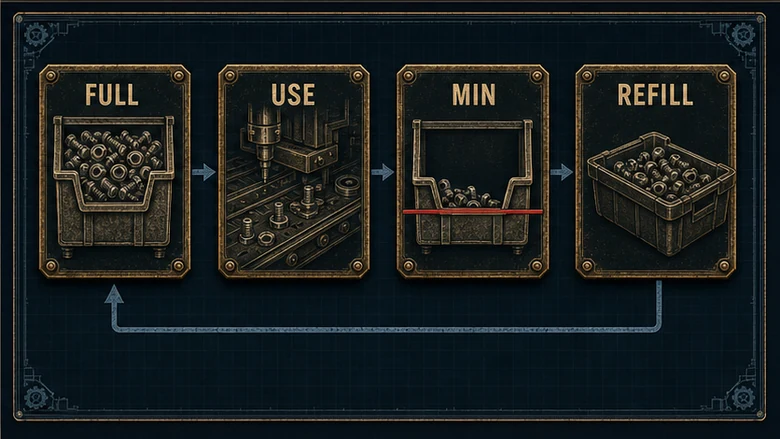
A fastener-bin example shows the mechanics without hiding behind software. Assume a plant consumes an average of 240 M8 washers per production day. The agreement sets a minimum of 1,200, a target maximum of 3,000, and a shipping pack of 500. The supplier receives the on-hand and usage file each morning.
Order quantity = target maximum − usable on-hand − confirmed inbound + backordersOn Monday, usable on-hand is 1,050, with no confirmed inbound and no backorders. The raw need is 1,950. Because the supplier ships in packs of 500, the agreement’s rounding rule raises the replenishment to 2,000. The projected receipt position becomes 3,050, which is 50 above the nominal maximum but compliant with the pack rule.
The supplier creates the agreed replenishment record and sends shipment notice. If the arrangement is non-consigned, the plant may take title on receipt. If it is consigned, the supplier may retain title until a washer is scanned out of the controlled bin. The physical trigger is identical; the accounting result is not.
The example also exposes the weak point. If the crib issued 400 washers without recording them, the supplier sees 1,450 instead of 1,050 and may not replenish. That is why VMI should follow accurate cycle counting and a sound manufacturing inventory management practice, not substitute for either one. Bad data does not become good because a vendor reads it.
VMI vs Consignment: Use the Right Model
VMI and consignment solve different problems: VMI delegates the replenishment decision, while consignment delays the ownership transfer. They can be used alone or together. The right choice depends on which burden the buyer is trying to remove.
- Use non-consigned VMI when repetitive ordering is the problem, the buyer accepts normal ownership timing, and the supplier can plan the item family better from shared demand.
- Use consignment without VMI when working capital or uncertain consumption is the problem, but the buyer still wants to control when and how much to reorder.
- Use VMI with consignment when both replenishment workload and early ownership are problems, and the parties can record consumption accurately enough to trigger title and billing.
- Keep traditional POs when demand is irregular, each order needs engineering or commercial approval, supplier substitution is common, or inventory data is not dependable.
PRO TIP
Draw a two-axis box before negotiating: “Who decides replenishment?” on one axis and “Who owns the stock?” on the other. If buyer, supplier, finance, and operations do not place the program in the same quadrant, the agreement is not ready.
When VMI Fits and When It Becomes a Trap
VMI fits items whose demand, identity, pack size, and replenishment rule are stable enough for a supplier to act without asking permission on every cycle. It fails when the relationship delegates a decision the supplier cannot make from the data provided.
VMI is a strong fit when:
- Items are high-use, low-value, and operationally annoying to reorder, such as fasteners, fittings, abrasives, filters, packaging, or standard MRO consumables.
- Demand is repetitive enough for min/max or consumption-based rules to work.
- The supplier can consolidate deliveries, hold buffer upstream, and respond inside the agreed lead time.
- Item masters, units of measure, receiving, issues, and cycle counts are already reliable.
- The buyer can benchmark price, service, and inventory outcomes instead of rewarding the supplier only for keeping bins full.
VMI is usually a weak fit when:
- Parts are custom, revision-sensitive, high-value, or bought in lumpy project quantities.
- Engineering changes can strand stock faster than the supplier receives lifecycle data.
- A single source already has too much bargaining power and the VMI integration would make switching harder.
- Inventory accuracy is poor, rejects are not segregated, or unrecorded line-side stock is common.
- The supplier’s own capacity, lead time, or financial health is unstable.
The hidden commercial cost is dependency. A supplier that owns the replenishment data, bin hardware, labels, and service route can become expensive to replace. Price increases also hide more easily when buyers stop placing and reviewing individual orders. VMI is therefore a strategic sourcing decision, not a housekeeping shortcut: preserve alternate-source specifications, periodic price benchmarks, data export rights, and an executable exit clause.
What a VMI Agreement Must Define
A VMI agreement must turn the replenishment model into auditable operating rules. “Supplier will keep bins full” is a promise, not a control design. At minimum, put the following items in the commercial agreement and its operating appendix.
- Scope: covered SKUs, revisions, locations, bins, and excluded demand.
- Decision rights: who sets min/max, who may override, and which changes require buyer approval.
- Ownership: title-transfer event, valuation basis, loss, damage, shrinkage, tax, and insurance responsibility.
- Data: source system, fields, cadence, units, timestamps, security, retention, and correction process.
- Order flow: blanket order, supplier-generated order, release, acknowledgement, ASN, receipt, invoice, and three-way-match treatment.
- Service: fill rate, stockout definition, lead time, expedite response, delivery window, and escalation path.
- Inventory control: cycle counts, variance tolerance, rejected stock, returns, obsolete stock, and year-end count procedure.
- Commercial controls: price file, review cadence, surcharges, substitutions, volume tiers, and audit rights.
- Change control: forecast breaks, plant shutdowns, launches, engineering changes, and item discontinuation.
- Exit: data export, bin and hardware ownership, remaining stock purchase or return, transition support, and termination notice.
Do not let the software implementation become the agreement. A portal configuration can show what the system does today, but it does not allocate liability when a count is wrong, a part becomes obsolete, or the supplier misses a line-stop delivery.
How to Measure a VMI Program
A VMI program should be measured against availability, inventory, data quality, service, and commercial control at the same time. Measuring only stockouts rewards overstock; measuring only days on hand rewards shortages.
| Measure | Question it answers | Watch for |
|---|---|---|
| Line-stop or stockout events | Did availability improve? | Definitions that exclude expedites or near misses |
| Fill rate and on-time-in-full delivery | Did the supplier meet the agreed service? | A high fill rate achieved with excess stock |
| Days on hand and inventory turns | Did the program reduce working inventory? | Buyer-owned and supplier-owned stock mixed together |
| Excess and obsolete stock | Did the supplier respond to demand and revision change? | Obsolete consigned stock ignored because it is off the buyer’s books |
| Inventory accuracy and data latency | Can the replenishment calculation be trusted? | Portal uptime mistaken for accurate transactions |
| Expedites and manual overrides | How often did the automatic rule fail? | Emergency work hidden outside the VMI dashboard |
| Price variance and total landed cost | Did convenience erode commercial value? | Service fees or route charges separated from unit price |
Start with a bounded item family, one location, explicit baseline measures, and a parallel reconciliation period. Prove that the physical count, supplier view, ERP balance, ownership record, and invoice agree before expanding. A plant-wide launch makes it harder to tell whether a miss came from the rule, the interface, the supplier, or the buyer’s transaction discipline.
The VMI Verdict for Manufacturers
Vendor-managed inventory is not outsourcing inventory management. It is delegating a narrow replenishment decision under a data contract and a commercial contract. The best programs make routine C-parts almost invisible without making ownership, price, or service invisible.
The test is not whether the supplier can keep a bin full. The test is whether both parties can explain, for any unit in that bin, why it is there, who owns it, what signal will replace it, what price applies, and how the relationship ends. If those answers are explicit, VMI can remove repetitive ordering. If they are not, the full bin is only hiding the next dispute.
Frequently Asked Questions
Vendor-managed inventory is a replenishment model in which the supplier monitors agreed stock, demand, and consumption data, then decides when and how much to replenish. The buyer sets the rules, scope, prices, and service levels. VMI transfers the replenishment decision; it does not automatically transfer inventory ownership.
VMI defines who manages and triggers replenishment, while consignment defines who owns the stock. A buyer can own supplier-managed VMI stock after receipt, or a supplier can retain title until consumption under consigned VMI. The two models often operate together, but neither one automatically implies the other.
Ownership depends on the VMI agreement. In non-consigned VMI, the buyer may take title on shipment or receipt while the supplier manages replenishment. In consigned VMI, the supplier usually retains title until the buyer consumes or withdraws the material. The contract must name the exact transfer event.
A VMI supplier typically needs usable on-hand inventory by item and location, consumption, forecasts or gross requirements, open orders, confirmed inbound, receipts, rejects, adjustments, lead times, min/max levels, pack sizes, and item changes. The feed also needs consistent item IDs, units of measure, timestamps, and exception ownership.
VMI can fit a small manufacturer when a dependable supplier serves repeat-use, low-value items and the plant already records receipts, issues, and counts accurately. It is a poor shortcut for dirty inventory data, volatile custom parts, or a single-source relationship with weak price controls. Start with one bounded item family.
