
Most small and mid-sized manufacturers don’t sit down and decide to automate. They react. A line goes down for the third time in a month, a customer demands tighter tolerances, a shift can’t be staffed, and someone buys a robot or a sensor to put out that specific fire. Six years later the plant runs a dozen disconnected point solutions that don’t talk to each other. Industrial process automation works best the other way around: as a planned stack, built layer by layer, where each addition removes a constraint you can actually measure.
This guide is the map. It covers what industrial automation is, the building blocks that make it work (from PLCs and SCADA to robots, cobots, machine vision, and factory AI), how to decide what to automate first, and what the return really looks like once the invoices clear. The goal isn’t to sell you a technology. It’s to help you spend the next capital dollar where it pays back fastest.
Direct answer — What is industrial automation?
Industrial automation is the use of control systems, sensors, and machines to run production with minimal human intervention. Programmable logic controllers (PLCs), SCADA software, robots, and machine vision execute and monitor tasks that people once did by hand. Process automation controls continuous flows like chemicals or heat; factory automation handles discrete parts on assembly and machining lines. Both cut variation, raise throughput, and improve safety, and both pay back by removing a specific, measured bottleneck rather than by automating everything at once.
Key Takeaways
- Industrial automation is a stack, not a single purchase: a sensing layer, a control layer (PLC/SCADA), an action layer (robots, cobots, vision), and a data layer that learns.
- Process automation runs continuous flows like chemicals, heat, and fluids; factory automation runs discrete parts. Most SMB plants need the discrete side first.
- Start where you already measure loss. Automating a bottleneck with known downtime or scrap pays back faster than a showcase project.
- Robots keep hitting records: 542,000 industrial robots shipped in 2024, and 4.66 million now operate in factories worldwide, per the IFR.
- The ROI is real but conditional. Automating a bad process just makes bad parts faster.
- Predictive maintenance and factory AI are the highest-return add-ons, but only once the control and sensing layers exist.
What is industrial automation?
Industrial automation is the use of control systems, software, and machines to operate industrial processes with little or no human intervention. A sensor measures something physical such as temperature, position, pressure, or presence; a controller decides what to do with that reading; and an actuator, motor, or robot carries out the action. Repeat that loop thousands of times an hour, reliably, and you have automation.
The term covers a wide range. At one end sits a single sensor that stops a conveyor when a part is missing. At the other sits a fully integrated plant where planning software, machine controllers, robots, and quality systems share one data backbone. People often treat industrial automation and robotics as the same thing, but a robot is only one building block inside a much larger system, and plenty of high-value automation involves no robot at all.
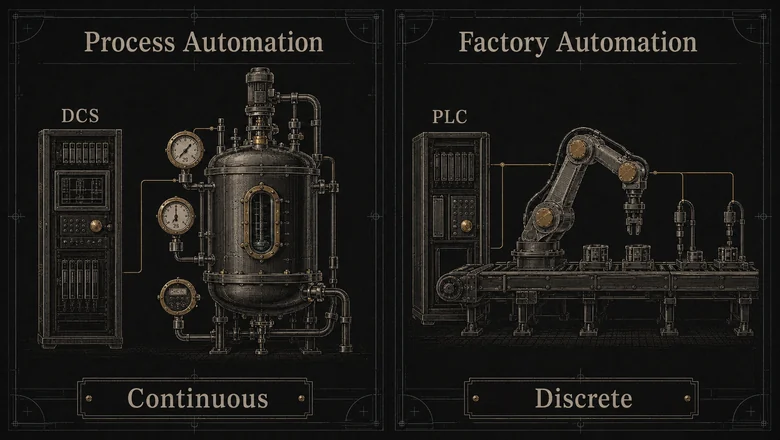
A few concrete examples make the range clear. On a packaging line, a PLC times the fillers and cappers while a vision camera rejects any bottle that’s underfilled or mislabeled. In a CNC machine shop, a cobot loads and unloads parts overnight so the spindle keeps cutting on an unattended shift. In a chemical or food plant, a DCS holds a reactor at the right temperature and pressure for hours without an operator touching a valve. Same idea, very different hardware.
Industrial process automation vs factory automation
The oldest split in the field is between process and factory (discrete) automation, and it decides which tools you’ll buy. Process automation controls continuous or batch flows: chemicals, oil and gas, food, pharmaceuticals, paper, and power. It manages variables like temperature, pressure, and flow, usually through a distributed control system (DCS), and its first priority is stable, safe production.
Factory automation handles discrete objects that get cut, formed, assembled, welded, or packaged. It prizes speed, precision, and repeatability, and it usually runs on PLCs driving robots, conveyors, and machining cells. Most small and mid-sized manufacturers live on the discrete side, which is why this guide leans there, though the control principles carry across both worlds.
The building blocks of industrial automation
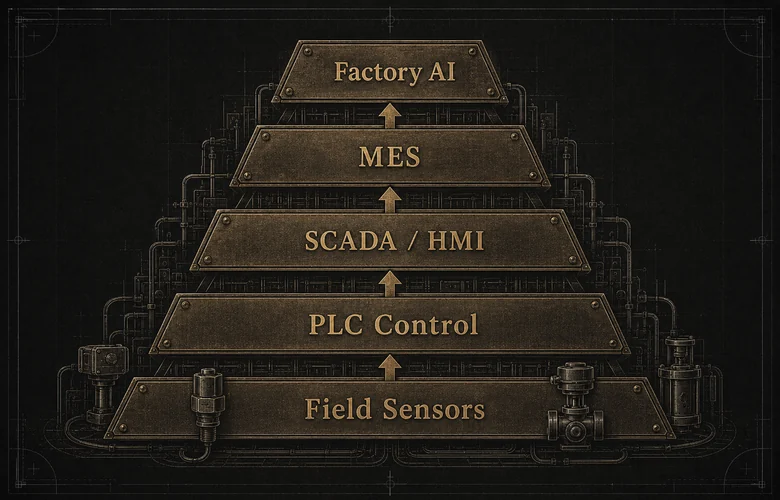
Industrial automation is built from a handful of standard building blocks: a sensing layer that turns physical conditions into data, a control layer that decides, an action layer that moves and makes, and a data layer that learns. You rarely buy all of them at once, and you don’t need to. But knowing the full stack tells you where a new investment fits and what it has to connect to. The table below maps the core technologies to what each does, where it’s typically used, and where it belongs in your plant.
| Technology | What it does | Typical use | Where it fits |
|---|---|---|---|
| PLCs & PACs | Execute control logic in real time | Machine and line control, discrete sequencing | The control layer, on nearly every automated machine |
| SCADA & DCS | Supervise and coordinate many controllers | Plant-wide monitoring; continuous process control | Above the PLCs, at the supervisory layer |
| HMI | Let operators see and command the process | Screens at the machine and in the control room | The human interface to the control layer |
| Industrial robots | Move, weld, machine, and palletize with reach and force | High-volume, repetitive, or hazardous discrete tasks | The action layer, in fenced work cells |
| Cobots | Work safely beside people without full guarding | Low-volume, high-mix tasks and machine tending | The action layer, next to operators |
| Machine vision | Inspect, measure, guide, and read codes | Quality inspection, robot guidance, traceability | Across control and action layers, at inspection points |
| Sensors & IIoT | Turn physical conditions into data | Condition monitoring, counting, part tracking | The sensing layer, everywhere |
| AGVs & AMRs | Move material without a driver | Internal transport, line feeding, warehousing | The material-movement layer, on the floor |
| Predictive maintenance | Flag failures before they stop the line | Motors, bearings, and other critical assets | The data layer, on top of the sensors |
| Factory AI | Find patterns people miss and optimize | Vision defects, scheduling, energy, quality | The data and decision layer, above the stack |
The control layer: PLCs, SCADA, and HMI
The programmable logic controller is the workhorse of the whole field. It reads inputs from sensors, runs the logic you program into it, and switches outputs to motors, valves, and actuators, all in a few milliseconds. SCADA and DCS software sit above the PLCs to supervise a whole line or plant, and the HMI is the screen where an operator watches and steers it. The ISA-95 standard describes how these layers stack from the floor up to business systems.
For most plants, automation starts and ends with reliable control logic, which is why understanding how PLC programming actually works on a factory floor is the skill that decides whether everything above it behaves. Get the control layer right and the robots, vision, and analytics have something stable to stand on.
Robots and cobots
Industrial robots are the muscle of factory automation: six-axis arms that weld, machine, palletize, and handle parts far faster and more consistently than a person can. Demand has never been higher. According to the International Federation of Robotics’ World Robotics 2025 report, 542,000 industrial robots were installed in 2024, more than double the number a decade earlier, bringing the global operational stock to 4.66 million units. This is the heart of what buyers mean when they search for industrial automation and robotics.
Cobots are the fast-growing branch of that family. A collaborative robot is built to work beside people without heavy guarding, which makes it a fit for the high-mix, low-volume work that defines most job shops. They’re slower and lighter-duty than caged industrial arms, but they redeploy easily and pay back on tasks a full robot cell can’t justify. The practical trade-offs of putting cobots on a real production line come down to payload, cycle time, and how often you change parts.
A handful of companies dominate the supply side of industrial automation, and most plants end up running a mix of them across control, robotics, and vision.
Alongside those four, you’ll meet ABB, KUKA, and Yaskawa in robotics; Schneider Electric, Emerson, and Mitsubishi Electric in control; and Cognex and Keyence in vision. None of them is a default answer. The right vendor depends on what you already run and who can support it near your plant.
Machine vision and inspection
Machine vision is the eyes of the system. A camera, lens, lighting, and software combine to inspect parts, measure dimensions, guide a robot to a pick point, or read a barcode for traceability. It’s how you move quality from a spot-check at the end of the shift to a 100% check on every part, at line speed, without adding inspectors.
Vision is also where AI has landed hardest on the floor, because a trained model catches defects that fixed rules miss. The details of specifying cameras, lighting, and tolerances live in our guide to machine vision systems, but the principle is simple: if a defect is expensive and a human keeps missing it, vision usually pays.
Material movement: AGVs and AMRs
Moving material is often the hidden waste in a plant, and two technologies address it. Automated guided vehicles (AGVs) follow fixed paths, magnetic tape, or wires, which makes them reliable but rigid. Autonomous mobile robots (AMRs) plot their own path using onboard sensors and maps, so they reroute around obstacles and adapt when the layout changes. For a growing shop, an AMR fleet can replace the forklift trips and hand-carts that quietly eat an operator’s day.
Sensors, IIoT, and predictive maintenance
None of the layers above work without data, and that data comes from sensors. The industrial internet of things (IIoT) is the practice of connecting those sensors so temperature, vibration, energy, and cycle counts flow into software instead of a clipboard. Connectivity is the backbone of the industrial IoT and Industry 4.0 shift, and it’s what turns a plant full of machines into a plant full of information.
Predictive maintenance is the first big payoff from that data. Instead of fixing equipment on a fixed calendar or after it breaks, you watch its condition and act just before failure. Deloitte’s analysis found predictive maintenance can raise equipment uptime by 10% to 20% while cutting overall maintenance costs by 5% to 10%. The software that turns sensor streams into work orders is predictive maintenance software, and it sits directly on the sensing layer you build here.
Factory AI
Factory AI is the newest layer, and it sits on top of everything else. Once your machines produce data, models can find patterns a person can’t: predicting a defect from subtle vision cues, scheduling jobs to cut changeovers, or flagging an energy spike before it becomes a bill. AI isn’t a machine you buy so much as a capability you add to machines you already run. The clearest view of where factory AI actually earns its keep is in narrow, measured problems, not plant-wide transformation. For a sense of how big that data layer can get, Noetra’s 27,500-GPU AI factory shows the extreme end of a purpose-built physical-AI plant.
Types of industrial automation
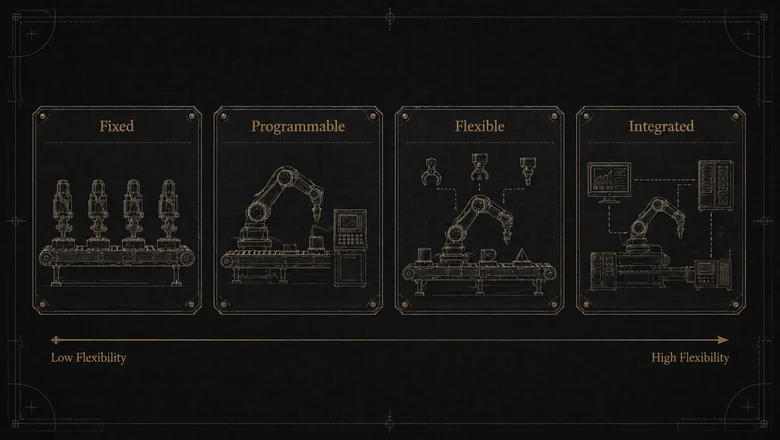
Industrial automation is usually grouped into four types by how flexible the system is. The right type depends on your product mix and volume, not on how advanced it sounds.
- Fixed (hard) automation: purpose-built for one high-volume product. Fast and cheap per part, costly to change.
- Programmable automation: reconfigurable between batches by changing the program.
- Flexible automation: switches products with little or no downtime, ideal for high-mix work.
- Integrated automation: the whole plant runs as one connected, software-coordinated system.
Most SMB manufacturers start with programmable or flexible automation, because their volumes rarely justify a fixed line. Integrated automation is a destination, not a starting point: it’s what a plant grows into after the individual cells and the data layer already work. Chasing it first is how facilities end up with expensive islands that never connect. The Siemens-HD Hyundai shipyard stack is a current example of that destination being pursued as a phased backbone across design, planning, manufacturing and execution.
How to approach automation: where to start
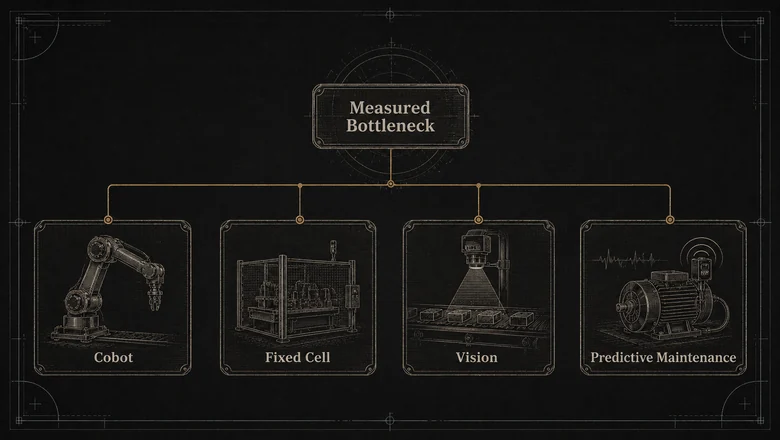
Start where you already measure loss. The best first automation project isn’t the most impressive one; it’s the one attached to a number you can already watch bleeding, whether that’s downtime hours, scrap rate, or a station you can’t keep staffed. A project tied to a known cost has a business case before you spend a rupee or a dollar.
Automate a task first when it’s repetitive, measured, and stable. Wait when the process itself is still changing week to week, when the volume can’t justify the payback, or when you don’t yet have anyone who can maintain the equipment. Those three conditions kill more automation projects than any technical problem does. Boeing’s low-rate Everett production start is a real-world case of waiting for a process to stabilize before pushing the rate.
- Pick one measured constraint: downtime, scrap, or a station you can’t staff.
- Confirm the process is stable enough to automate. Fix a chaotic process first.
- Right-size the technology to the volume and mix. A cobot suits high-mix; a fixed cell suits high-volume.
- Check the data path. Can the new equipment feed the systems you already run?
- Budget for integration and training, not just the hardware.
- Pilot on one line, measure against the baseline, then replicate what worked.
PRO TIP
Before you automate a station, spend one week recording exactly why it stops. Half the time the fix is a process change that costs nothing, and the automation you were about to buy would only have preserved the waste at higher speed.
You can’t automate what you don’t measure, which is why plants that already track uptime move faster. An MES that captures run-time and scrap on the floor gives you the baseline that every automation business case needs, and it’s often the cheapest first step toward automating anything.
What industrial automation costs and its ROI
Industrial automation pays back by removing a cost you can measure, and the biggest measurable cost in most plants is downtime. Every unplanned stop burns idle labor, premium-priced parts, and late orders at once. Siemens’ True Cost of Downtime 2024 analysis put the annual bill for the world’s 500 largest companies at roughly $1.4 trillion, with a single idle hour costing an average large manufacturer about $260,000 and an automotive plant as much as $2.3 million.
You don’t need those numbers to build a case; you need your own. The math is the same at any scale.
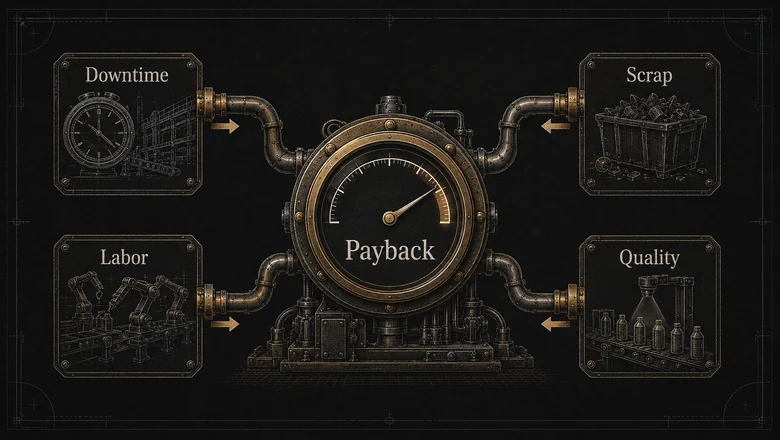
Payback (months) = Total Project Cost ÷ Monthly Savings from Recovered Downtime + Labor + Scrap
Put real numbers in it. Say a single recurring stoppage costs a 40-person shop six hours a month, and a $60,000 sensor-and-controls project recovers most of that plus a night-shift operator’s manual checks, for roughly $8,000 a month in recovered downtime, labor, and scrap. That’s a payback under eight months, before you count the quality gains. The projects that stall are almost always the ones where nobody could fill in those numbers beforehand.
Where automation earns the most is on the maintenance and quality lines of that equation. The market is pricing that in: the industrial automation market was worth about $256 billion in 2025 and is projected to reach roughly $280 billion in 2026 on its way past $600 billion by 2035. The maintenance side of the payback often starts small, with a CMMS that schedules the work orders before you ever add sensors and prediction on top of it.
IMPORTANT
The sticker price of a robot or a control system is rarely half the real cost. Integration, guarding, programming, fixturing, and training routinely match or exceed the hardware quote. Budget the whole project, not the line item.
Where industrial automation fails
Industrial automation fails most often when it’s bolted onto a process that isn’t stable. This is the single most expensive mistake in the field, and it’s a management mistake, not a technical one. Automate a chaotic process and you don’t fix the chaos; you just produce it faster and more expensively, with a machine that now needs its own upkeep.
The other failure modes are quieter. Teams underestimate integration and blow the budget on connecting equipment that shipped as an island. They buy hardware with no plan for who maintains it, so a robot cell with no maintenance capability becomes the most expensive way yet invented to stop production. And they chase lights-out full automation before they’ve proven a single cell, which turns a learnable project into an unrecoverable one.
None of that is an argument against automating. It’s an argument for sequencing. Deciding whether to run maintenance on a fixed schedule or on live condition is part of the automation decision itself, not a detail to sort out later, because the equipment you install is only as reliable as the plan that keeps it running.
Frequently Asked Questions
Industrial automation is the use of control systems, sensors, software, and machines to run production with minimal human intervention. A sensor measures a condition, a controller such as a PLC decides what to do, and a motor, valve, or robot acts. It reduces variation, raises throughput, and improves safety across both continuous processes and discrete part production.
The four types are fixed (hard) automation for one high-volume product, programmable automation reconfigured between batches, flexible automation that switches products with almost no downtime, and integrated automation where the whole plant runs as one connected system. Most small manufacturers begin with programmable or flexible automation because their volumes rarely justify a fixed line.
Industrial automation is the umbrella term. Under it, process automation controls continuous or batch flows like chemicals and heat using a DCS, while factory (discrete) automation handles individual parts that are assembled, machined, or packaged, usually with PLCs and robots. Process automation prioritizes stability and safety; factory automation prioritizes speed and repeatability.
Yes, when it targets a measured constraint. Automation pays back fastest on a bottleneck with known downtime, scrap, or staffing cost, and slowest on showcase projects with no baseline. Right-size the technology to your volume, budget for integration and training beyond the hardware, and pilot on one line before you scale.
A programmable logic controller (PLC) is the industrial computer that runs a machine’s control logic. It reads sensor inputs, executes the program you write, and switches outputs to motors, valves, and actuators in milliseconds. PLCs are the control layer of nearly every automated line, which is why reliable PLC programming is the foundation the rest of the automation stack stands on.
