
Most SEO advice written for manufacturers optimizes for the wrong finish line. It chases rankings and raw traffic, then treats a busy analytics chart as the win. The number that pays your shop floor is different: a qualified request for quote from a buyer who can actually purchase what you make.
That gap is why SEO for manufacturing companies needs its own playbook. 6sense’s survey of 934 B2B buyers found they stay roughly 70% through the buying journey before they contact a seller. By the time an engineer reaches your RFQ form, they have already shortlisted suppliers from what they found in search. If your capability, material, and certification pages never showed up, or showed up but failed to answer the qualifying question, you were cut before the conversation started.
This playbook treats the RFQ as the only metric that counts. It covers the page architecture that earns qualified quotes, the keyword strategy behind them, the technical and AI-search foundations buyers and engines expect, and how to decide whether to build the work in-house or hire help.
Direct answer — What is SEO for manufacturing companies?
SEO for manufacturing companies is the practice of ranking your website for the exact process, material, tolerance, capability, and certification queries that engineers and procurement teams search, so qualified buyers find you and submit an RFQ. It rests on five page types (capability, process, material, industry, and certification pages) plus an RFQ form that filters weak enquiries. The goal is qualified quote requests, not generic traffic.
Key Takeaways
- Rank for the query behind the quote (process, material, tolerance, certification), not the highest-volume keyword.
- Build five page types, each answering one buyer qualification question, so search and AI engines can match you to a need.
- The RFQ form is part of SEO. A form that filters weak enquiries protects your sales team’s time and raises lead quality.
- Measure the qualified RFQ rate and pipeline value, not sessions or keyword positions.
- AI Overviews now answer many buyer questions directly, so structure pages to be cited, not just ranked.
What SEO for manufacturing companies actually means
SEO for manufacturing companies is the work of making your site the obvious answer when an engineer or buyer searches for a specific process, material, tolerance, or certification. It is industrial SEO, and it behaves differently from the consumer SEO most agencies sell.
Consumer SEO optimizes for volume and clicks. Industrial SEO optimizes for fit. A buyer searching “316 stainless passivation to ASTM A967” is not browsing; they are qualifying a supplier against a real spec. Win that query with a page that answers it precisely, and you have earned a place on the shortlist. Win a high-volume term like “manufacturing” with a generic page, and you have earned traffic that never quotes.
The reason this matters is that manufacturer content rarely connects to the buyer’s task. In the Content Marketing Institute’s 2025 manufacturing research, only 20% of manufacturing marketers said their content strategy was very effective, and 47% admitted their content was not tied to the customer journey. Generic SEO widens that gap. RFQ-focused SEO closes it.

The table below is the difference in one view. Print it, and check your current program against the right-hand column.
| Dimension | Generic SEO | RFQ-focused manufacturing SEO |
|---|---|---|
| Goal | Rankings and sessions | Qualified RFQs from buyers who can purchase |
| Target query | High-volume head terms | Process, material, tolerance, and certification queries |
| Core pages | Blog posts and a generic services page | Capability, process, material, industry, and certification pages |
| Content test | Does it contain the keyword? | Does it answer the question that qualifies a buyer? |
| Success metric | Traffic and keyword position | Qualified RFQ rate and pipeline value |
| Who it convinces | A search crawler | An engineer, a procurement manager, and an AI answer engine |
The RFQ-Ready Page Stack: five pages that earn quotes
An RFQ-ready manufacturer website is built from five page types, each one answering a different question a buyer asks before requesting a quote. We call it the RFQ-Ready Page Stack, and it is the spine of every manufacturing SEO program that produces real enquiries.
Most manufacturer sites publish a homepage, an “about” page, and a single “capabilities” page that lists every process in one paragraph. That structure cannot rank for specific queries because it never answers a specific question. The fix is to give each qualification question its own page.
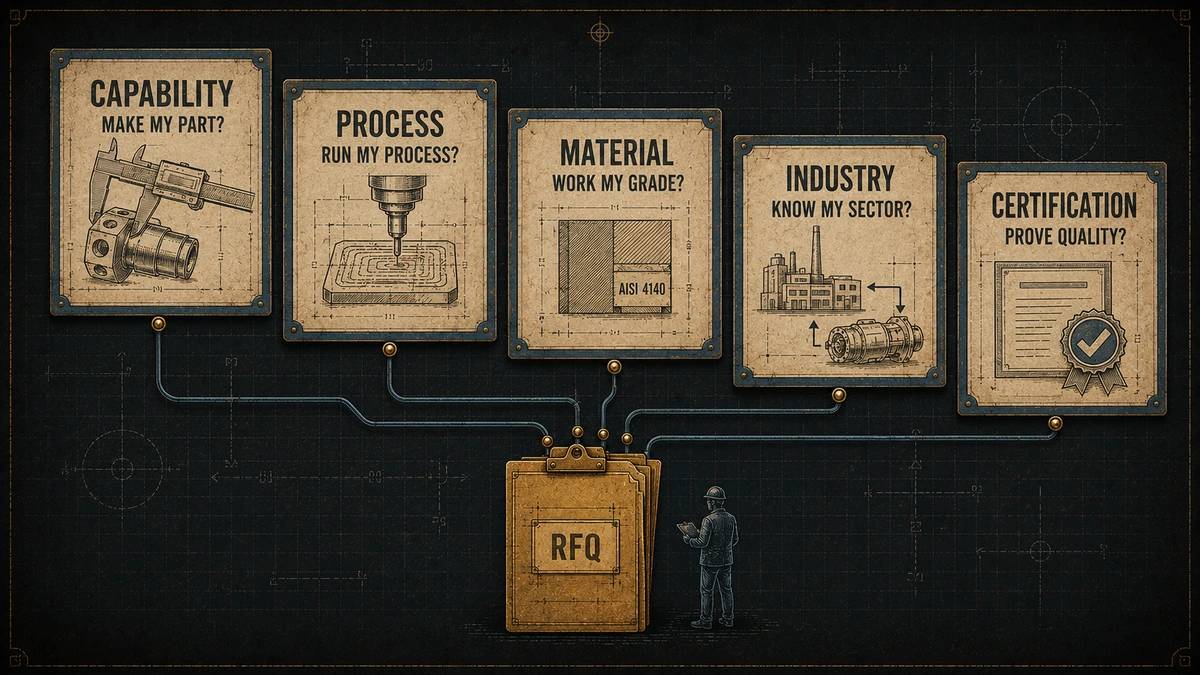
| Page type | Buyer question it answers | Must include | Example query |
|---|---|---|---|
| Capability page | Can you make my part? | Processes, equipment list, size and tolerance limits, volumes, lead time | “5-axis CNC machining for aerospace brackets” |
| Process page | Do you run the process I need? | Process specs, materials supported, finishes, tied certifications | “TIG welding for stainless enclosures” |
| Material page | Do you work in my material? | Grades, properties, typical applications, machinability notes | “316 stainless steel passivation” |
| Industry page | Do you serve buyers like me? | Industry standards, example parts, compliance, project context | “contract manufacturer for medical devices” |
| Certification page | Can I trust your quality system? | ISO 9001, AS9100, IATF 16949, ITAR status, scope, audit dates | “ISO 9001 certified machine shop” |
Write each page like a spec sheet, not a brochure
Each page should read like a spec sheet a buyer can act on, not a brochure. State the limits plainly: the largest part you can hold, the tightest tolerance you can certify, the volumes you run well, and the lead time a buyer should expect. Specifics build trust and pre-qualify the enquiry, which is exactly what raises RFQ quality.
The page architecture and the design decisions that make a capability page convert are worth treating as their own discipline; our guide to the features industrial buyers expect from a manufacturing website covers the layout, evidence, and navigation that turn these pages into quote requests.
PRO TIP
Build one capability page per process-plus-industry pair you genuinely want more of. A shop that wants more aerospace machining work should have a page for exactly that, not a line buried in a combined capabilities list.
Keyword strategy: target the query behind the quote
Manufacturing keyword research starts with the query behind the quote, not the keyword with the biggest search volume. The keywords that produce RFQs are commercial-investigation searches: a buyer comparing materials, confirming a tolerance, or checking whether a process fits their part.
Group your targets by the page they belong to. Process, material, and certification terms map to the page stack above. Comparison queries (“hardened steel vs carbide for wear resistance”) deserve their own short technical pages, because the buyer running that search is mid-decision and close to an RFQ. These long-tail, low-competition terms convert far better than head terms like “industrial SEO” or “manufacturing SEO services,” even though the head terms look bigger in a keyword tool.
Publishing the technical content buyers actually search for is the engine behind this, and it pays back twice: once in rankings, and again in the credibility that closes a quote. Our approach to capability-first content for manufacturers sequences which pages to build before you write a single blog post. Deciding how much of a tight budget that content deserves before paid ads or a trade-show booth is the harder call, and it is the one our guide to which channels deserve funding before the flashier ones is built to answer.
A useful test for any target keyword: could a procurement manager use it to shortlist a supplier? “ISO 9001 certified CNC machining in Ohio” passes. “Best manufacturing” does not. Write for the first kind, and you write for the people who sign POs.
Technical and entity foundations engines expect
Technical SEO for manufacturers means making your pages fast, crawlable, and readable by both buyers and the engines that rank and cite them. None of it is exotic, but skipping it caps everything else.
Start with the basics that block buyers: mobile rendering, page speed, and a clean site structure that lets a crawler reach every page in the stack. Then add structured data. Marking up products and specifications with Google’s Product structured data lets details like specs and availability surface directly in results, and it gives AI engines clean, labeled facts to quote.
Write the pages for people first. Google’s own people-first content guidance is explicit that content should be created for humans, not to manipulate rankings. For a manufacturer that means answering the real qualification question on the page instead of repeating “precision manufacturing services” eight times.
Before you start, run a diagnostic so you fix the right things in the right order. Our five-lens review checklist for manufacturer websites walks through buyer task, technical foundation, page quality, evidence, and structured data, and tells you what to repair before you invest in new content.
One entity layer is easy to forget: local and directory presence. A complete Google Business Profile and a presence in the industrial directories your buyers already use both feed the same goal, which is being findable at the moment a buyer is sourcing.
Turn rankings into RFQs: the form that filters
The RFQ form is where SEO either pays off or leaks, so treat it as the last and most important page in your funnel. A buyer who searched a precise query, read a precise page, and then hit a vague “Contact us” box will often leave, and the ones who do submit hand your sales team little to work with. The difference is form design: turning that same traffic into quotable requests comes down to requiring only what an estimator needs and routing it fast.
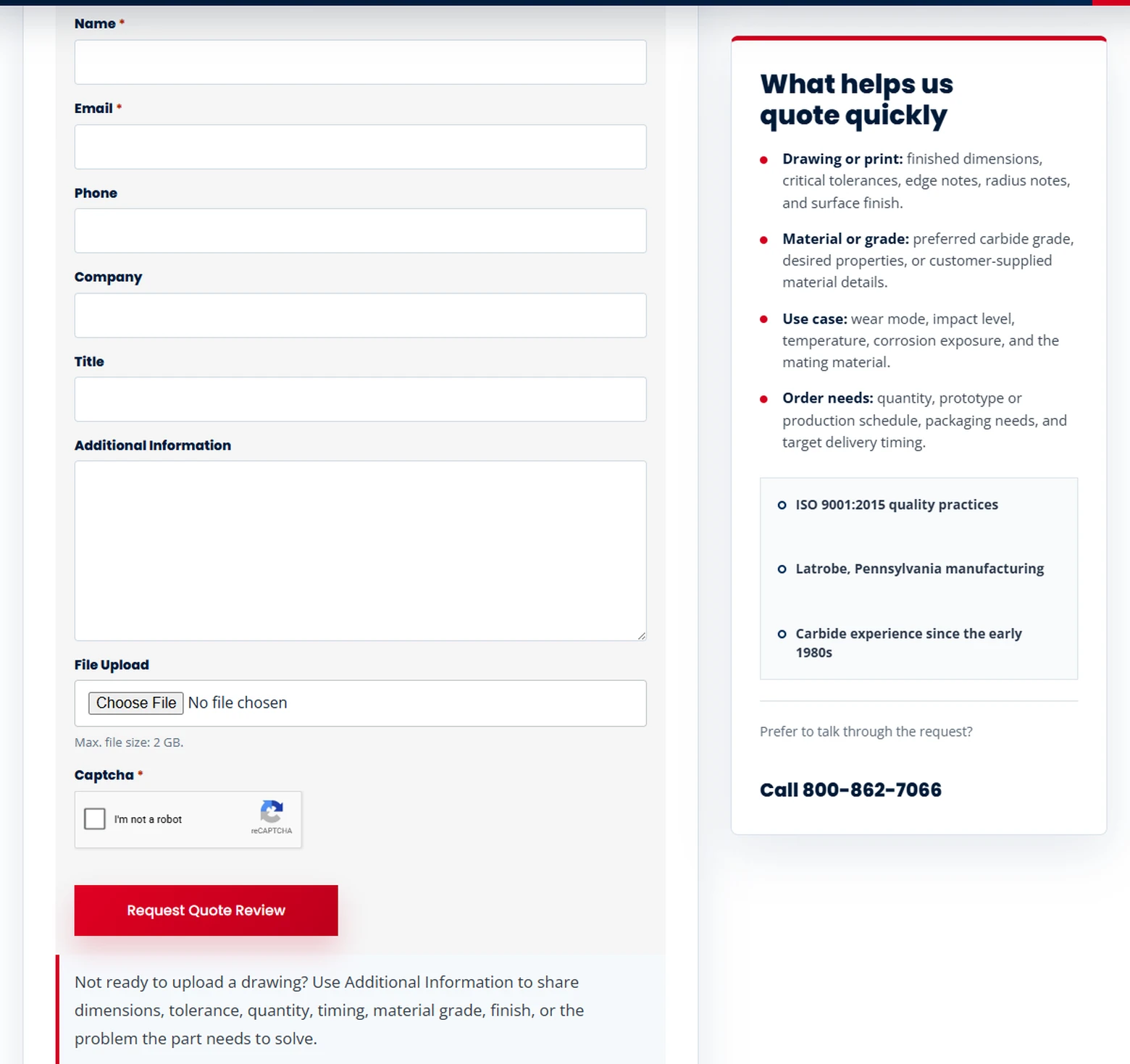
Design the form to qualify. Ask for the material, quantity or volume, tolerance or spec, target timeline, and a drawing or file upload. Those fields do two jobs: they raise the quality of every enquiry, and they quietly filter out the tire-kickers who will not invest two minutes to describe a real job. This is conversion work, and the discipline of tightening an RFQ form so it filters weak enquiries without losing good buyers is where most of the recoverable revenue sits.
Measure the qualified RFQ rate, not sessions
Measure the outcome, not the activity. The single most useful number in manufacturing SEO is the share of organic visitors who become qualified quote requests. That conversion rate becomes more useful when it feeds the monthly S&OP cycle that turns pipeline into a feasible plan, rather than sitting in a marketing dashboard after capacity decisions are made.
Qualified RFQ Rate = Qualified RFQs ÷ Organic Sessions × 100Track that rate by landing page, and your weakest capability pages and your best ones become obvious. It also reframes content effort: the goal of the next page is not more sessions, it is a higher qualified RFQ rate. The same research that found 47% of manufacturer content disconnected from the journey also found 66% of marketers struggle to create content that prompts a desired action. A filtering RFQ form, tied to pages that answer real questions, is the most direct fix for both.
IMPORTANT
Do not hide critical details, like lead times or tolerances, behind a gated PDF or a “request access” wall. Buyers who can’t qualify you in 60 seconds move to the supplier who let them. Gating specs costs you the exact RFQ you wanted.
In-house or a manufacturing SEO agency?
Whether to hire a manufacturing SEO agency or build the capability in-house comes down to three honest questions about time, expertise, and accountability. There is no universally right answer, only the right answer for your shop’s stage. If the answer is hire, the harder question is which firm to trust; our framework for choosing a manufacturing marketing agency scores candidates on the criteria that actually predict RFQ results.
Keep it in-house when you have a marketer who can learn industrial SEO and, more importantly, an engineer or estimator willing to spend an hour a week supplying real specs. Most of the value here is technical accuracy that only your team has. An outside writer cannot invent your tolerance limits or certification scope.
Hire help when you need the page stack built fast, when no one internally can own the technical SEO, or when you want a partner accountable to RFQ outcomes rather than rankings. When you evaluate manufacturing SEO companies, judge them on one thing: do they measure their work in qualified quote requests, or in traffic charts? Be wary of any agency selling “best platform for SEO for manufacturing” packages that are really generic templates with your logo dropped in.
The best manufacturing SEO agency for you is the one that asks about your shop floor before it asks about your keywords.
This RFQ-first approach is the basis of our own manufacturing SEO and AI-visibility service, which is built to treat the qualified RFQ as the only metric that matters. Whether you run the work yourself or bring in a partner, hold it to that standard.
A simple decision framework
- Build in-house when you have marketing time, internal technical input, and patience for a 6 to 12 month ramp.
- Hire a partner when speed, technical SEO depth, or outcome accountability matters more than cost.
- Avoid any provider that reports rankings and traffic but cannot tie its work to RFQs, or that promises guaranteed first-page results.
AI search and AEO: getting cited, not just ranked
AI search visibility means getting your manufacturing pages quoted by ChatGPT, Perplexity, and Google’s AI Overviews, not just ranked in the blue links. This is the fastest-moving part of manufacturing SEO, and it rewards the same discipline as the page stack.
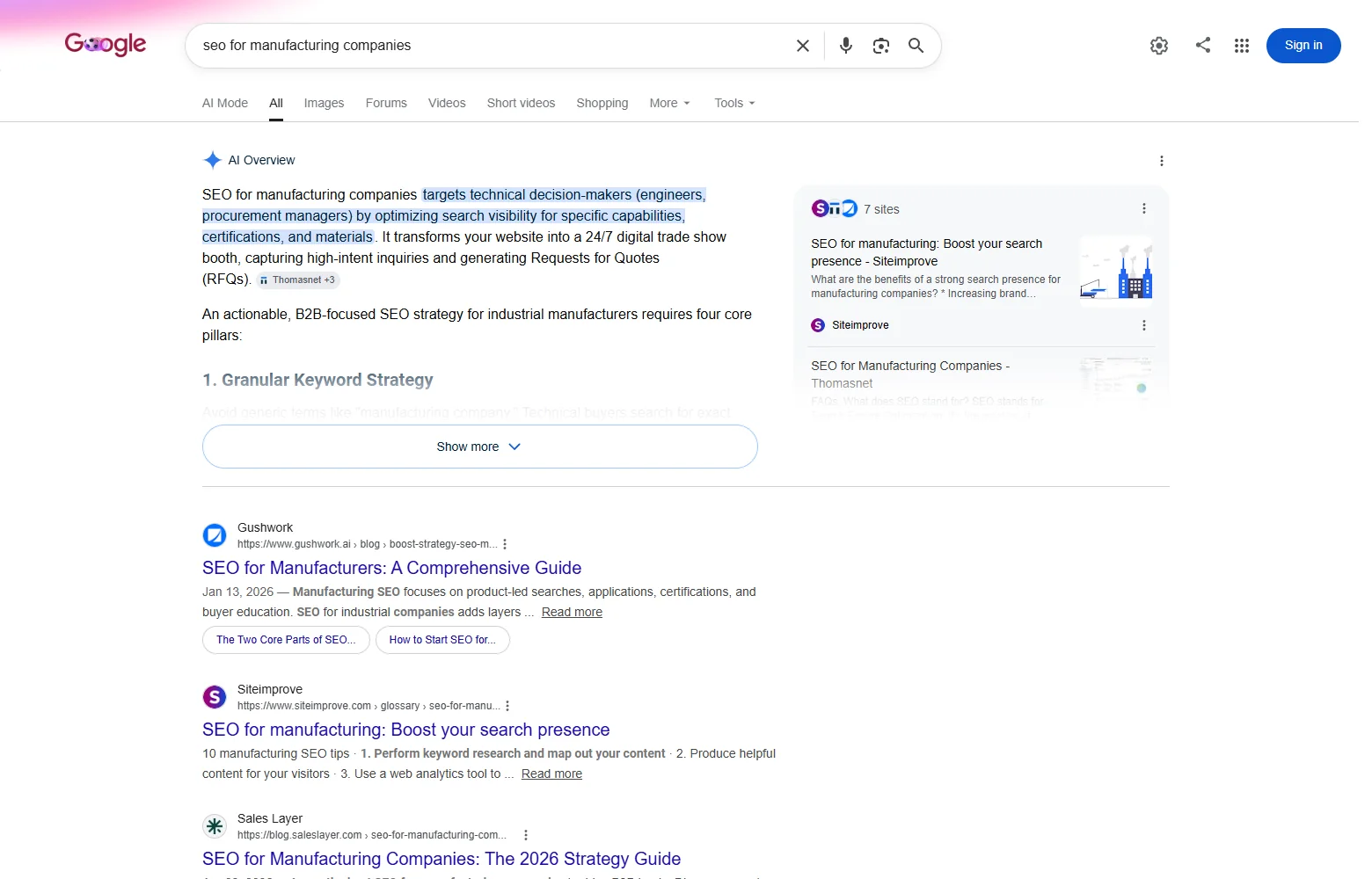
As of mid-2026, a search for manufacturing SEO terms returns a Google AI Overview that answers the question above the organic results and cites a handful of sources. Engines build those answers from pages with clean, labeled facts: a direct definition, a comparison table, specs stated as specs, and a clear question-and-answer structure. The pages that get cited are the ones that made the answer easy to lift.
Is SEO dead in 2026 because of AI? No, but the prize moved. Some informational clicks now resolve inside the AI answer, so the value shifts to high-intent queries and to being the cited source behind the answer. For a manufacturer, that is good news: an AI engine recommending your shop for “ISO 9001 certified aluminum die casting” is worth more than a thousand stray visits.
Can ChatGPT do SEO for you? It can draft and suggest, but it cannot supply your real tolerances, certification scope, or lead times, and those facts are exactly what make a manufacturer page rank and get cited. Use AI to accelerate the work, not to invent the specifications. The shops that win AI search are the ones publishing verifiable, first-party detail that the models are glad to quote.
Frequently Asked Questions
SEO in manufacturing is optimizing your website so engineers and procurement teams find it when they search for a specific process, material, tolerance, or certification, then request a quote. It focuses on capability, process, material, industry, and certification pages plus an RFQ form, aiming for qualified enquiries rather than raw traffic.
Most manufacturers see meaningful movement on specific, low-competition queries in three to six months, and compounding RFQ growth over six to twelve months. Long-tail process and material pages rank faster than competitive head terms, so a page targeting one precise capability can attract qualified enquiries well before broad terms move.
Yes. AI Overviews answer some informational searches directly, but high-intent queries that lead to RFQs still drive clicks, and AI engines cite well-structured supplier pages in their answers. Being the cited source for a precise capability query is more valuable than broad traffic, so the work shifts rather than disappears.
AI tools can draft content, suggest keywords, and speed up research, but they cannot supply your real tolerances, certification scope, or lead times. Those first-party specs are what make a manufacturer page rank and get cited. Use AI to accelerate the work, and rely on your engineers for the facts that win the quote.
Not always. If you have marketing time and an engineer who can supply specs, you can build it in-house. Hire a manufacturing SEO agency when you need the page stack built fast, lack technical SEO skills internally, or want a partner accountable to qualified RFQs rather than traffic reports.
If you want a clear read on where your current site is losing quotes, request a free manufacturer website investigation and we will show you which pages are costing you RFQs and what to fix first.
