
Most plants do not choose a maintenance strategy on purpose. They inherit one: run the machine until it stops, then scramble. The argument over predictive maintenance vs preventive maintenance only starts once that scramble gets expensive enough to notice, and it gets expensive fast. Siemens put the cost of unplanned downtime at roughly $1.4 trillion a year for the world’s 500 largest companies, about 11% of turnover, with a single automotive line now losing up to $2.3 million for every hour it sits idle.
Preventive vs predictive maintenance is really one question about timing: do you service equipment on a fixed schedule, or only when the equipment itself signals that it needs attention? Both beat waiting for a breakdown. They cost different amounts, need different data, and fail in different ways. This guide separates the four strategies that actually run on a factory floor, shows where each one earns its keep, and points you to the software built for each, so you can match the approach to the asset instead of the other way around.
Direct answer — What is the difference between preventive and predictive maintenance?
Preventive maintenance is serviced on a fixed schedule set by calendar time or equipment runtime, whether or not the machine needs it. Predictive maintenance is serviced only when condition-monitoring data, such as vibration, temperature, or oil analysis, shows a failure starting. Preventive is cheaper to start but can replace healthy parts and still miss random failures. Predictive catches failures earlier and wastes less, but needs sensors, a data baseline, and skills. Both beat reactive, run-to-failure repair.
Key Takeaways
- Preventive maintenance is triggered by time or usage; predictive maintenance is triggered by the measured condition of the asset. That single difference drives cost, tooling, and data needs.
- Reactive (run-to-failure) and condition-based maintenance are the other two strategies in the mix. Most plants run a blend, not one pure approach.
- Preventive is the cheapest to start and the easiest to schedule, but it replaces parts that still had life left and cannot catch a random failure between two services.
- Predictive detects failure earlier and cuts both downtime and wasted maintenance, but it needs sensors, a clean data baseline, and people who can read the signals.
- Software follows the strategy: a CMMS runs preventive work orders, and predictive platforms read sensor data. Pick the strategy per asset, then pick the tool.
Here is the whole field on one page. The rest of this guide unpacks each row and shows you which one belongs on which machine.
| Strategy | Trigger | Upfront cost | Tooling | Data needed | Best for |
|---|---|---|---|---|---|
| Reactive | The asset fails | Lowest to start, highest per failure | Spares and labor | None | Cheap, non-critical, quickly replaced assets |
| Preventive | Calendar date or runtime hours | Low to moderate | A CMMS and a schedule | Asset list and service intervals | Standard equipment with known wear patterns |
| Condition-based | A live reading crosses a set limit | Moderate | Sensors or manual inspection routes | Real-time condition readings | Assets with a measurable, visible wear signal |
| Predictive | A model forecasts an approaching failure | Highest to start, lowest per failure | Sensors plus analytics or machine learning | Historical and live data, plus a baseline | Critical, costly-to-fail assets worth instrumenting |
The four maintenance strategies, in one picture
Factory maintenance runs on four strategies: reactive, preventive, condition-based, and predictive. They form a ladder from “fix it when it breaks” to “fix it just before it breaks,” and each rung trades more upfront cost and data for less downtime and less waste. Knowing where an asset belongs on that ladder is the whole decision.
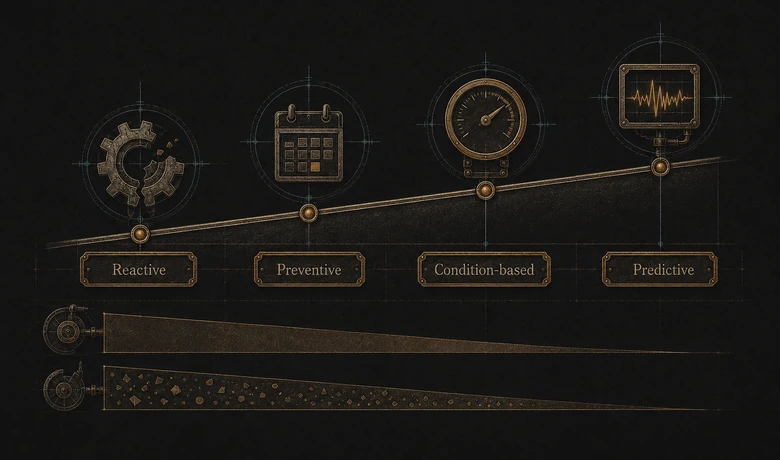
Reactive maintenance, also called run-to-failure, means you operate the asset until it breaks, then repair or replace it. It carries no planning overhead, which is exactly why it feels cheap right up until a critical line stops mid-shift. The bill then arrives as emergency labor, expedited parts, scrap, and lost production. Every hour a line sits down quietly eats your OEE, and reactive is the strategy most likely to hand you those hours unannounced. It is a defensible choice for cheap, non-critical parts you can swap in minutes, and a dangerous default for anything whose failure stops the floor.
Preventive maintenance services equipment on a fixed schedule, whether the machine needs it or not, to head off failures before they happen. Condition-based maintenance acts instead on a live reading, doing the work once a measured signal crosses a threshold you set. Predictive maintenance goes one step further, using data and models to forecast how much life an asset has left, so the fix lands just before failure rather than on an arbitrary date.
Ask a veteran about the “three P’s of maintenance” and you will usually hear preventive, predictive, and proactive. Proactive maintenance is the reliability mindset sitting underneath all of this: chase the root cause of failure, not just the symptom. The four strategies above are the tactics; proactive thinking is what tells you which tactic each asset deserves.
What is preventive maintenance?
Preventive maintenance is scheduled maintenance performed at fixed intervals to reduce the chance of failure, regardless of the asset’s current condition. The interval is set by calendar time, such as every 90 days, or by usage, such as every 500 running hours or 10,000 cycles. Inspection, lubrication, calibration, and parts replacement happen on that cadence, so routine wear gets handled before it becomes a breakdown.
Types of preventive maintenance
Preventive maintenance splits by what sets the schedule. The four common types are:
- Time-based: service on a calendar interval, such as a quarterly inspection, no matter how much the asset ran.
- Usage-based: service after a set number of running hours, cycles, or units produced, read from a meter on the machine.
- Failure-finding: scheduled tests of protective devices, such as relief valves and alarms, that sit idle until the day they are needed.
- Risk-based: tune the interval to how critical the asset is, so a machine whose failure stops the line gets a tighter cadence than a spare one.
The schedule only works if someone owns it. That is the job of a CMMS, the system that schedules and records that recurring work and stops preventive tasks from quietly slipping the week the floor gets busy.
Where preventive wins and where it wastes
Preventive maintenance shines on equipment with known, predictable wear: pumps, motors, gearboxes, conveyors, and HVAC. For those assets, a good schedule turns most failures into planned, short, cheap interventions. It is simple to run, easy to budget, and a massive upgrade over waiting for the breakdown. What makes that schedule real on the floor is a written checklist and a fixed cadence: the specific tasks, intervals, and tolerances each asset needs, laid out so a technician runs them the same way every time.
It wastes money two ways, though. It replaces components that still had useful life left, and it cannot see a random failure that develops between two scheduled visits. There is also a parts problem hiding inside every PM plan: the schedule is only as good as the spare on the shelf, so making sure the spare part is actually there when the work order opens matters as much as the calendar reminder that opened it. For repeat-use maintenance consumables, VMI separates replenishment control from stock ownership, letting a supplier watch usage and refill agreed levels while the contract states exactly when title transfers.
What is predictive maintenance?
Predictive maintenance is condition-driven maintenance that uses sensor data and analytics to forecast when an asset will fail, so service happens just before failure instead of on a fixed date. It reads signals like vibration, temperature, and oil chemistry against a healthy baseline, then flags the asset only once the data shows real degradation. The goal is maximum useful life with minimum surprise.
The techniques that make predictive work
Predictive maintenance is only as good as what it can measure. The workhorse condition-monitoring techniques are:
- Vibration analysis: detects imbalance, misalignment, and bearing wear in rotating equipment before it becomes audible.
- Infrared thermography: finds hot spots in electrical panels, motors, and bearings that signal loose connections or friction.
- Oil and lubricant analysis: spots wear metals and contamination in a sample before the component they came from seizes.
- Ultrasonic analysis: hears pressure leaks, electrical arcing, and early bearing faults pitched above human hearing.
- Motor current signature analysis: reads a motor’s electrical draw to catch rotor and winding faults from the wiring cabinet.
Layer machine learning on top of that sensor stream and the system moves from “this reading is high” to “this bearing has about three weeks left.” That leap from monitoring to forecasting is why predictive belongs in the same conversation as the wider move to a connected, AI-assisted factory rather than sitting off in the maintenance department alone.
The P-F curve, and why timing is everything
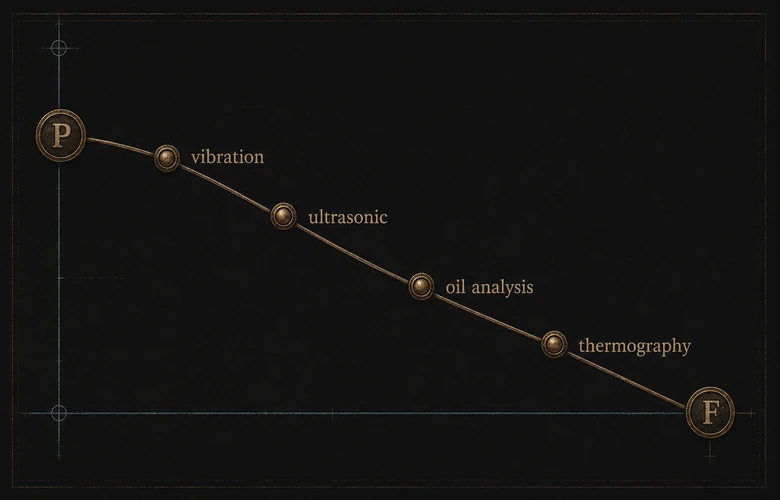
Reliability engineers describe failure with the P-F curve. “P” is the point a developing failure first becomes detectable; “F” is functional failure, when the asset can no longer do its job. The interval between them is your entire window to act. Preventive maintenance ignores the curve and services on a date. Condition-based maintenance acts the moment a reading crosses P. Predictive maintenance estimates how far along the curve you already are, which buys the longest possible runway to order the part, schedule the crew, and fix it on your terms. That warning window is useful only if the part can arrive before F, so a critical-spares buffer tied to failure risk turns the forecast into an executable repair.
Preventive vs predictive maintenance: the real differences
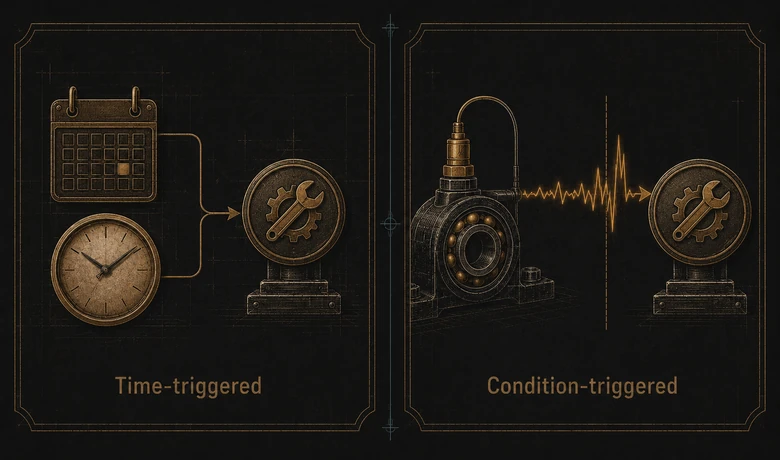
Preventive vs predictive maintenance comes down to five practical differences: what triggers the work, what it costs to stand up, what data it needs, how well it protects against failure, and how much it wastes along the way.
| Dimension | Preventive maintenance | Predictive maintenance |
|---|---|---|
| Trigger | Fixed schedule: calendar date or runtime hours | Measured condition: sensor data crosses a forecast threshold |
| Upfront cost | Low; a CMMS and a schedule get you started | High; sensors, data pipeline, and analytics |
| Data and tooling | Asset list and manufacturer service intervals | Historical and live condition data against a baseline |
| Failure protection | Good for predictable wear; blind to failures between visits | Catches developing and many random failures early |
| Waste profile | Replaces parts that still had life; over-services | Services only when needed; minimal wasted life |
| Skills needed | Maintenance planning and discipline | Condition-monitoring and data analysis skills |
The payoff for the extra investment is real. Deloitte’s analysis of predictive technologies found that predictive maintenance can cut maintenance planning time by 20 to 50 percent, raise equipment uptime by 10 to 20 percent, and lower maintenance costs by 5 to 10 percent. Those are averages, not guarantees, and they only land if you act on what the data tells you.
The harder truth is the gap between strategy on paper and strategy on the floor. In MaintainX’s 2026 State of Industrial Maintenance report, 64% of leaders said they run a preventive-maintenance program, yet half of teams still spend less than 40% of their time on planned work. Most plants are more reactive than they think, which is why the choice between preventive and predictive matters less than the discipline to actually run either one.
Which maintenance strategy to use, and when
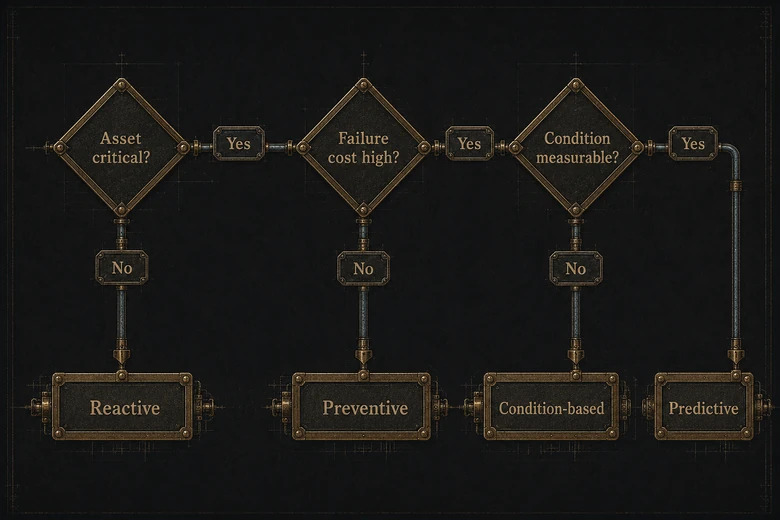
Choosing a maintenance strategy is an asset-by-asset decision, not a plant-wide religion. Match the approach to two numbers: what the asset costs to instrument, and what its failure costs to absorb. Here is how that shakes out in practice.
- Use reactive maintenance when the asset is cheap, non-critical, and quickly replaced, and a failure costs less than the effort to prevent it. A $30 sensor with a spare in the drawer rarely justifies a monitoring program.
- Use preventive maintenance when wear is predictable and the asset matters, but instrumenting it would be overkill. Most pumps, motors, gearboxes, and building systems live here comfortably.
- Use condition-based maintenance when the asset gives a clear, measurable warning sign you can watch cheaply, whether through a fixed sensor or a technician on an inspection route.
- Use predictive maintenance when the asset is critical, expensive to fail, and worth instrumenting, and you have the data and skills to act on the forecast in time.
- Avoid predictive maintenance on assets whose failures are cheap or instantaneous, where sensors add cost without buying you a usable warning window.
In practice almost every plant runs a blend. A structured way to decide the mix is reliability-centered maintenance (RCM), which sorts assets by the consequence of their failure, while total productive maintenance (TPM) pushes routine care out to the operators who run the machines every day. Both point at the same conclusion: spend your maintenance budget where failure hurts most, and stop over-servicing the machines nobody would miss. That operator-owned care belongs inside a lean manufacturing system that treats equipment stability as a condition for flow, not as a side project run only by maintenance.
PRO TIP
Do not try to go predictive plant-wide at once. Rank your assets by downtime cost, instrument the worst five, and prove the warning window pays before you scale. The clean data baseline you build there is what makes every rollout after it cheaper and faster.
The software for each maintenance strategy
Each maintenance strategy runs on its own kind of software, and buying the wrong category is a common and costly mistake. Get the mapping right and the tools reinforce each other; get it wrong and you pay for a platform your team never adopts.
Preventive and reactive work both live in a CMMS, a computerized maintenance management system that keeps work orders, PM schedules, asset history, and spare-parts tracking in one place. For most manufacturers, the CMMS is the first system that turns firefighting into a recorded, measurable process, and it is the natural home for a preventive program. If a schedule-first PM rollout is your immediate goal, dedicated preventive-maintenance software covers that lane with tighter scheduling and compliance features.
Predictive and condition-based maintenance need a different stack: sensors on the asset, a pipeline to move the readings, and an analytics or machine-learning layer that turns those readings into forecasts. That is the domain of predictive-maintenance platforms that read sensor data and push an alert into the maintenance workflow before failure. The strongest setups run both: the predictive layer generates the early warning, and the CMMS turns it into a scheduled, parts-ready work order your technicians can actually close.
Frequently Asked Questions
Preventive maintenance is triggered by a schedule of calendar time or runtime hours, while predictive maintenance is triggered by the asset’s measured condition. Preventive services equipment whether or not it needs it; predictive uses sensor data to service it only when failure is approaching. Both prevent breakdowns, but predictive wastes less and costs more to set up.
Not universally. Predictive maintenance catches failures earlier and wastes less part life, but it needs sensors, a data baseline, and skilled analysis. For cheap or non-critical assets, that investment never pays back, and preventive or even reactive maintenance is the smarter economic choice. Predictive wins on critical, costly-to-fail equipment worth instrumenting.
Not always. Predictive maintenance needs condition data, but that can come from permanent IoT sensors or from manual route-based readings with handheld vibration and thermal tools. Sensors make monitoring continuous and scalable; manual collection is cheaper to start. Begin with your most critical assets and add fixed sensors where continuous coverage pays for itself.
The three P’s of maintenance are preventive, predictive, and proactive. Preventive works on a schedule, predictive works on measured condition, and proactive maintenance fixes the root causes of failure rather than the symptoms. Reactive, or run-to-failure, is often added as a fourth strategy for non-critical assets you are happy to run until they break.
Yes, and most plants should. Preventive maintenance handles routine, predictable wear, while predictive monitoring watches your critical assets for early failure signs. A common setup keeps a preventive baseline in a CMMS and layers predictive alerts on the equipment where downtime is most expensive. Match each asset to the strategy its failure cost justifies.
