
A wireless sensor on a coolant pump caught the imbalance three weeks early. The vibration signature climbed, the readings sat in a dashboard nobody had wired to a work order, and the pump still seized at 2 a.m. on a Saturday. The plant did not lack data. It lacked the software layer that turns a rising vibration trend into a forecast, a priority, and a job someone actually gets assigned. That layer is predictive maintenance software, and buying it is a different decision from buying the sensors.
Predictive maintenance software is one of the harder categories a plant will shop, because the same phrase covers a $199 sensor trial, a managed service with a reliability analyst on your account, and an enterprise platform that scores asset health across forty sites. This guide separates dedicated predictive-maintenance solutions from the predictive add-ons bolted onto a CMMS, scores six real tools on how they sense, diagnose, and integrate, and answers the question most listicles skip: whether you need new sensors at all. It sits inside the wider move to connected factory automation, but it earns its keep on one job, catching failures before they cost you a shift.
Direct answer — What is predictive maintenance software?
Predictive maintenance software uses condition-monitoring sensors (vibration, temperature, ultrasound, oil, or motor current) and machine-learning models to detect the early signs of a fault, forecast when a machine will fail, and push an alert or work order before it does. Unlike calendar-based preventive maintenance, it acts on each asset’s real condition. Most platforms pair wireless sensors with a cloud analytics layer and a reliability team; enterprise tools are quote-priced, and only a few publish per-user or trial pricing.
Key Takeaways
- Predictive maintenance software reads condition-monitoring sensor data with machine learning to forecast failures and trigger a work order. It acts on an asset’s actual condition, unlike schedule-based preventive maintenance.
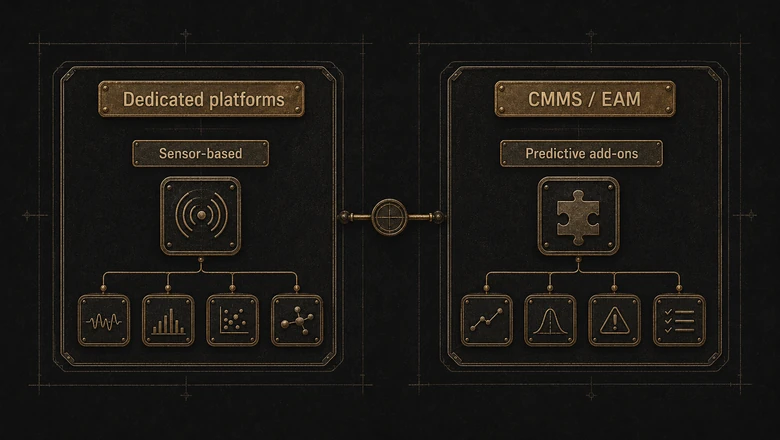
- Two buys hide under one name: dedicated platforms built around sensors and diagnostics (Augury, Siemens Senseye, Tractian, Waites, MachineMetrics, KCF), and predictive add-ons on a CMMS or EAM (IBM Maximo Predict, Fiix, Limble). They are priced and deployed differently.
- The payoff is real but conditional. The U.S. Department of Energy puts a predictive program 8% to 12% ahead of preventive and up to 40% cheaper than run-to-failure, and Deloitte reports 10% to 20% higher uptime, only when someone acts on the alerts.
- Most dedicated platforms are quote-priced managed services. You are buying sensors, analytics, and often a reliability analyst on your account, not just software seats.
- You may not need new sensors. Some tools read existing PLC, SCADA, or historian data; others require a wireless sensor retrofitted to every monitored asset.
- Predictive is one maintenance strategy, not the whole program. It rides on top of preventive scheduling and needs a CMMS to turn its alerts into recorded, assigned work.
Methodology
How this buyer guide was scored
- Scope
- We scored 6 dedicated predictive-maintenance platforms and named 4 CMMS and EAM tools with predictive add-ons for coverage, screened from roughly 15 vendors surfaced by the July 2026 Google SERP for “predictive maintenance software,” its AI Overview, and the named tools in the top listicles. Each was assessed for a maintenance or reliability team in a discrete or process plant, not a facilities or fleet buyer.
- Sources reviewed
- Each vendor’s own product and pricing pages, read live; the customer results each vendor publishes; and primary research from the U.S. Department of Energy and Deloitte. Vendor-reported figures are cited as vendor claims, not our measurements.
- Date range
- Product capabilities, sensing models, pricing posture, and vendor status verified July 2026 (Q3 2026).
- Tools used
- The Factory Investigator Predictive-Maintenance Fit read: five axes assessed per platform, not on one cross-market scale. (1) sensing coverage (failure modes and sensor types); (2) diagnostic depth (anomaly detection versus diagnosis versus remaining-useful-life prognostics); (3) integration (does the alert become a CMMS work order); (4) deployment model and effort (retrofit sensors plus managed service versus self-serve on existing data); (5) pricing transparency.
- Limitations
- Quote-only vendors cannot be price-ranked. We ran no hands-on deployments. Capability claims reflect vendor documentation and must be confirmed against your own assets before you sign. Reported ROI and downtime figures are the vendors’ own.
- Editorial independence
- No vendor named here paid for placement, ranking, or coverage. Our editorial independence rule keeps the wall explicit: Factory Investigator sells manufacturer website and SEO services, not predictive-maintenance software or its implementation.
- Conflicts of interest
- Factory Investigator sells website services; none of the scored vendors were clients at evaluation time.
What predictive maintenance software does
Predictive maintenance software is the analytics layer that turns condition data into a forecast. It watches an asset through sensors, learns what “normal” looks like for that specific machine, and flags the deviation that signals a developing fault, then estimates how long you have before it fails. That last step, the estimate of remaining useful life, is what separates predictive maintenance from plain condition monitoring, which only tells you a reading crossed a threshold.
The category is often called condition-based or IoT-based maintenance, and the terms overlap. Condition monitoring is the sensing; predictive maintenance is the forecasting the software does on top of it. In practice, what is predictive maintenance to a buyer is this: instead of servicing a bearing every 90 days whether it needs it or not, you service it when the software says its vibration signature has started the climb that ends in failure. The machine tells you, through the data, and the software translates.
The payoff, when a plant acts on the forecasts, is well documented. The U.S. Department of Energy puts a functioning predictive program 8% to 12% ahead of preventive and up to 40% cheaper than run-to-failure, and Deloitte’s analysis of predictive technologies reports 10% to 20% higher equipment uptime and maintenance planning time cut by 20% to 50%. The condition on all of it is action. None of the numbers land unless three things stack together: a source of condition data, a model that interprets it, and a path from the model’s alert into the maintenance team’s actual workflow. Miss the third and you get the pump-at-2-a.m. story from the top of this page: good data, no action. The best predictive maintenance iot deployments are judged less by sensor count than by how reliably a rising trend becomes an assigned, closed work order.
Predictive vs preventive vs CMMS: which software runs what
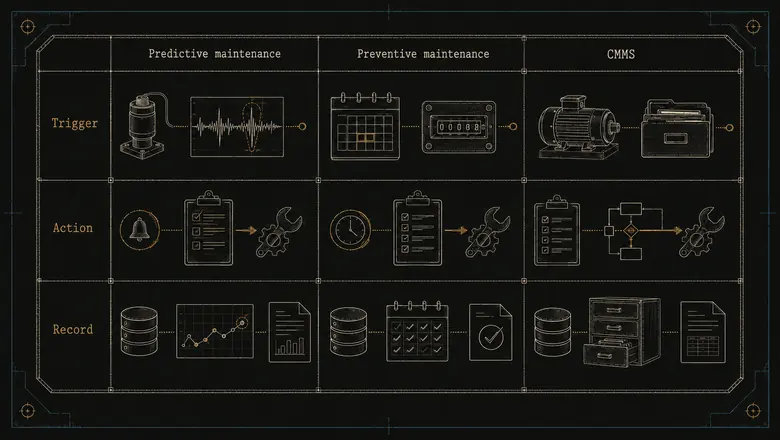
Predictive, preventive, and CMMS software solve three different maintenance problems, and buyers routinely confuse them. Predictive maintenance software forecasts failures from condition data. Preventive maintenance software schedules service by time or usage. A CMMS is the system of record that turns any trigger into a work order and logs what happened. They are complementary, not competing, and most mature plants run all three.
| Software | What triggers the work | Buy it when | Full guide |
|---|---|---|---|
| Predictive maintenance | Sensor condition data plus an ML forecast of a developing failure | Downtime on critical rotating or process assets is expensive and you can sense the early signs | This guide |
| Preventive maintenance | A calendar date, runtime hours, or a meter reading | Failure is time- or usage-driven and a fixed schedule prevents most of it | PM software guide |
| CMMS | Any request or trigger, turned into an assigned, recorded work order | Always; it is the system that makes any strategy repeatable and measurable | CMMS buyer guide |
The honest version: predictive tells you a failure is coming, preventive stops the failures you can predict by the calendar, and the CMMS records and assigns the work either way. Choosing predictive over preventive is not really the decision; it is a per-asset call about which failures you can see coming with a sensor, and that predictive-versus-preventive call every maintenance team makes deserves its own read before you shortlist a platform. What predictive maintenance software adds to the stack is the forecast. It still needs the CMMS underneath it to close the loop.
How predictive maintenance software works
Predictive maintenance software works in a chain: sense the asset, move the readings, model them, and act on the forecast. Understand the four stages and you can read any vendor’s architecture without getting lost in the branding.
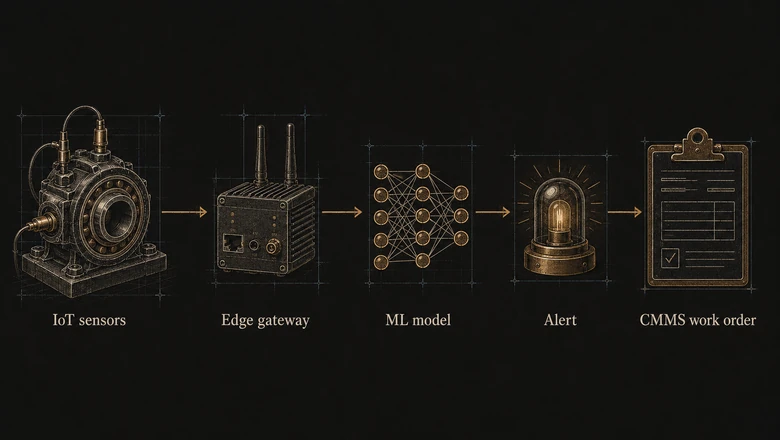
- Sense. A sensor reads the asset: a wireless vibration and temperature pack on rotating equipment, or existing machine and process data pulled from PLCs, SCADA, and historians.
- Collect. A gateway or edge device moves the readings to the cloud, sometimes running a first pass on the edge to cut noise and bandwidth. The plumbing underneath is the same industrial IoT that powers Industry 4.0.
- Model. Machine-learning models compare live data to the asset’s learned baseline, detect anomalies, diagnose the likely fault, and estimate remaining useful life. This is one of the clearest AI use cases on the plant floor.
- Act. The platform raises a prioritized alert and, in the better deployments, opens a work order in the CMMS with the diagnosis attached.
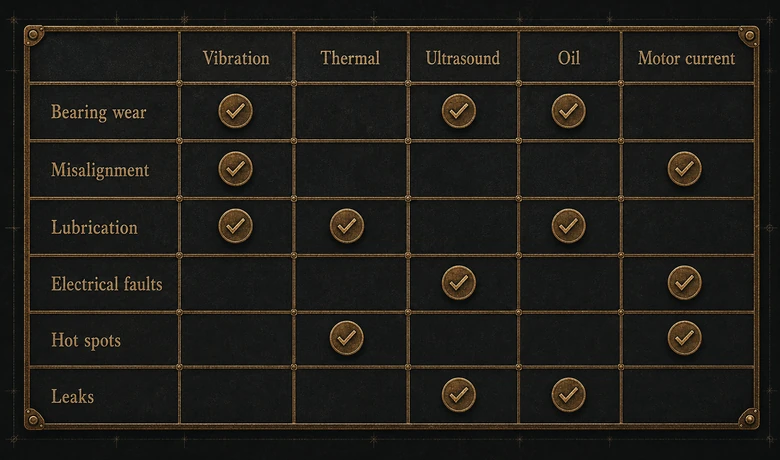
The sensing stage is where predictive programs live or die, because different failures show up in different signals. Condition monitoring for predictive maintenance leans on a handful of techniques, and most dedicated platforms combine several.
- Vibration analysis. The workhorse for rotating equipment: motors, pumps, fans, and gearboxes. A rising or shifting vibration signature is the earliest sign of imbalance, misalignment, and bearing wear.
- Thermal and temperature. Heat flags electrical faults, friction, and lubrication problems, read by fixed sensors or infrared.
- Ultrasound and acoustic. High-frequency sound catches early bearing faults and leaks in compressed-air and steam systems.
- Oil and lubrication analysis. Particle and contamination counts reveal wear inside gearboxes and hydraulics before it reaches the vibration signature.
- Motor current signature. Reading the electrical draw detects rotor and load faults without a sensor on the machine body.
PRO TIP
Match the sensing technique to the failure you actually lose shifts to. If your bad actors are motors and pumps, vibration is non-negotiable; if they are electrical panels and drives, thermal and current signature earn their place first. Buying a platform strong in the wrong technique is the most common predictive mistake.
The best predictive maintenance software, compared
The best predictive maintenance software senses your actual failure modes and closes the loop into a work order, rather than winning a generic feature ranking. Six dedicated platforms follow, assessed on the Predictive-Maintenance Fit read and grouped by how they sense, then the predictive add-ons you may already own inside a CMMS. Each entry covers what it is, who it fits, its standout, and its pricing posture verified in July 2026.
Dedicated predictive-maintenance platforms
Augury is an AI machine-health service for rotating and process equipment, pairing wireless Halo sensors with diagnostics validated by certified vibration analysts. Best for mid-market to enterprise plants that want managed reliability, not another dashboard to staff. Its standout is the human-plus-AI model: root-cause analysis and a recommended action, not just an anomaly flag. Augury publishes no price and sells by quote, with deployment ranging from self-serve to white-glove; it cites a Forrester-measured 310% ROI and 170-plus manufacturers on the platform (as of Q3 2026).
Siemens Senseye Predictive Maintenance is a sensor-agnostic analytics platform that forecasts machine failure and remaining useful life from data you already have. Best for large, multi-site manufacturers with historians and existing sensors who want to scale predictive across thousands of assets without a hardware rollout. Its standout is that it works with legacy machine data, IoT platforms, or new sensors alike. Pricing is quote-only, contact-sales (as of Q3 2026).
Tractian is a sensor-plus-software platform that bundles wireless vibration and temperature monitoring with its own CMMS, so the alert and the work order live in one system. Best for plants that want condition monitoring and maintenance management from a single vendor rather than integrating two. Its standout is that tight sensor-to-work-order loop. Tractian sells by quote through a price calculator and reports 1,500-plus manufacturers on the platform (as of Q3 2026).
Waites is a full-stack condition-monitoring service built around wireless vibration and temperature sensors and a team of certified analysts reviewing data around the clock. Best for SMB-to-mid-market plants that want enterprise-grade reliability coverage without building an in-house vibration team. Its standout is that managed-analyst layer plus a fast payback claim. Pricing is quote-only; Waites reports average ROI in under four months and an Owens Corning case that avoided an $11 million loss (as of Q3 2026).
MachineMetrics is a machine-data platform for discrete manufacturing that reads high-frequency signals straight from CNCs and PLCs to predict tool and machine failures, then feeds work orders into a connected CMMS. Best for machine shops and discrete plants where the useful signal is in the machine’s own data, not a bolt-on sensor. Its standout is spindle-level anomaly detection; it cites detecting a tool failure with 99% confidence up to 40 minutes early (as of Q3 2026). Pricing is quote-only.
KCF Technologies is a wireless condition-monitoring and managed-reliability platform whose sensors track vibration, temperature, pressure, and oil humidity, backed by its DeskAI engine and optional SENTRYservices analysts. Best for reliability programs on rotating equipment that want to start small and scale. Its standout is an unusually low entry point: a $199, 30-day trial with 48 sensors and a base station, then quote-based tiers (as of Q3 2026). It reports an average 10x ROI.
Predictive add-ons inside a CMMS or EAM
If maintenance management is your primary need and prediction is a feature you want later, several predictive maintenance tools now bolt onto the system of record instead of standing apart from it. IBM Maximo Predict adds failure and remaining-useful-life prediction inside the Maximo Application Suite, licensed through its AppPoints model. Fiix, owned by Rockwell Automation, includes its Foresight AI engine from the Professional tier at $75 per user per month, above a Basic tier at $45 (as of Q3 2026). Limble surfaces anomaly detection on its Premium+ plan and adds IoT sensor integrations at the Enterprise tier for an extra cost. Fracttal One packages AI and IoT predictive workflows into a mid-market CMMS. These are a different buy from the dedicated platforms above, scored on maintenance-management fit in our guide to CMMS software for manufacturers, not here.
Predictive maintenance software comparison table
The six dedicated platforms side by side. Prices are each vendor’s own published figure or “Quote” where none is disclosed (as of Q3 2026). Sensing and diagnostic notes reflect vendor documentation read the same month.
| Platform | Best-fit plant | Sensing & data | Diagnostic depth | Pricing (Q3 2026) | Deployment |
|---|---|---|---|---|---|
| Augury | Mid-market to enterprise, rotating + process | Wireless Halo sensors (vibration, temp, magnetic) | Anomaly + root cause + RUL, analyst-validated | Quote | Managed service |
| Siemens Senseye | Large multi-site enterprise | Sensor-agnostic; existing historian/IoT data or new sensors | ML prognostics + remaining useful life | Quote | Software on existing data |
| Tractian | Mid-market, mixed assets | SmartTrac wireless (vibration, temp) + built-in CMMS | AI anomaly + failure detection | Quote | Sensors + integrated CMMS |
| Waites | SMB to mid-market | Wireless vibration + temperature (ImpactVUE) | ML + 24/7 certified analysts | Quote | Full-stack + managed analysts |
| MachineMetrics | Discrete / CNC machining | Machine-tool + PLC data (spindle, high-frequency) | Anomaly + tool-failure prediction | Quote | Machine data + auto-CMMS |
| KCF Technologies | Rotating-equipment reliability | Wireless (vibration, temp, pressure, oil humidity) | DeskAI + optional analysts | $199 trial, then quote | Sensors + managed reliability |
Read the table by sensing model, not top to bottom. If the useful signal is already inside your machines, Siemens Senseye and MachineMetrics avoid a hardware rollout; if your bad actors are standalone motors and pumps, the wireless-sensor platforms put a sensor where the failure actually shows up. There is no single best predictive maintenance software. There is a best fit for your failure modes, your existing data, and whether you want to staff the analysis or rent it.
Do you need IoT sensors for predictive maintenance?
Predictive maintenance does not always require new IoT sensors; it depends on where the failure signal already lives. Some assets already stream the data that predicts their failures; others say nothing useful until you put a sensor on them. This is the single biggest cost-and-effort fork in the decision, so answer it before you shortlist.
Two paths exist. If your critical machines are CNCs, drives, or PLC-controlled lines, tools like Siemens Senseye and MachineMetrics can read existing controller, SCADA, and historian data, and you may need no new hardware at all. If your bad actors are standalone rotating assets, motors, pumps, fans, and gearboxes with no smart controls, you will retrofit wireless vibration and temperature sensors, one per monitored point, and that hardware plus installation is a real line item.
The ai predictive maintenance pitch is the same in both cases: the model does the forecasting. What changes is the data it feeds on. Tools that use existing data scale cheaply across a connected plant but see only what the controls already measure. Tools built on retrofit IoT sensors for predictive maintenance see the mechanical signal directly, but cost more per asset and take installation time. Most plants end up mixing both, sensors on the critical unmonitored assets and data pulled from everything already connected.
IMPORTANT
Count your monitored points before you price anything. Ten critical assets at one sensor each is a very different quote from a hundred. The per-asset sensor cost, not the software subscription, is usually what decides whether a predictive program is affordable this year.
What predictive maintenance software costs
Predictive maintenance software is mostly quote-priced, because a deal bundles hardware, software, and often an analyst service that a per-user sticker cannot express. Only the edges of the market publish a number: KCF’s $199 30-day trial at the entry end, and the CMMS add-ons like Fiix from $45 to $75 per user per month at the software-only end (as of Q3 2026). The dedicated platforms price by scope, so the quote depends on how many assets you monitor and whether a reliability team is included.
Four cost components sit inside a predictive quote, and buyers who price only the first get surprised:
- Sensors and hardware. Wireless vibration and temperature packs, gateways, and base stations, priced per monitored point.
- Platform subscription. The analytics software itself, usually annual and often per-asset rather than per-user.
- Installation and onboarding. Mounting sensors, mapping assets, and setting baselines before the model earns anything.
- Analyst service. On managed platforms, a reliability team reviewing your data, the line that separates a service from a tool.
The way to judge it is payback, not sticker price. A predictive deployment justifies itself when the downtime it prevents outweighs its full cost.
Simple payback
Payback (months) = Total first-year cost ÷ (Avoided downtime $ per year ÷ 12)
Run that with your own numbers on your five worst assets before you sign. The pattern mirrors what we found pricing the wider category in our manufacturing software cost study: the subscription is the visible cost, and the hardware, installation, and analyst service are the ones that decide the real bill. Vendors like Waites lean on this math directly, citing average payback in under four months; treat that as a claim to test against your assets, not a promise.
How to choose predictive maintenance software
Choosing predictive maintenance software comes down to five questions, answered in order, so the sensor demo does not steer the decision.
- Rank your bad actors by failure mode. List the five assets that cost you the most downtime, and note how each fails: mechanical, electrical, thermal, or lubrication. That list decides which sensing technique you actually need.
- Settle the sensor question. Check whether those assets already stream useful data. Tools that use existing data skip a hardware rollout; unmonitored rotating equipment needs retrofit sensors. This sets your real budget.
- Match diagnostic depth to your team. A lean team wants managed analysis and a recommended action; a plant with its own reliability engineers may only want the anomaly and the raw signal. Do not pay for an analyst service you will not use, or skip one you need.
- Confirm it closes the loop. The alert has to become an assigned work order. Verify the integration into your CMMS, or that the platform’s own work management is one your technicians will use.
- Pilot on one bad actor and count catches versus false alarms. Put it on your worst asset for a quarter. A platform that catches a real failure early and rarely cries wolf beats one with the longer feature list.
IMPORTANT
Ask every vendor two questions in writing: what is the typical false-positive rate, and who is expected to act on each alert, your team or theirs? A predictive platform that floods a short-staffed team with low-confidence alerts gets muted within a month, and a muted platform predicts nothing.
Frequently Asked Questions
Predictive maintenance software uses condition-monitoring sensors and machine-learning models to detect early fault signs, forecast when a machine will fail, and trigger a maintenance work order before it does. It acts on each asset’s real condition rather than a fixed schedule, which is what separates it from preventive maintenance.
Preventive maintenance services equipment on a fixed schedule, by date, runtime, or meter reading. Predictive maintenance uses sensor data and a model to service equipment only when its measured condition signals a developing failure. Predictive catches problems a calendar misses, but needs sensors and software the schedule does not.
Not always. Assets with smart controls, like CNCs and PLC-driven lines, can be monitored from existing machine, SCADA, or historian data with no new hardware. Standalone rotating equipment usually needs a wireless vibration or temperature sensor retrofitted to each monitored point, which is the biggest per-asset cost in most predictive programs.
Most dedicated platforms are quote-priced because a deal bundles sensors, software, and often an analyst service. Published figures are rare: KCF offers a $199 30-day trial, and CMMS add-ons like Fiix run $45 to $75 per user per month (as of Q3 2026). Budget hardware, installation, and analysis on top of the subscription.
No. Predictive software forecasts failures; a CMMS turns those forecasts into assigned, recorded work orders and tracks the history. They work together: the predictive platform raises the alert, and the CMMS runs the job. Some platforms include light work management, but most plants still run a dedicated CMMS underneath.
The best predictive maintenance software is not the one with the most sensors or the longest AI claim. It is the one that senses your actual failure modes, fits the data you already have, and reliably turns a rising trend into a job your team closes. Rank your bad actors, settle the sensor question, and pilot on your worst asset before you sign. And if the deeper problem is that buyers cannot find or trust your plant before the RFQ ever lands, that is a different fix; our free manufacturer website investigation shows where prospects lose confidence on your site.
