
The machines that changed the economics of factory automation over the last decade were not the big caged arms behind light curtains. They were smaller robots that could sit on a bench next to a machinist and hand parts to a CNC without a fence. Collaborative robots in manufacturing, or cobots, earned their place by being cheap enough to justify on a single task and safe enough to redeploy when that task changed.
This guide is the honest version. You’ll get a working definition, how a cobot differs from a traditional industrial robot, the six jobs cobots do well on real production lines, what the safety standards actually require, and the part most vendors skip: when a cobot is the wrong tool and you should buy a full robot cell instead.
Direct answer — What is a collaborative robot (cobot)?
A collaborative robot, or cobot, is a lightweight robot arm built to work in the same space as people without safety fencing. It uses force limits, speed limits, sensors, and rounded design so any contact stays below the injury thresholds set in ISO/TS 15066. Cobots trade raw payload and speed for safety and fast redeployment. A traditional industrial robot moves faster and lifts more, but it needs guarding and a fixed cell.
Key Takeaways
- A cobot is defined by its safety-rated force and speed limits, not by its brand: any arm run inside collaborative limits qualifies, and the same arm behind a fence stops being collaborative.
- Cobots were 11.9% of the 542,000 industrial robots installed worldwide in 2024, up from 10.6% a year earlier, so they are growing but still a minority of installs.
- Payload runs roughly 3 to 35 kg and collaborative speed is capped, which is why cobots win on flexibility, not throughput.
- The six highest-value jobs are machine tending, palletizing, welding, assembly and screwdriving, inspection, and pick-and-place.
- A cobot arm costs about $25,000 to $65,000; a fully deployed system runs $40,000 to $150,000 and usually pays back in 12 to 18 months.
- Choose a full robot cell instead when cycle time, heavy payload, or round-the-clock speed matters more than sharing space with people.
What is a collaborative robot (cobot)?
A collaborative robot is an industrial robot arm rated to operate safely near people, without the cage a conventional robot requires. The word describes a safety capability, not a size or a logo. Take a cobot, bolt a sharp tool to it, and run it at full speed behind a fence, and it is no longer working collaboratively even though the hardware never changed.
The category went mainstream when Universal Robots shipped the first commercially successful arm in 2008 and made programming simple enough that a process engineer, not a robotics specialist, could teach it a task by hand. That shift matters more than any spec sheet. Cobots are one layer of a wider stack, and they sit on top of the same controls, sensors, and networks covered in our guide to how industrial automation actually fits together, which is worth reading first if robots are your entry point into automating a line.
Underneath, a cobot is a six-axis arm with torque sensing in every joint. It watches how hard it is pushing, and when the force climbs past a set limit, it stops or backs off. That single feature is what lets it share a workspace with a person. Everything else, the easy teach pendant, the rounded edges, the low weight, exists to support it.
The four collaborative operation modes
There is no single “cobot mode.” Safe human-robot work is achieved through four methods, first defined in ISO/TS 15066 and now folded into the 2025 revision of ISO 10218-1, the core industrial-robot safety standard. A real deployment often blends two of them.
- Safety-rated monitored stop: the robot halts when a person enters the shared zone and resumes when they leave. Good for load/unload stations.
- Hand guiding: the operator physically moves the arm to teach or position it, with the robot holding position when released.
- Speed and separation monitoring: sensors track the distance to a person and slow or stop the robot as they approach, so contact never happens.
- Power and force limiting: the robot is engineered so that any contact stays below the biomechanical injury limits in the standard. This is the mode that allows true side-by-side work with no barrier.
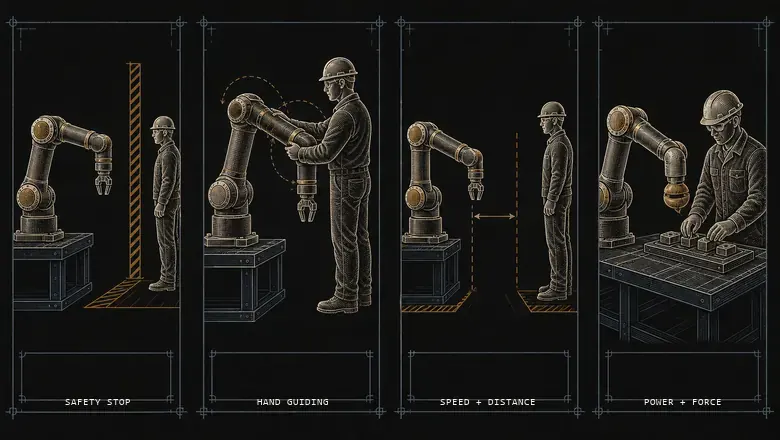
Power and force limiting is what most people picture when they hear “cobot,” but it is also the most restrictive. Keeping contact under injury thresholds means slower motion and lower payload, which is the trade you accept in exchange for losing the fence.
Cobots vs traditional industrial robots
Cobots are the fast-growing slice of factory robotics, but still a minority. They were 11.9% of the 542,000 industrial robots installed worldwide in 2024, up from 10.6% a year earlier, according to the IFR’s World Robotics 2025 report. The rest were traditional caged arms, which is your first clue that the two are not interchangeable.
The difference between a cobot and a traditional industrial robot is where the safety lives: inside the robot, or in a cage around it. That one choice cascades into payload, speed, cost, floor space, and how quickly you can move the robot to the next job. The table below is the comparison most buyer guides leave out.
| Factor | Collaborative robot (cobot) | Traditional industrial robot |
|---|---|---|
| Payload | 3 to 35 kg (most 5 to 20 kg) | Up to 1,000+ kg |
| Speed | Capped in collaborative mode; slower | Fast; optimized for cycle time |
| Safety | Built into the arm; often no fence | Requires guarding, light curtains, interlocks |
| Setup & floor space | Days to weeks; fits on a bench | Weeks to months; needs a dedicated cell |
| Deployed cost | $40,000 to $150,000 | $100,000 to $500,000+ |
| Redeploy to new task | Hours to days; move and re-teach | Hard; the cell is engineered around one job |
| Best for | Low-volume, high-mix, labor relief | High-volume, high-speed, heavy payload |
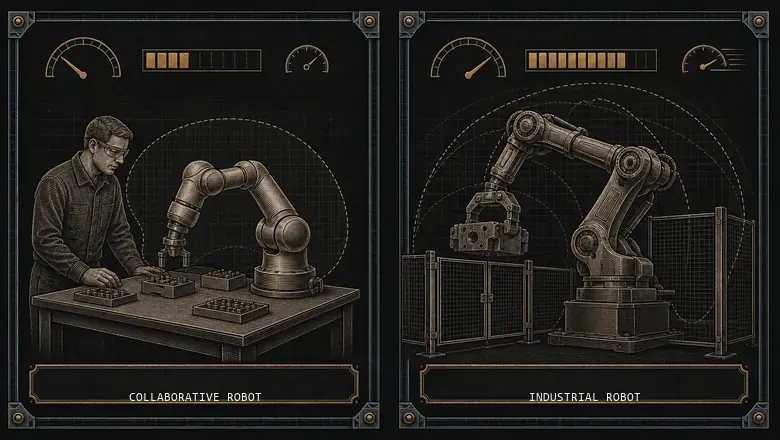
Read the table as a statement about volume. If you make thousands of identical parts an hour, the caged robot’s speed pays for its rigidity many times over. If you make small batches that change often, the cobot’s ability to move to a new task in an afternoon is worth more than raw throughput. Cobots are the physical end of the same trend covered in our roundup of where AI actually pays off on the plant floor: cheaper, safer automation that a plant can adopt one task at a time.
On brands, the “big four” of traditional industrial robotics are ABB, FANUC, KUKA, and Yaskawa, and all four now sell cobots too. The distinction is the application and the safety rating, not the manufacturer. FANUC’s CRX line and ABB’s GoFa are cobots; the same companies’ caged arms are not.
What cobots actually do on the plant floor
Cobots earn their keep on repetitive, low-payload tasks that a person finds dull, tiring, or slightly unsafe. They rarely replace a whole role. More often they take the worst two hours of someone’s day and give it back. These are the six applications where the payback shows up first.
- Machine tending: loading and unloading CNC machines, presses, and injection-molding cells so one operator can run several machines.
- Palletizing: stacking boxes or parts onto pallets at the end of a line, the single most common cobot job in small plants.
- Welding: collaborative welding arms let a skilled welder set up jobs and supervise instead of laying every bead by hand.
- Assembly and screwdriving: repetitive fastening, insertion, and pick-and-place assembly steps that demand consistent torque.
- Inspection: moving a camera or probe to fixed positions for dimensional and visual quality checks.
- Pick-and-place: transferring parts between conveyors, fixtures, and bins at a steady, error-free pace.
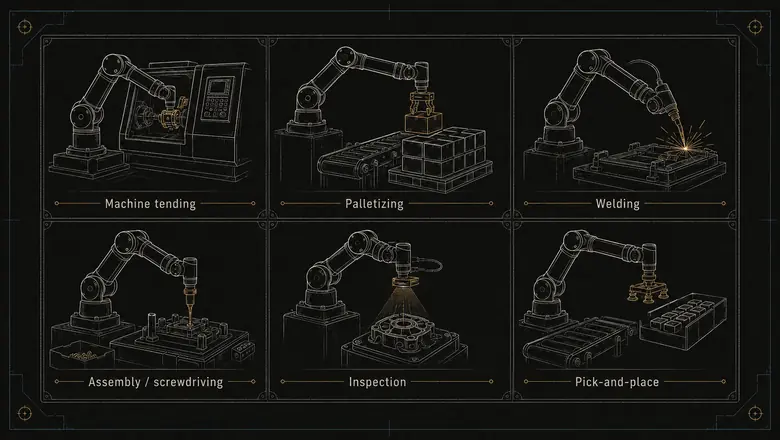
Machine tending is usually the first job worth automating, because it directly buys back labor: a cobot feeding a lathe overnight turns a single-shift machine into a near-continuous one. That extra spindle time is real capacity, and it shows up in the availability side of your OEE numbers faster than almost any other change. Pair the cobot with a system that logs run data and you can see the gain instead of guessing at it.
Inspection is where cobots and vision blur together. A collaborative arm is often just the motion for a camera, and the value lives in the software reading the image. If quality is the reason you’re automating, start with the sensing problem, not the robot, and read our breakdown of how machine vision systems catch defects before you spec an arm. The same machine-tending and inspection data also feeds the shop-floor layer covered in our guide to the MES software that tracks production in real time, which is how a cobot’s output stops being a black box.
Two forces are pulling cobots onto more floors. Skilled manufacturing labor is hard to hire and hold, so automating a person’s worst two hours is usually the real business case, not cutting headcount. The hardware keeps getting more flexible too: the newest variant is the mobile cobot, a collaborative arm mounted on an autonomous mobile robot (AMR) so it can travel between stations instead of staying bolted to one bench. That suits plants with several low-volume cells that each need a robot for only part of a shift, though it adds navigation and battery complexity a fixed cobot avoids.
Are cobots safe? And what’s inside the arm
Cobots are safe by design, but they are not automatically safe in application. The safety rating belongs to the installed system, including the tool and the part, not to the bare arm on a datasheet. A cobot moving a rounded plastic housing at 250 mm/s is genuinely safe next to a person; the same cobot holding a deburring blade is a powered knife, and it needs its own risk assessment under ISO 10218-2.
That assessment is the step buyers skip most often. It looks at the tool, the part edges, the speed, the force at each contact point, and what a person is likely to be doing nearby. Sometimes the answer is that the cobot can run fenceless. Sometimes it needs a light curtain or a slower zone over the sharp-tool area. The standard exists precisely because “it’s a cobot” is not a safety case on its own.
IMPORTANT
A cobot with a welding torch, a blade, or a sharp-edged part is not inherently collaborative. Fenceless operation is a conclusion you reach after a risk assessment, never an assumption you start with.
Anatomy of a collaborative robot arm
A collaborative robot arm has six rotating joints, which give it the freedom to reach a point from almost any angle within its envelope. The two numbers that define it are payload, how much it can carry including the gripper, and reach, how far it extends. Universal Robots’ lineup spans 3 kg and 500 mm on the small UR3e up to 20 kg and 1,750 mm on the UR20, which brackets what most manufacturing tasks need.
The last link in the chain is the end-of-arm tooling: the gripper, vacuum cup, screwdriver, or welding head that actually does the work. Buyers routinely underspec it, then wonder why the cobot can’t hold the part. Budget for the tooling and the integration as seriously as the arm, because together they are more than half the deployed cost. A total-cost sourcing model should therefore compare the arm, tooling, integration, validation, training, maintenance, and recovery support as one system.
When a cobot fits, and when you need a full robot cell
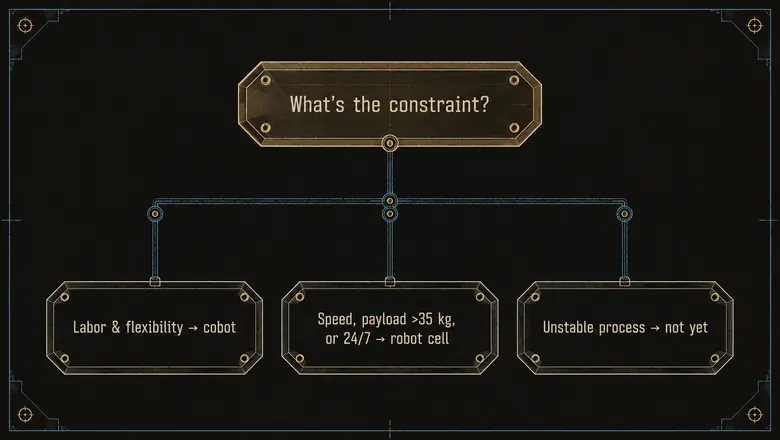
A cobot fits when the constraint is labor and flexibility. A full robot cell fits when the constraint is speed, payload, or uptime. If you can name your bottleneck honestly, the choice usually makes itself. The mistake is buying a cobot for a job that actually needs a caged robot, then blaming the cobot for being slow. Before equipment selection, lean manufacturing should stabilize the task and expose the real constraint so the cobot solves a measured bottleneck rather than a moving target.
Choose a cobot when the task is a repetitive low-payload job, volumes are moderate or the mix changes often, a person is doing the work today, and you want the option to redeploy the arm later. Machine tending, palletizing, and light assembly almost always land here.
Choose a traditional robot cell when you need high speed, payloads above roughly 35 kg, tight cycle times on a single high-volume part, or the process is inherently dangerous, such as heavy spot welding or handling hot metal. Fencing the robot is not a downside in those cases; the speed you gain is the whole point.
PRO TIP
Start with the single most repetitive, highest-labor task on the floor, and stabilize the process before you automate it. A cobot bolted onto a messy, changing process automates the mess. Fix the process first, then let the cobot hold the gain.
There is also an honest third answer: sometimes you should not automate yet. A task with constant part changes, no fixturing, and no stable takt time will fight any robot. Cobot deployment goes best when the work is boring and predictable, which is exactly the work people least want to keep doing.
Choosing a cobot and running a first pilot
Choosing a cobot starts with the task and the part, not the brand. Weigh the part at its heaviest, add the gripper, and buy payload headroom above that number. Do the same with reach, then check cycle time against your takt. Only after those numbers are set does the shortlist of vendors matter, and by then most of them can do the job.
Budget the whole system, not the arm. A cobot arm runs about $25,000 to $65,000 depending on payload and reach (as of Q3 2026), but the arm is only 40 to 50% of the deployed cost. The rest is tooling, a controller and pendant, any vision or sensors, integration engineering, the safety assessment, and operator training, which together push a working system to $40,000 to $150,000. Most single-task deployments pay that back in 12 to 18 months, and multi-shift jobs recover it faster.
Run a real pilot before you scale. Pick one task, deploy one cobot, and measure the labor hours it returns and the uptime it holds. That uptime depends on integration and upkeep more than on the robot: the arm has to talk to the machine it tends, which is where solid PLC programming ties the cell together, and it has to keep running, which is why a cobot line benefits from the same predictive maintenance that flags a failing joint or gripper before it stops the shift. Prove those two things on one cell, and the second and third cobots are a rollout, not a gamble.
Frequently Asked Questions
Collaborative robots, or cobots, are industrial robot arms built to work safely alongside people without a safety cage. They use torque sensing, force and speed limits, and rounded design so any contact stays below the injury thresholds in ISO/TS 15066. That safety rating, not size or brand, is what makes a robot collaborative.
A cobot builds safety into the arm and can often run without fencing, but it is slower and lifts less. A traditional industrial robot is faster and can lift far more, but it needs a guarded cell. Cobots suit low-volume, high-mix work; caged robots suit high-volume, high-speed production.
Most cobots handle 3 to 20 kg, and the largest models reach about 35 kg. Payload always includes the gripper or tool, so usable capacity for the part is lower than the headline number. If your part plus tooling exceeds roughly 35 kg, you are into traditional industrial-robot territory.
Yes, when the whole application is rated safe, not just the arm. A cobot handling a smooth part at reduced speed can run fenceless. Add a sharp tool, a sharp-edged part, or high speed and it needs a risk assessment under ISO 10218-2, which may call for a light curtain or a slowed zone.
A cobot arm costs roughly $25,000 to $65,000 as of Q3 2026, but the arm is only about half the total. A fully deployed system with tooling, integration, safety assessment, and training usually runs $40,000 to $150,000, and most single-task jobs pay it back within 12 to 18 months.
