
Direct answer — What is the best quality management software for manufacturing?
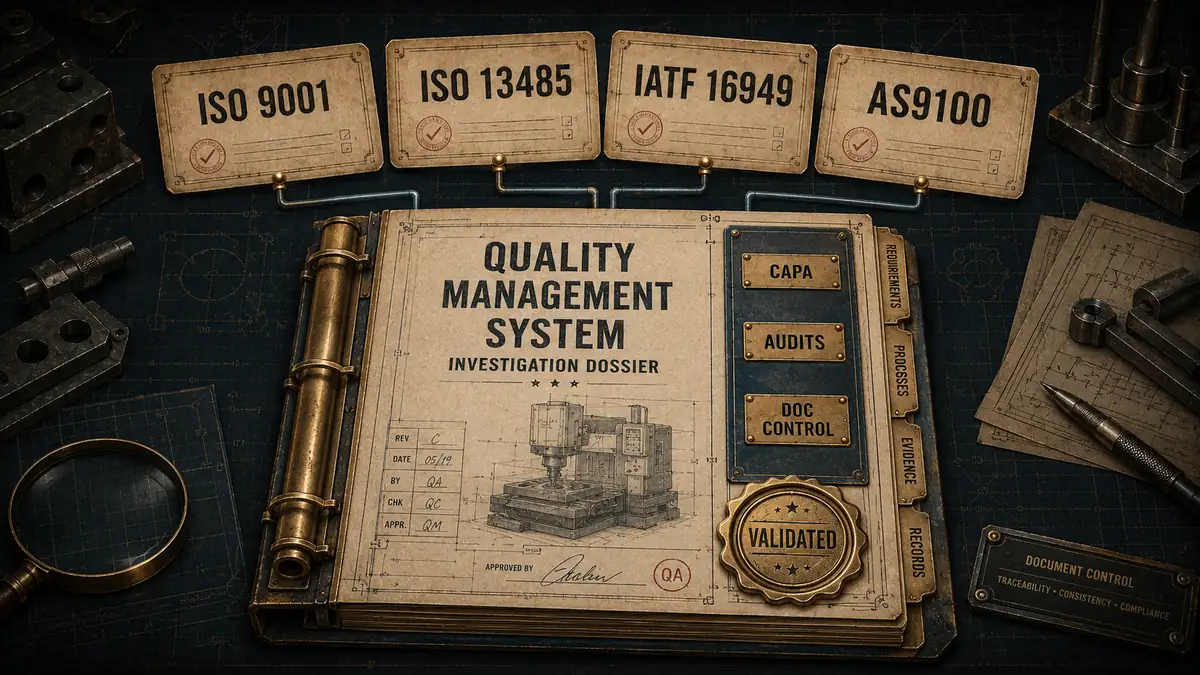
Quality management software for manufacturing (a QMS, or eQMS) runs document control, CAPA, nonconformance, audits, change control, training, and supplier quality against a compliance standard. The best system is the one that fits the standard you must hold: a general ISO 9001 tool (Isolocity, Intellect) for a job shop; a validated ISO 13485 and FDA 21 CFR Part 11 system (Greenlight Guru, MasterControl, SimplerQMS) for medical devices and pharma; an IATF 16949 or AS9100 platform (Siemens Opcenter Quality, ComplianceQuest) for automotive and aerospace. Most vendors price by quote only.
The fastest way to overspend on quality management software for manufacturing is to shop by brand instead of by standard. A four-person machine shop chasing its first ISO 9001 certificate and a Class III medical-device maker living under FDA inspection both type “best QMS software” into Google, see the same ten logos, and assume the heavyweight names are the safe pick. One of them is about to buy a validated, six-figure system it will never need. The other is about to trust an audit it cannot pass.
Quality software splits along one line that the listicles bury: regulatory load. The document control, corrective-action, and audit workflows look similar across every vendor demo. What separates a $220-per-user tool from a quote-only enterprise suite is which standards the system supports out of the box, and how much validation work you have to fund before an auditor will accept it. Get that match right and the shortlist almost builds itself.
Key Takeaways
- Choose a QMS by the standard you must hold, not by brand. ISO 9001, ISO 13485, IATF 16949, AS9100, and FDA 21 CFR Part 11 each point to a different and differently-priced tier of software.
- The market splits into four buyer segments: general ISO 9001 shops, validated medical-device and pharma makers, automotive and aerospace suppliers, and food and beverage processors.
- Of the 11 platforms we scored, only three publish a usable price (Intellect, SimplerQMS, Isolocity). The validated and enterprise end of the market is almost entirely quote-only, as of June 2026.
- The hidden line item is validation. A modest annual license on a regulated QMS can still carry an implementation and validation bill several times the subscription.
- QMS is not QC. A QMS runs documents, CAPA, and compliance; quality control software runs inspection and SPC on the line. Many buyers need both, from different tools.
Methodology
How this buyer guide was scored
- Scope
- We scored 11 quality management software platforms for manufacturing and named 6 more for coverage, screened from an initial set of 20-plus eQMS tools surfaced by the June 2026 Google SERP, the AI Overview, and our own software cost investigation. Segments: general ISO 9001, validated medical/pharma, automotive/aerospace, food and beverage.
- Sources reviewed
- Each vendor’s own product, pricing, and compliance/standards pages (verified live); the ISO Survey 2024 certificate data; and Factory Investigator’s published manufacturing-software cost study.
- Date range
- Pricing, standards support, and vendor status verified June 2026.
- Tools used
- The QMS Standards-Fit Rubric: four axes scored within each segment, not on one cross-market scale. (1) standards supported out of the box; (2) validation and implementation burden; (3) core-module completeness out of eight; (4) pricing transparency.
- Limitations
- Quote-only vendors cannot be price-ranked. We did not run hands-on validation projects. Standards support reflects vendor documentation and must be confirmed against your own scope. G2, Capterra, and Gartner recognition is cited as third-party context, not as our score, and we publish no aggregate star rating.
- Editorial independence
- No vendor named here paid for placement, ranking, or coverage. Our editorial independence rule keeps the wall explicit: Factory Investigator sells manufacturer website and SEO services, not QMS software or QMS implementation.
- Conflicts of interest
- Factory Investigator sells website services; none of the scored vendors were clients at evaluation time.
What quality management software for manufacturing actually is
Quality management software for manufacturing is a system that digitizes and enforces your quality processes against a standard: document control, corrective and preventive action (CAPA), nonconformance and defect handling, internal and supplier audits, change control, training records, supplier quality, and complaint handling. The category is also called an eQMS, for electronic quality management system. The Rolls-Royce SMR Pioneer Works announcement is a useful reminder that high-integrity manufacturing lives or dies on those same controlled records before production scales.
It is not the same as quality control software, and it is not your ERP’s quality tab. Quality control (QC) software runs inspection plans and statistical process control (SPC) on the shop floor, catching defects in real time. A QMS governs the documented system around that: who approved the procedure, what you did when a part failed, and whether you can prove it to an auditor. Where a QMS ends and your other systems begin is a recurring source of confusion, and it maps onto the same stack question that separates MRP, ERP, and MES layers. A QMS can stand alone, ride inside an ERP as a quality module, or sit next to an MES that already records batch and genealogy data on regulated lines.
Why the standard drives everything: scale tells the story. The 2024 ISO Survey counted 1,474,118 ISO 9001 certificates against 31,215 for ISO 13485, the medical-device standard, worldwide. The general-quality world is roughly 47 times the size of the validated-medical world, yet the tools built for that small validated slice routinely cost the most and disclose the least. Buying across that line, in either direction, is the central mistake this guide exists to prevent.
The four segments of QMS buyers
Manufacturing quality software sorts cleanly into four buyer segments by regulatory load. Find your row first; it eliminates most of the market before you watch a single demo.
| Segment | What it is | Choose this tier when | Avoid when |
|---|---|---|---|
| General ISO 9001 | Document control, CAPA, audits for job shops, machine shops, and general discrete or contract manufacturers | You need or hold ISO 9001 and want fast, affordable, self-serve adoption | You ship regulated medical, pharma, automotive, or aerospace product |
| Validated medical & pharma | ISO 13485, FDA 21 CFR Part 11 and Part 820/QMSR, GxP, with validation | An auditor can shut your line down and electronic signatures must hold up | You only need general quality records and the validation overhead is dead weight |
| Automotive & aerospace | IATF 16949 and AS9100 with APQP, PPAP, FMEA, and SPC built in | Your customers are OEMs demanding PPAP submissions and part genealogy | You are a general shop with no automotive or aerospace customer requirement |
| Food & beverage | FSMA, SQF, and BRC workflows: supplier control, audits, mobile checks | You run food-safety plans and need audit-ready supplier and CCP records | Your compliance is purely ISO 9001 with no food-safety scheme |
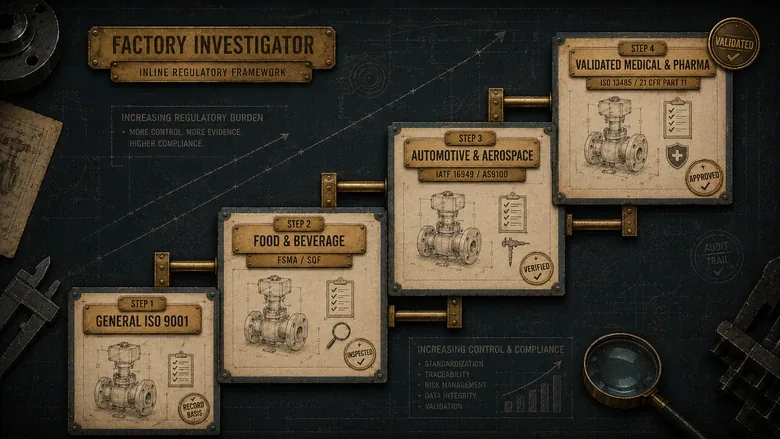
The trap is the jump between rows. A general ISO 9001 tool will not survive an FDA inspection because it lacks validated electronic signatures and audit-trail controls. A validated GxP suite, bought by a job shop that only needs ISO 9001, buries a small team under change-control rigor it will quietly stop using inside a year. Match the row, then shortlist inside it.
The QMS standards-coverage map for manufacturing
This is the table every competitor leaves out: which quality management software supports which standard out of the box. “Out of the box” means the standard is a marketed, documented focus with templates and controls ready, not merely “configurable if you build it.” Confirm any cell against your own audit scope before you sign.
| Platform | ISO 9001 | ISO 13485 | IATF 16949 | AS9100 | FDA 21 CFR Part 11/820 | Food (FSMA/SQF) |
|---|---|---|---|---|---|---|
| Isolocity | ✓ | ✓ | config | config | config | ✓ |
| Intellect | ✓ | ✓ | config | config | ✓ | config |
| Greenlight Guru | – | ✓ | – | – | ✓ | – |
| Qualio | config | ✓ | – | – | ✓ | – |
| MasterControl | ✓ | ✓ | config | config | ✓ | config |
| SimplerQMS | ✓ | ✓ | – | – | ✓ | – |
| ETQ Reliance | ✓ | ✓ | ✓ | config | ✓ | config |
| ComplianceQuest | ✓ | ✓ | ✓ | ✓ | ✓ | config |
| Siemens Opcenter Quality | ✓ | config | ✓ | config | config | – |
| QT9 QMS | ✓ | ✓ | config | ✓ | ✓ | config |
| Ideagen Quality | ✓ | ✓ | ✓ | ✓ | ✓ | config |
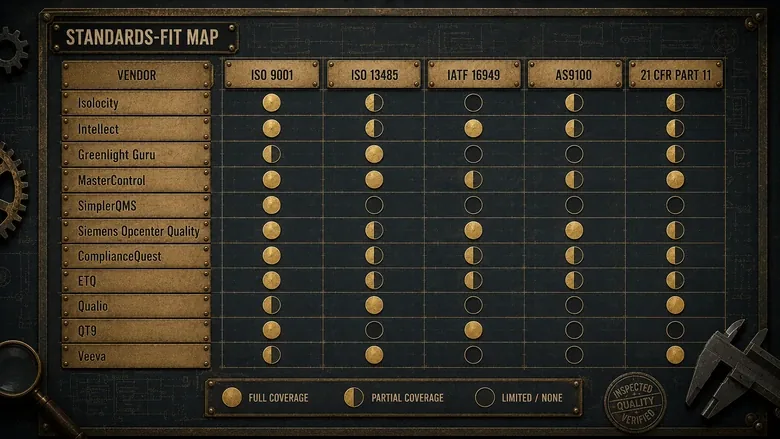
Read the map by column, not by row. If you need AS9100 for aerospace, ComplianceQuest, QT9, and Ideagen carry it as a focus while most medical-first tools do not. If you need IATF 16949 for automotive, Siemens Opcenter Quality, ETQ Reliance, ComplianceQuest, and Ideagen are built for it. The medical-device specialists, Greenlight Guru and Qualio, score deliberately narrow: they are excellent inside ISO 13485 and FDA Part 820, and they do not pretend to be automotive platforms.
How to shortlist a QMS for your standard
Use a repeatable sequence so the demo theater does not pull you off course. Five steps move you from the full market to a defensible three-vendor shortlist.
- Name your governing standard first. Write down the one standard an auditor will judge you against (ISO 9001, ISO 13485, IATF 16949, AS9100, or an FDA regulation). That single line removes most of the market.
- List your must-have modules. From the eight core modules, mark which are non-negotiable. A medical maker needs validated document control and CAPA; a job shop may not need complaint handling at all.
- Set a published-versus-quote expectation. Decide whether you need a price before you talk to sales. If yes, your real shortlist narrows to the handful that publish, plus turnkey validated options.
- Shortlist three to five inside your segment. Use the standards map above. Do not let a famous name from another segment onto the list.
- Demo with your own SOP and a real CAPA. Bring an actual procedure and a recent nonconformance. A tool that handles your messiest record beats one that handles the vendor’s clean sample.
IMPORTANT
If your product is regulated, ask every vendor one question in writing: does the subscription include system validation, and who owns the validation documentation? The answer changes your true cost more than the license ever will.
The best quality management software for manufacturing, by segment
Eleven platforms scored, grouped by the segment each one is built to serve. General shops that already run an ERP should first check whether the quality module in their manufacturing ERP covers ISO 9001 before buying a standalone tool. Each entry covers what it is, who it fits, its standout strength, the standards it supports out of the box, and its pricing posture as of June 2026.
General ISO 9001 quality management software
Isolocity is a self-serve QMS aimed at small and mid-size manufacturers formalizing ISO 9001, with ISO 13485 and food-safety templates available. Best for a small team that wants to be running this quarter. Its standout is transparency: Isolocity publishes a Standard tier at $220 per full user per month on an annual plan ($270 monthly), with free setup, training, and SOP support (as of June 2026), making it one of the few quality tools you can budget without a sales call.
Intellect is a no-code QMS platform spanning general manufacturing and life sciences, with pre-validated document control and training modules. Best for teams that want to configure their own forms and workflows without developers. Its standout is that it is the rare enterprise-grade eQMS that publishes pricing: Core at $26,000 per year, Operational Control at $32,000, and Enterprise Transformation at $47,000 (as of June 2026). It supports ISO 9001, ISO 13485, and FDA 21 CFR Part 11.
Validated medical device and pharma QMS
Greenlight Guru is a medical-device-first QMS built around ISO 13485, FDA 21 CFR Part 820, EU MDR, and ISO 14971 risk management. Best for device makers who want design controls and quality in one purpose-built system rather than a generic suite bent to fit. Its standout is medical-device fluency: the workflows speak the auditor’s language out of the box. Pricing is quote-only.
Qualio is a cloud QMS for growing life-sciences and medical-device companies, covering ISO 13485, FDA 21 CFR Part 11 and Part 820, and MDSAP. Best for a first formal QMS at a startup or scale-up that needs to be audit-ready without a heavy IT project. Its standout is fast, managed onboarding. Pricing is quote-only across its Foundation, Growth, and Scale tiers.
MasterControl is an enterprise quality and manufacturing-execution platform for regulated pharma and medical device, with deep document control, CAPA, and electronic batch records under FDA 21 CFR Part 11 and Part 820. Best for established regulated manufacturers that need validated rigor at scale. Because MasterControl spans quality and execution, it also appears in our MES software guide for the same regulated lines. Pricing is quote-only, and the system is a validated, heavier implementation.
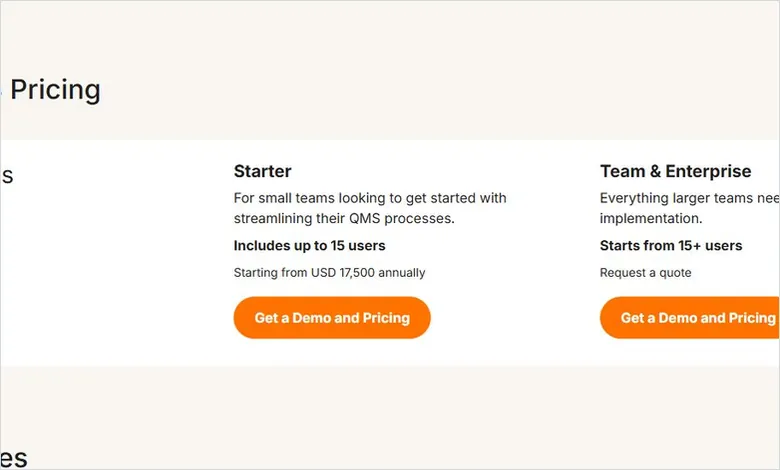
SimplerQMS is a pharma and life-sciences QMS validated to GAMP 5 and compliant with FDA 21 CFR Part 11, EU Annex 11, and ISO 13485. Best for a small regulated team that wants validation handled for them. Its standout is an all-inclusive model that bundles validation, onboarding, and training, and, unusually for this segment, publishes a Starter price of $17,500 per year for up to 15 users (as of June 2026).
Automotive, aerospace, and multi-sector enterprise QMS
ETQ Reliance is a configurable, multi-sector QMS strong in automotive and general manufacturing, covering ISO 9001, ISO 13485, IATF 16949, and FDA requirements across 40-plus applications. Now part of Octave following its separation from Hexagon in May 2026, it remains an enterprise mainstay. Best for multi-site manufacturers standardizing quality across plants. Standout: no-code configurability. Pricing is quote-only.
ComplianceQuest is a Salesforce-native QMS with the widest standards spread on this list, supporting ISO 9001, ISO 13485, IATF 16949, AS9100, and FDA QMSR. Best for organizations already on Salesforce that want quality, supplier, and EHS in one platform. Standout: breadth across regulated verticals in a single system. Pricing is quote-only, structured per role.
Siemens Opcenter Quality is an enterprise QMS for automotive and discrete manufacturing, built around ISO 9001 and IATF 16949 with APQP, PPAP, FMEA, control plans, and SPC. Best for OEM suppliers that must submit PPAP and run advanced quality planning. Standout: automotive quality planning depth few others match. Pricing is quote-only, and it is an enterprise-grade implementation.
QT9 QMS is a multi-sector QMS with more than 25 modules and templates spanning ISO 9001, ISO 13485, AS9100, FDA 21 CFR Part 11, and EU cGMP. Best for aerospace, medical, or mixed-compliance shops wanting broad coverage in one tool. Standout: module breadth on a concurrent-license model. Despite a reputation for transparency, QT9’s pricing page routes to a custom quote (as of June 2026), so treat it as quote-only.
Ideagen Quality is an enterprise quality and compliance platform for highly regulated multi-site manufacturers, covering ISO 9001, ISO 13485, IATF 16949, AS9100, and FDA 21 CFR Part 11. Best for aerospace, defense, and large industrial groups. Standout: enterprise audit and risk management at scale. Pricing is quote-only.
PRO TIP
Worth naming for coverage outside the scored set: Veeva Vault QMS for pharma enterprises, Arena QMS by PTC for PLM-led teams, AssurX for utilities and regulated multi-sector use, and isoTracker or Effivity as lower-cost general-ISO options. For inspection and SPC rather than documents, look at SafetyCulture and InfinityQS, covered below.
What quality management software costs for manufacturing
QMS is the second-most-gated category in manufacturing software after MES, and the gating is not random. When we priced six enterprise eQMS platforms for our manufacturing software cost investigation, only Intellect published a figure; ETQ Reliance, MasterControl, Greenlight Guru, Qualio, and AssurX all routed to a quote, and they still do as of June 2026. Widening the lens for this guide changes the picture only at the edges.
Of the 11 platforms scored here, three publish a usable price: Intellect ($26,000 to $47,000 per year), SimplerQMS ($17,500 per year for up to 15 users), and Isolocity ($220 per full user per month). The other eight quote only. The lesson is segment-shaped: published pricing clusters in the general-ISO and small-team turnkey tiers, while the validated and enterprise platforms keep numbers behind a sales conversation, because their deals carry validation and implementation scope that a sticker cannot express.
Why validated QMS costs more than its license
That validation scope is the line nobody quotes up front. In regulated manufacturing, a QMS often has to be validated, meaning documented proof that the system performs as intended under your processes. Validation is a project in its own right, separate from the license and the implementation, and it is why a “cheap” published seat can mislead. A regulated QMS with a modest subscription can still carry a validation and implementation bill several times the annual software cost, which is exactly why turnkey vendors that bundle validation, like SimplerQMS, can be cheaper in total than a lower-priced license you must validate yourself.
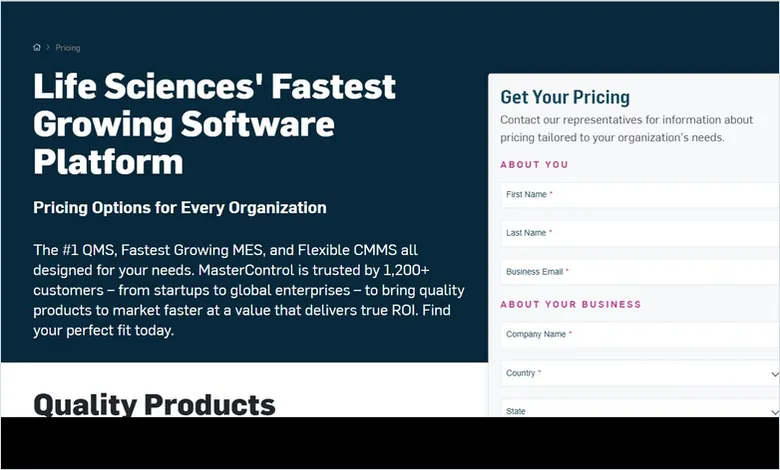
Practically, that means you should price a QMS as a three-part total: license, implementation, and (if regulated) validation. Ask each vendor to scope all three in writing. A quote-only posture is not a red flag by itself in this category; it is the norm at the validated end. The red flag is a vendor that will not break the quote into those three parts when you ask.
Quality management software vs quality control software for manufacturing
Buyers conflate these two, and vendors are happy to let them. Quality management software for manufacturing governs the documented system: procedures, CAPA, audits, training, and compliance records. Quality control software for manufacturing runs the measurement: inspection plans, gauging, first-article inspection, and statistical process control on the line.
A QMS answers “can we prove our quality system works.” A QC tool answers “is this part in spec right now.” Tools like SafetyCulture for mobile inspections and InfinityQS for SPC live on the QC side; MasterControl, Qualio, and ComplianceQuest live on the QMS side. Larger platforms blur the boundary, and many manufacturers run both: an eQMS for the audit trail and an inspection or SPC tool feeding it data from the floor. Decide which problem is urgent before you let a single suite sell you on solving both adequately and neither completely.
QMS software comparison table for manufacturing
The 11 scored platforms side by side. Pricing is each vendor’s own published figure or “quote” where none is disclosed (as of June 2026). Recognition is third-party context, not our score.
| Platform | Best-fit segment | Standards focus | Validation burden | Pricing (June 2026) | 3rd-party recognition |
|---|---|---|---|---|---|
| Isolocity | General ISO 9001 | ISO 9001, 13485, food | Light | $220/user/mo (published) | Capterra 4.7 |
| Intellect | General + life sciences | ISO 9001, 13485, Part 11 | Medium | $26k–$47k/yr (published) | Gartner Peer Insights listed |
| Greenlight Guru | Medical device | ISO 13485, FDA 820, MDR | Medium | Quote | G2 4.6 |
| Qualio | Medical / life sciences | ISO 13485, Part 11/820 | Light–medium | Quote | G2 4.3 |
| MasterControl | Pharma / medical (enterprise) | Part 11/820, ISO 13485 | Heavy (validated) | Quote | G2 4.5 |
| SimplerQMS | Pharma / life sciences | GAMP 5, Part 11, ISO 13485 | Heavy (validated, turnkey) | $17,500/yr (published) | G2 4.6 |
| ETQ Reliance | Multi-sector enterprise | ISO 9001, 13485, IATF | Medium (configurable) | Quote | Gartner-recognized |
| ComplianceQuest | Multi-sector (auto/aero/med) | 9001, 13485, IATF, AS9100 | Medium | Quote | G2 4.4 |
| Siemens Opcenter Quality | Automotive / discrete | ISO 9001, IATF 16949 | Heavy (enterprise) | Quote | Gartner Peer Insights |
| QT9 QMS | Multi-sector (aero/med) | 9001, 13485, AS9100, Part 11 | Medium | Quote | Capterra 4.8 |
| Ideagen Quality | Aerospace / multi-site | 9001, 13485, IATF, AS9100 | Medium | Quote | Gartner-recognized |
One reading of the table: the published-pricing tools cluster in the general and turnkey tiers, and the standards breadth concentrates in the multi-sector enterprise platforms. There is no single best quality management software for manufacturing. There is a best system for your standard, your modules, and your tolerance for a sales conversation.
Frequently Asked Questions
For quality control specifically (inspection and SPC on the line), SafetyCulture suits mobile inspections and InfinityQS suits statistical process control. For the broader quality management system around them (documents, CAPA, audits), choose by your standard: Isolocity or Intellect for ISO 9001, Greenlight Guru or MasterControl for regulated medical and pharma.
Manufacturers use a QMS or eQMS to manage document control, CAPA, nonconformance, audits, change control, training, and supplier quality. Common platforms include MasterControl, ETQ Reliance, ComplianceQuest, Siemens Opcenter Quality, Qualio, Greenlight Guru, Intellect, and SimplerQMS. The right one depends on the compliance standard you must hold.
The seven basic quality tools are the cause-and-effect (fishbone) diagram, check sheet, control chart, histogram, Pareto chart, scatter diagram, and flowchart or stratification. Most QMS and SPC software digitize several of these, especially control charts and Pareto analysis, inside their nonconformance and statistical-process-control modules.
Most QMS vendors quote only. Among published figures (as of June 2026): Isolocity is $220 per user per month, SimplerQMS is $17,500 per year for up to 15 users, and Intellect runs $26,000 to $47,000 per year. For regulated systems, budget license plus implementation plus validation, which together often exceed the license several times over.
Only if you operate under FDA 21 CFR Part 11, Part 820/QMSR, or GxP, typical of medical device and pharma. Validation means documented proof the system works under your processes. A general ISO 9001 job shop does not need it, and paying for validated software it will not use is a common and costly mismatch.
Start from your standard, not the brand on the demo. Map your governing requirement to the segment, use the coverage table to shortlist three vendors inside it, and price each as license plus implementation plus validation before you commit. If your quality problem is really that buyers cannot find or trust you before the RFQ stage, that is a different fix, and our free manufacturer website investigation shows where prospects lose confidence on your site.